


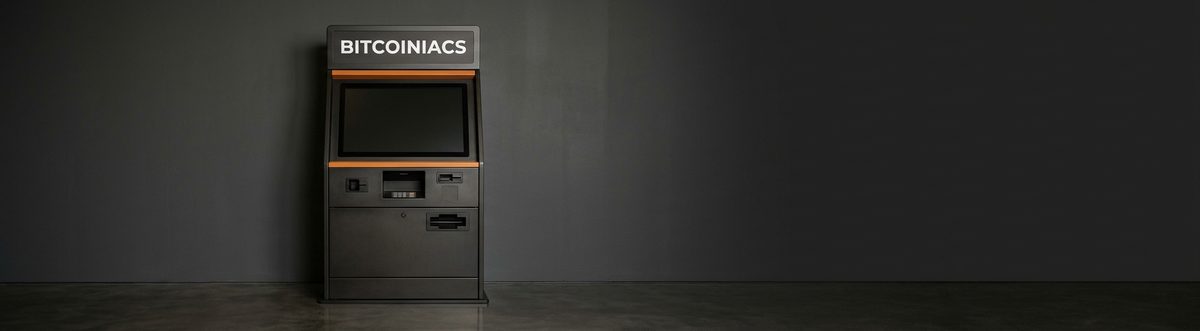
If you want to buy Bitcoin in Alberta with cash, the machines are already in place. Bitcoiniacs operates four Bitcoin ATMs across the province, in Calgary, Airdrie and Red Deer, and every one of them works in both directions: cash in for Bitcoin, Bitcoin in for cash. This guide covers where the machines are, what a purchase actually costs once the spread and network fee are counted, and the red flags worth knowing before you hand over a $500 bill. If you are focused on the city rather than the province, our complete Calgary guide covers the downtown and north-end options in more detail.
Table of Contents
- Where to Buy Bitcoin in Alberta
- How to Buy Bitcoin in Alberta at an ATM
- Fees, Spread and What You Actually Pay
- Selling Bitcoin for Cash in Alberta
- Before You Buy: Registration, Red Flags and Taxes
- Frequently Asked Questions
Where to Buy Bitcoin in Alberta
Bitcoiniacs places machines inside independent retail businesses rather than bank branches or shopping mall concourses, so you buy from a clerk-attended counter with fixed opening hours. The four Alberta locations are:
- Calgary (Whitehorn) – AK Grocery & Variety Store, 5008 Whitehorn Dr NE, Calgary, AB T1Y 1V1 (buy and sell)
- Calgary (4 St SW) – Rawleigh Food Mart, 1525 4 St SW, Calgary, AB T2R 0Y4 (buy and sell)
- Airdrie – Foggy Gorilla Vape Shop, 960 Yankee Valley Blvd #208, Airdrie, AB T4A 2E4 (buy and sell)
- Red Deer – Foggy Gorilla Vape Shop, 6842 50 Ave #5, Red Deer, AB T4N 4E3 (buy and sell)
Calgary: two machines, opposite ends of the city
The Whitehorn machine sits in northeast Calgary near the airport corridor, and the 4 St SW machine is a short walk from the downtown core. Between them, most Calgarians are inside a fifteen-minute drive of a terminal. Red Deer and Airdrie are single-machine locations, so there is no second terminal to fall back on if a machine is down, and it is worth checking live status before making a long drive.
Store hours apply, and convenience stores do not stay open around the clock. Addresses, directions and current status for every terminal live on the Bitcoiniacs Bitcoin ATM locations page, which stays accurate as stores change hands or relocate a machine.
Edmonton, Lethbridge and the rest of Alberta
There is no Bitcoiniacs machine in Edmonton, Lethbridge, Medicine Hat, Grande Prairie or St. Albert, and we would rather say so plainly than have you drive across the province to find a locked door. Your options there are an online exchange, a peer-to-peer trade, or a short drive to the nearest machine. If you are buying a large amount rather than topping up a position, an over-the-counter trade is the better route: you can book a crypto appointment and confirm the rate and paperwork in advance instead of handling a five-figure purchase over a store counter.
How to Buy Bitcoin in Alberta at an ATM
The transaction takes a few minutes and needs no bank account, no credit check and no appointment. It does need a Bitcoin wallet you control and a piece of government-issued photo ID.
Step by step at the machine
- Set up a wallet first. Install a wallet app and let it generate a receiving address. A self-custody wallet holds the private keys on your device; an exchange account holds them for you. Either works at the machine, but self-custody means the Bitcoin is yours the moment it confirms.
- Open your receive screen. The machine will scan or ask for your wallet address. The QR code is faster and less error-prone than typing a 34-character string by hand.
- Enter your amount. You insert cash, so the amount you feed in is the amount you spend. There is no card to decline.
- Verify your identity. The screen asks for ID even on modest purchases, and the machine will not release Bitcoin until that step is complete.
- Read the quote before confirming. The screen shows how much Bitcoin your cash buys at the offered rate. This is your last chance to decline.
- Confirm and wait. The transaction is broadcast to the Bitcoin network and your wallet normally shows the incoming amount as unconfirmed within minutes.
What identification you need
Bring government-issued photo ID showing your full legal name and date of birth. A driver’s licence, passport or Alberta photo card all satisfy the requirement, and the name on the ID should match the wallet you are funding. Using someone else’s wallet or ID is how a routine purchase turns into a frozen transaction and a compliance report.
Why the machine asks for ID at all
Crypto dealers in Canada that trade virtual currency as a service are money services businesses under federal law, and FINTRAC sets out exactly what they must collect and report. Identity verification is a legal obligation on the operator, not a store policy, and you can read the requirements in FINTRAC’s money services business guidance. Any operator advertising “no ID, no limits” is misrepresenting the rules.
Fees, Spread and What You Actually Pay
An ATM purchase has a different cost structure from a trading platform. Three components decide what you walk away with:
- The operator’s fee or spread. This is the gap between the market price and the rate the machine quotes you. It is displayed on screen and baked into the number you accept.
- The network fee. A small charge paid to the Bitcoin network to include your transaction in a block. It has nothing to do with the operator and exists on every rail, including exchange withdrawals.
- No issuer fee, no interest. Because you are paying cash, there is no card surcharge, no cash-advance interest and no foreign exchange markup. That is a real advantage over card-based purchases, and it is why cash ATMs stay competitive for smaller amounts.
How to judge the quote you are offered
Look up the current spot price before you go and compare it with the rate on the screen. That comparison, not the headline percentage in an advertisement, is the number that matters. The Bank of Canada daily exchange rates give you the USD to CAD rate for the day, which is what you need to convert a quoted Bitcoin price into the currency you are spending.
Limits vary by location and by how much identity verification the machine completed. If the amount you want exceeds what a terminal allows, book an over-the-counter appointment rather than splitting the purchase into several trips.
Records worth keeping
Keep the receipt: the CAD amount, the BTC amount, the quoted rate, the fee, the timestamp, the receiving address and the transaction ID. The Canada Revenue Agency’s crypto-asset guidance for taxpayers treats crypto as property, so buying and later selling are separate events. The purchase record establishes your cost base when you eventually dispose of it, and reconstructing that a year later from memory is far harder than photographing a receipt on the spot.
Selling Bitcoin for Cash in Alberta
Selling works in reverse: you send Bitcoin to an address the machine generates, and the machine dispenses cash once the network confirms the transfer. All four Alberta machines support both directions, which is worth knowing before a trip, because a buy-only terminal nearby is not a backup. Our guide to selling Bitcoin for cash in Canada covers the mechanics, including why a confirmed transfer and a pending one are not the same thing to the machine.
What to bring when you sell
The same photo ID, plus enough Bitcoin in the sending wallet to cover the sale amount and the network fee. Send from a wallet you control, not from an exchange that may hold withdrawals for manual review. A transaction that arrives late looks identical to one that never arrived, and the machine will not dispense cash for an unconfirmed transfer.
Before You Buy: Registration, Red Flags and Taxes
Alberta’s crypto market is active and fraud reports keep climbing, which makes a short check worthwhile before any purchase. If someone is selling you crypto or offering investment advice, they should appear in a provincial registration database. The Alberta Securities Commission publishes a registrant list and an investment caution list of firms and websites that may pose a high risk to investors. No entry, no business.
Know the standard scam script. The Canadian Anti-Fraud Centre catalogues the frauds that keep working, and they follow the same shape: someone creates urgency, promises a return, then asks you to move money or crypto to an address they control. The Canadian Anti-Fraud Centre fraud directory is a fast way to check whether a story you have been told is a known pattern.
Red flags at the machine
- You are on the phone with someone who told you to keep it quiet.
- You are buying because an “agent”, “support desk” or “government department” said your account is compromised and needs securing with crypto.
- Someone offers to send you a QR code or a pre-filled wallet address to scan at the machine.
- You are told to buy now to catch a guaranteed return, a bonus or a limited window.
- Anyone asks for your seed phrase, your wallet password or a one-time code.
None of those requests has a legitimate version. A real purchase never requires hurry, secrecy, or a wallet address supplied by somebody else. And never fund Bitcoin with borrowed money or a cash advance: crypto prices move, debt does not.
Frequently Asked Questions
Is there a Bitcoin ATM in Edmonton or Lethbridge?
Not from Bitcoiniacs, and we would rather be straight about that than have you make the drive. Our Alberta machines are in Calgary (Whitehorn and 4 St SW), Airdrie and Red Deer. For Edmonton and Lethbridge, an online exchange or a peer-to-peer trade is the realistic route today.
Do all Bitcoin ATMs require ID?
In practice, yes. Operators in Canada that deal in virtual currency as a service fall under federal anti-money-laundering rules and must identify their customers, so a regulated machine asks for photo ID. An unregistered terminal advertising anonymous purchases is a warning sign, because it usually means nobody is checking transactions.
Why did I put in $100 and get less Bitcoin than the spot price?
Because the quoted rate is not the market rate, and the difference is the operator’s fee. If you insert $100 and the screen quotes a rate a few percent above spot, you receive roughly the Bitcoin that a smaller amount would buy at spot. The quote is displayed before you confirm, so the amount is knowable in advance, and it is the most important number on the screen. Cash in does not mean dollar for dollar out.
Can I buy Bitcoin in Alberta with paper cash?
Yes. Cash is the only payment method these machines take, and coins, crumpled notes and the kind of cash you have been meaning to get rid of all work the same way. The machine counts what it accepts and the purchase goes straight to your wallet address. Bring a wallet app and a piece of photo ID, and you are set.
Do I need to keep records if I only buy and never sell?
Buying is not a taxable event and holding is not, so there is nothing to report if you never dispose of anything. Keep the receipt anyway, because the day you do sell, the CRA will want to know what you paid, when you paid it and how much you received. Photograph it at the machine.
Start with the location that suits you: Calgary, Airdrie or Red Deer, all with cash buy and cash sell capability. If you are buying a large amount or you want a specific rate locked in, book a crypto appointment and we will work through the details with you directly.