


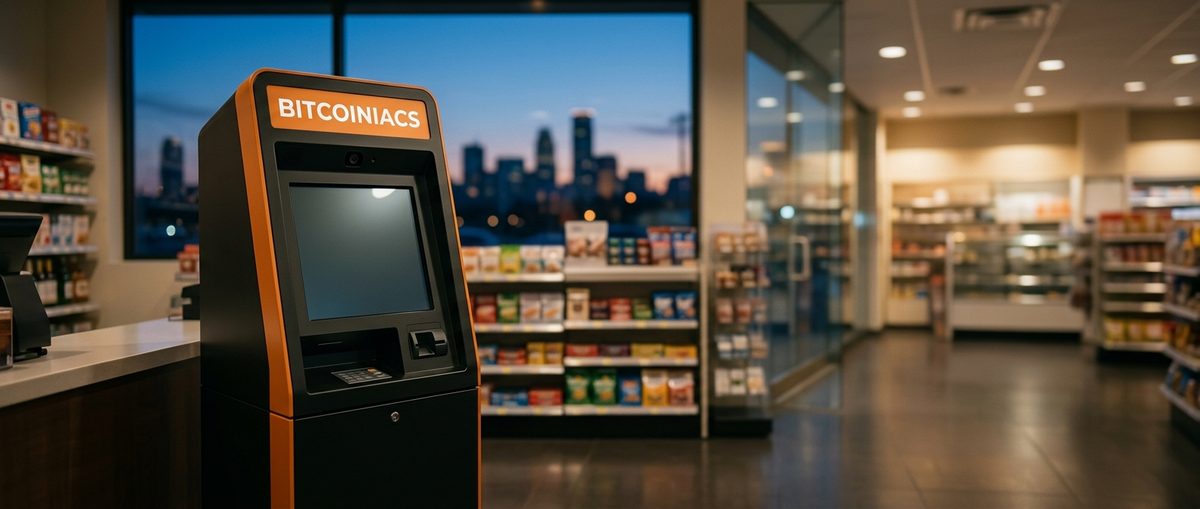
If you want to buy Bitcoin in Ontario with cash, the quickest option is usually a machine inside a convenience store — and there are more of them across the Toronto area than most people realize. Bitcoiniacs operates four Ontario Bitcoin ATMs, from Bathurst Street in North York to Orpington Road in Peterborough. This guide covers where those machines are, what to bring, what a purchase actually costs once the spread and network fee are counted, and how selling works at the locations that support it.
Table of Contents
- Where Bitcoiniacs Bitcoin ATMs Are in Ontario
- How to Buy Bitcoin in Ontario at an ATM
- Fees, Limits and What You Actually Pay
- Selling Bitcoin for Cash in Ontario
- Before You Buy: Registration, Red Flags and Taxes
- Frequently Asked Questions
Where Bitcoiniacs Bitcoin ATMs Are in Ontario
Bitcoiniacs places machines inside independent retail businesses rather than bank branches or mall concourses, so you buy from a clerk-attended store with fixed opening hours. The four Ontario locations are:
- North York — JRV Filipino Market, 4949 Bathurst St Unit 8, North York, ON M2R 1Y1 (buy and sell)
- Mississauga — Red Apple Convenience, 5700 Mavis Rd, Mississauga, ON L5V 2N6 (buy)
- Richmond Hill — Woodland Convenience, 10815 Bathurst St, Richmond Hill, ON L4C 9Y2 (buy)
- Peterborough — Mister Convenience, 608 Orpington Rd, Peterborough, ON K9J 4A4 (buy)
Toronto and the Greater Toronto Area
Three of the four Ontario machines sit along the Bathurst and Mavis corridors, within a short drive of much of Toronto, Vaughan, Thornhill and Mississauga. From the downtown core, the North York location is the closest and the only one in the province that also handles sell transactions. Store hours apply, so check before you travel — a convenience store does not stay open around the clock.
Addresses, directions and current status for every terminal, including Peterborough and the Kawarthas, stay on the Bitcoiniacs Bitcoin ATM locations page. That page is the source of truth — stores occasionally change hands or move a machine, and the map reflects those changes before any article does.
How to Buy Bitcoin in Ontario at an ATM
The transaction itself takes a few minutes and does not require a bank account, a credit check or an appointment. What it does require is a Bitcoin wallet you control and a piece of government-issued photo ID.
Step by step at the machine
- Set up a wallet first. Install a wallet app on your phone and let it generate a receiving address. A self-custody wallet holds the private keys on your device; an exchange account holds them for you. Either works at the machine, but self-custody means the Bitcoin is yours the moment it confirms.
- Open your receive screen. The machine will scan or ask for your wallet address. Showing the QR code is faster and less error-prone than typing a 34-character string by hand.
- Enter your amount. You insert cash, so the amount you feed in is the amount you spend — there is no card to decline or authorize.
- Verify your identity. Canadian anti-money-laundering rules require regulated dealers in virtual currency to identify customers, which is why the screen asks for ID even on modest purchases. The machine will not hand over Bitcoin until that step is complete.
- Read the quote before confirming. The screen shows how much Bitcoin your cash buys at the offered rate. This is your last chance to decline.
- Confirm and wait. The transaction is broadcast to the Bitcoin network. Your wallet normally shows the incoming amount as unconfirmed within minutes.
What identification you need
Bring government-issued photo ID with your full legal name and date of birth. A driver’s licence, passport or Ontario photo card all satisfy the requirement. The name on the ID should match the wallet you are funding where possible; using someone else’s wallet or ID is how a routine purchase turns into a frozen transaction and a compliance report.
Why the machine asks for ID at all
Crypto dealers in Canada that trade virtual currency as a service are money services businesses under federal law, and FINTRAC sets out what they must collect and report. Identity verification is a legal obligation on the operator, not a store policy — you can read the requirements directly in FINTRAC’s money services business guidance. Any operator advertising “no ID, no limits” is misrepresenting the rules.
If you are buying in the city rather than the suburbs, the same process applies — see the guide to buy Bitcoin in Toronto for the downtown and midtown options and how they compare to the Bathurst Street terminal.
Fees, Limits and What You Actually Pay
An ATM purchase has a different cost structure than a trading platform, and the difference is worth understanding before you feed in cash. Three components decide what you receive:
- The operator’s fee or spread. This is the gap between the market price and the rate the machine quotes you. It is displayed on screen and baked into the number you accept.
- The network fee. A small charge paid to the Bitcoin network to include your transaction in a block. It has nothing to do with the operator and it exists on every rail, including exchange withdrawals.
- No issuer fee, no interest. Because you are paying cash, there is no card issuer surcharge, no cash-advance interest and no foreign exchange markup on a card. That is a real advantage over card-based purchases, and it is the reason cash ATMs remain competitive for small amounts despite a wider spread.
How to judge the quote you are offered
Look up the current spot price before you go, then compare it with the rate on the screen. That comparison — not the headline percentage in an advertisement — is the number that matters.
Limits vary by location and by how much identity verification the machine completed. If the amount you want to buy is larger than a terminal allows, the Mississauga terminal is worth checking first for proximity — the Bitcoin ATM in Mississauga page lists the current hours and site details — and for anything beyond counter-level size, book ahead rather than making multiple trips.
Records worth keeping
Keep the receipt: note the CAD amount, the BTC amount, the quoted rate, the fee, the timestamp, the receiving address and the transaction ID. The Canada Revenue Agency’s crypto-asset guidance for taxpayers treats crypto as property, so buying and later selling are separate events — and the purchase record is what establishes your cost base when you eventually dispose of it.
Selling Bitcoin for Cash in Ontario
Selling works in reverse: you send Bitcoin to an address the machine generates, and the machine dispenses cash once the network confirms the transfer. Only the North York terminal at JRV Filipino Market is set up for both directions, so confirm the sell capability for your location before you load a wallet and drive out.
What to bring when you sell
The same photo ID, plus enough Bitcoin in the sending wallet to cover both the sale amount and the network fee. Send from a wallet you control, not from an exchange that may hold withdrawals for manual review — a transaction that arrives late looks identical to one that never arrived, and the machine will not dispense cash for an unconfirmed transfer. For larger amounts, or if you would rather not run a five-figure transaction through a store counter, Bitcoiniacs also handles over-the-counter trades by appointment; you can book a crypto appointment and confirm the rate and logistics in advance.
Before You Buy: Registration, Red Flags and Taxes
Ontario’s crypto market is active and crypto fraud reports keep climbing, which makes a short check worthwhile before any purchase — at a machine or anywhere else.
Confirm the platform is registered. Anyone selling you crypto or giving investment advice in Ontario should appear in the Canadian Securities Administrators’ national registration database. The Ontario Securities Commission’s check before you invest tool takes a name and returns a registration status in seconds. No entry, no business.
Know the standard scam script. The Canadian Anti-Fraud Centre catalogues the frauds that keep working, year after year, and they follow the same shape: someone creates urgency, promises a return, and eventually asks you to move money or crypto to an address they control. The Canadian Anti-Fraud Centre fraud directory is a fast way to check whether a story you have been told is a known pattern.
Red flags at the machine
- You are on the phone with someone who told you to keep it quiet.
- You are buying because an “agent”, “support desk” or “government department” said your account is compromised and needs to be secured with crypto.
- Someone offers to send you a QR code, or a pre-filled wallet address, to scan at the machine.
- You are told to buy now to catch a guaranteed return, a bonus or a limited window.
- Anyone asks for your seed phrase, your wallet password or a one-time code.
None of those requests has a legitimate version. A real purchase never requires hurry, secrecy, or a wallet address supplied by somebody else. And never fund Bitcoin with borrowed money or a cash advance: crypto prices move, debt does not.
Frequently Asked Questions
Do all Bitcoin ATMs in Ontario require ID?
In practice, yes. Operators in Canada that deal in virtual currency as a service fall under federal anti-money-laundering rules and must identify their customers, so a regulated machine asks for photo ID. An unregistered terminal advertising anonymous purchases is a warning sign, not a feature — it usually means nobody is checking transactions, which is the environment fraudsters look for.
Why did I receive less Bitcoin than the cash I put in?
Because the quoted rate is not the market rate, and the difference is the operator’s fee. If you insert $100 and the screen quotes a rate a few percent above spot, you receive roughly the Bitcoin that a smaller amount would buy at spot. The quote is displayed before you confirm the purchase, so the amount is knowable in advance — it is the single most important number on the screen. Cash-in does not mean dollar-for-dollar out.
Can I buy Bitcoin in Ontario with paper cash?
Yes, and that is the main reason the machines exist. Cash purchases need no bank transfer, no card and no account, which makes them practical for anyone who is unbanked, new to the country, or who would rather not link a bank account to a crypto purchase. The trade-off is the fee and the ID check; higher amounts may need additional verification.
Where can I sell Bitcoin for cash in Ontario?
Not every machine runs both directions. Among the Bitcoiniacs terminals, the North York location at 4949 Bathurst St supports selling; the Mississauga, Richmond Hill and Peterborough sites are buy-only. Check the locations page for the current sell status before travelling, and remember that the transfer must confirm on the network before cash is dispensed.
Is an ATM more expensive than a crypto exchange?
On spread, usually yes — the ATM spread is wider than the trading fee at a registered platform. What that comparison leaves out is everything else: exchange withdrawal fees, bank transfers that take days to clear, and account verification both sides require anyway. For small, immediate, cash-funded purchases the totals end up closer than the headline percentages suggest. For large buys, a registered platform or an over-the-counter desk normally wins on cost.
Buying Bitcoin in Ontario comes down to matching the rail to the errand. If you have cash in hand and want it converted within the hour, a Bitcoiniacs terminal in North York, Mississauga, Richmond Hill or Peterborough does the job with a clear, on-screen quote and a receipt you can keep for tax purposes. Bring photo ID, set up your own wallet first, read the rate before you confirm, and treat any request for secrecy or urgency as the fraud it almost certainly is.