


If you own Bitcoin and live in Canada, knowing how to sell Bitcoin in Canada efficiently is just as important as knowing how to buy it. Whether you need cash quickly, want to take profits, or are consolidating your portfolio, there are several ways to convert your BTC into Canadian dollars, each with its own trade-offs in speed, fees, and convenience.
This guide walks you through the three main methods Canadians use to sell Bitcoin in 2026: Bitcoin ATMs, online crypto exchanges, and peer-to-peer marketplaces. You will learn the step-by-step process for each method, what verification is required, how much you can expect to pay in fees, and how to avoid common pitfalls that trip up sellers.
Table of Contents
- Methods to Sell Bitcoin in Canada
- Selling Bitcoin at a Bitcoin ATM
- Selling Bitcoin Through a Crypto Exchange
- Selling Bitcoin Peer-to-Peer
- Frequently Asked Questions
Methods to Sell Bitcoin in Canada
In Canada, selling Bitcoin is legal and regulated. The Financial Consumer Agency of Canada recommends understanding the fees and risks before converting crypto to cash. Every method falls under FINTRAC oversight, which means legitimate services will ask for identification, this is normal and required by law.
There are three primary ways to sell Bitcoin in Canada, and they serve different needs:
- Bitcoin ATMs, best for speed and cash in hand
- Online crypto exchanges, best for lower fees and larger amounts
- Peer-to-peer (P2P) platforms, best for payment flexibility and direct negotiation
Selling Bitcoin at a Bitcoin ATM
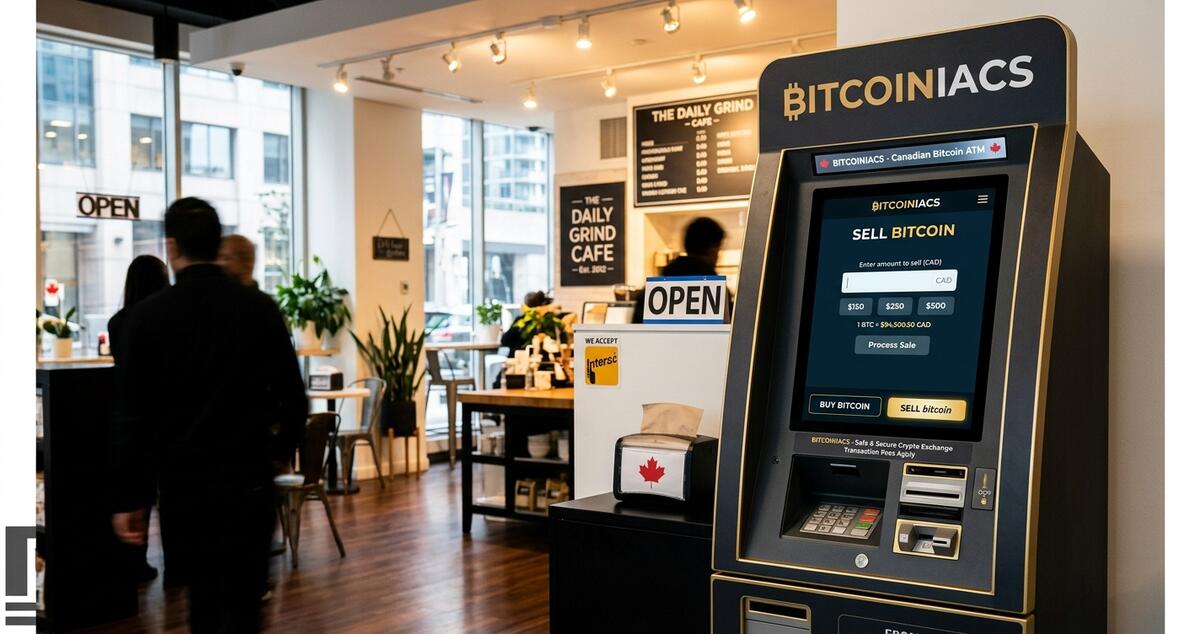
Bitcoin ATMs are the fastest way to sell bitcoin for cash in Canada. Unlike a regular ATM that dispenses cash from your bank account, a two-way Bitcoin ATM lets you send Bitcoin from your wallet and receive physical Canadian dollars from the machine, all within minutes.
Bitcoiniacs operates Bitcoin ATMs across Canada that support both buying and selling. For anyone in Vancouver, Richmond, Burnaby, or Toronto who needs cash on the spot, a Bitcoin ATM is the most direct option.
What You Need Before You Go
Before heading to a Bitcoin ATM to sell, have these ready:
- A Bitcoin wallet on your phone, the ATM will display a QR code you scan to send BTC from your wallet
- Government-issued photo ID, FINTRAC regulations require identity verification for transactions above certain thresholds
- Your phone number, most machines send an SMS verification code before the transaction proceeds
- A receiving address check, double-check you are sending to the ATM’s address, not someone else’s
The ATM Selling Process
Selling Bitcoin at an ATM follows a simple workflow:
- Select “Sell Bitcoin” on the ATM screen
- Enter your phone number and verify with the SMS code
- Scan your government ID when prompted
- The ATM displays a QR code, scan it with your wallet app to send the Bitcoin
- Once the transaction receives enough network confirmations, the machine dispenses your cash
According to Bankrate, the entire process typically takes under five minutes from scan to cash in hand, though confirmation time depends on network congestion and how many confirmations the operator requires.
How Much Do Bitcoin ATM Fees Cost?
Bitcoin ATM fees for selling typically range from 4% to 8% of the transaction amount, significantly lower than buy-side fees, which can reach 15% or more. A 2026 industry analysis by Paybis confirms that selling through a Bitcoin ATM is one of the fastest cash-out methods, with limits typically between $500 and $5,000 per transaction depending on the operator and your verification level.
For example, if you sell $1,000 worth of Bitcoin at a 6% fee, you will walk away with $940 in cash. The premium is the price of instant liquidity, no waiting for bank transfers, no exchange withdrawal delays, and no risk of an e-Transfer being held.
Selling Bitcoin Through a Crypto Exchange
If you are selling a larger amount and can wait a day or two for the funds to land in your bank account, an online crypto exchange will almost always give you a better rate than an ATM. Exchange trading fees are typically in the 0.1% to 1.5% range, a fraction of what an ATM charges.
Choosing a Canadian Exchange
Look for exchanges that are registered with FINTRAC as Money Services Businesses (MSBs). Canadian-regulated exchanges must follow strict compliance rules, which protects you as a seller. Key factors to compare:
- Trading fees, most Canadian platforms charge 0.2% to 0.5% per trade
- Withdrawal methods, Interac e-Transfer is the fastest (minutes to hours); bank wires take 1–3 business days
- Withdrawal fees, some exchanges charge a flat fee per e-Transfer (typically $1–$5); others waive it
- CAD trading pairs, selling BTC directly for CAD avoids a second currency conversion
- Verification time, account approval ranges from same-day to several business days
Verification Requirements
Every regulated Canadian exchange will ask you to complete KYC (Know Your Customer) verification before you can sell. This is not optional, it is required by FINTRAC regulations for all money services businesses operating in Canada. You will need:
- A photo of your government-issued ID (driver’s license or passport)
- A selfie or live video for liveness verification
- Proof of address in some cases (utility bill or bank statement)
Once verified, selling is straightforward. Transfer Bitcoin from your wallet to the exchange, place a sell order at the market price or a limit price of your choosing, and withdraw the CAD proceeds to your bank account.
Selling Bitcoin Peer-to-Peer
Peer-to-peer platforms connect Bitcoin sellers directly with buyers, cutting out the middleman. You set your own price, choose your preferred payment method, and deal directly with the buyer. This can mean lower overall costs, but it also comes with more risk, so caution is essential.
P2P Platforms Available in Canada
Several P2P marketplaces serve Canadian users. Some are centralized (the platform holds the Bitcoin in escrow during the trade), while others are fully decentralized. Common payment methods on these platforms include Interac e-Transfer, bank transfer, and even in-person cash meetups.
How to Stay Safe When Selling P2P
Selling Bitcoin peer-to-peer is safe when you follow basic precautions, but scams do happen. Refer to our full guide on staying safe with Bitcoin for a deeper dive, but here are the non-negotiable rules:
- Use escrow. Only trade on platforms that hold the Bitcoin in escrow until payment is confirmed
- Never release Bitcoin before payment clears. An e-Transfer notification is not the same as cleared funds, wait until the deposit appears in your account
- Check the buyer’s reputation. Established P2P platforms show trade history, feedback scores, and verification badges, stick to buyers with a long, clean history
- Avoid off-platform communication. Scammers try to move conversations to WhatsApp, Telegram, or SMS where there is no platform protection
- Meet in a safe, public place for cash trades. If selling for physical cash in person, choose a well-lit public location, ideally a Bitcoin ATM location or a bank branch with security cameras
Frequently Asked Questions
What is the cheapest way to cash out Bitcoin in Canada?
Online crypto exchanges offer the lowest fees for selling Bitcoin in Canada, typically 0.1% to 0.5% in trading fees plus a small withdrawal fee for Interac e-Transfer. Bitcoin ATMs charge 4% to 8% for selling, while P2P platforms fall somewhere in the middle depending on how you price your offer. If you are selling a large amount, an exchange will save you the most money. If speed matters more than the fee, a Bitcoin ATM delivers cash in minutes.
Do I need ID to sell Bitcoin at a Bitcoin ATM in Canada?
Yes. All regulated Bitcoin ATM operators in Canada are required by FINTRAC to verify customer identity. Small transactions may only require SMS verification, but any amount over the operator’s threshold (often $1,000 per transaction or $3,000 cumulative) will trigger a full ID scan. Bring a valid government-issued photo ID, a driver’s license or passport works.
Can I sell Bitcoin for cash instantly in Canada?
Yes, a two-way Bitcoin ATM is the fastest method. You send Bitcoin from your wallet to the machine and receive physical cash on the spot, typically within minutes. Online exchanges require bank transfers that take hours to days. P2P cash meetups are another instant option, but they require coordinating with a buyer and carry more risk.
How do I avoid scams when selling Bitcoin?
Stick to regulated platforms with identity verification and escrow protection. Be wary of buyers who offer above-market rates, pressure you to release Bitcoin before payment clears, or insist on communicating outside the trading platform. If a deal sounds too good to be true, it almost certainly is. Using a FINTRAC-registered service with a physical presence, like a Bitcoin ATM at a known location, eliminates the counterparty risk entirely.
Are there tax implications when I sell Bitcoin in Canada?
Yes. The Canada Revenue Agency (CRA) treats Bitcoin as a commodity, not a currency. When you sell Bitcoin for a profit, 50% of the capital gain is taxable at your marginal income tax rate. If you trade frequently or as a business, 100% of the profit may be treated as business income. Keep records of your acquisition cost (the price you paid), the sale price, and the date of each transaction, you will need these when filing your taxes.
Selling Bitcoin in Canada does not need to be complicated. Whether you choose the speed of a Bitcoin ATM, the lower fees of an online exchange, or the flexibility of a peer-to-peer marketplace, the right method depends on how quickly you need your cash and how much you are willing to pay for convenience. For cash in hand within minutes, a Bitcoin ATM remains the fastest option available to Canadians, and with operators like Bitcoiniacs serving major cities from Vancouver to Toronto, there is likely a machine near you.
Ready to sell? Find your nearest Bitcoiniacs Bitcoin ATM location or visit our Sell Bitcoin Vancouver page for location-specific details.