


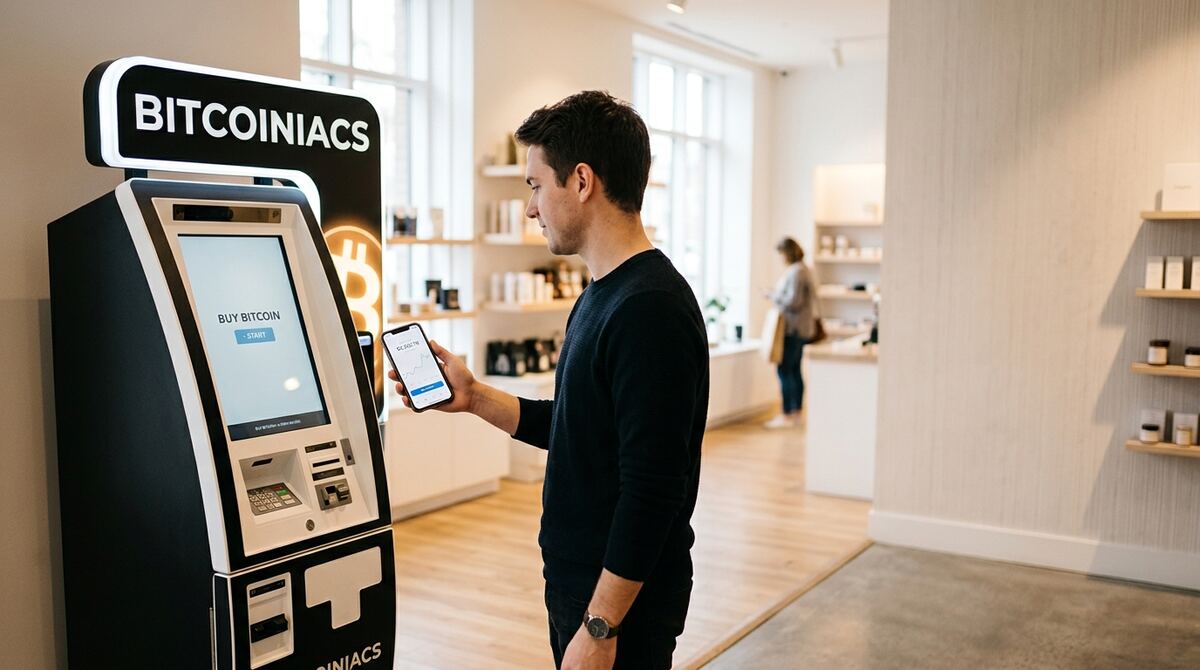
The Bitcoin ATM vs online exchange Canada decision comes down to what you actually need: a Bitcoin ATM lets you walk up with cash and walk out with Bitcoin in your wallet in under five minutes, with no account signup and no bank link. An online exchange like NDAX or Shakepay usually offers lower fees and tighter spreads, but asks you to verify your identity, link a bank account, and wait for an Interac e-Transfer to clear before the Bitcoin lands. Choosing between the two is one of the first decisions new crypto buyers face.
This guide breaks down the real differences between the two in 2026: how fees compare, how speed and privacy stack up, what the verification rules are, and which situations favour one over the other. You’ll also get answers to the questions Canadians actually ask in r/BitcoinCA and r/BitcoinBeginners about Bitcoin ATMs, online exchanges, and which is safer for first-time buyers.
If you’d rather skip the comparison and just walk into a Bitcoin ATM near you today, Bitcoiniacs operates over 25 Bitcoin ATM locations across Canada in Calgary, Vancouver, Victoria, Kelowna, Surrey, Burnaby, Richmond, Airdrie, Red Deer, the Greater Toronto Area, and several other cities. Every machine is FINTRAC-registered, accepts cash and debit, and supports Bitcoin, Ethereum, Litecoin, and USDC.
Table of Contents
- How Bitcoin ATMs Work in Canada
- How Online Exchanges Work in Canada
- Fees Compared: Bitcoin ATM vs Online Exchange Canada
- Speed, Privacy, and Buying Limits
- Which Should You Use in Canada?
- Frequently Asked Questions
How Bitcoin ATMs Work in Canada
A Bitcoin ATM is a physical kiosk, usually mounted inside a convenience store, vape shop, coffee shop, or grocery, that sells Bitcoin (and sometimes other cryptocurrencies) in exchange for cash or debit. The machine prints a paper wallet QR code, scans your mobile wallet, or generates a new wallet for you on the spot. You insert cash, the machine calculates the Bitcoin amount at the current spot rate plus a service fee, and the coins are sent to your wallet within minutes.
Every legitimate Bitcoin ATM operator in Canada must register with FINTRAC as a money services business. As FINTRAC’s own sectoral advisory on virtual currency ATMs explains, operators are required to verify customer identity on transactions over $1,000, file suspicious transaction reports when activity looks like money laundering, and report any single virtual currency transaction of $10,000 or more under the Large Virtual Currency Transaction Reporting rules. That means even though you can walk up without an account, every ATM you use is recording your ID details on the back end once you cross the threshold.
Bitcoiniacs Bitcoin ATMs follow the same federal framework, plus provincial rules where applicable. You can buy Bitcoin in Vancouver at any of our seven Lower Mainland locations, or use the national locator to find a machine in your city. No appointment, no account signup required for small transactions, and most machines operate seven days a week during store hours.
What Happens When You Use a Bitcoin ATM
The basic flow at any Canadian Bitcoin ATM looks like this: you walk up to the machine, select Bitcoin (or another supported coin), choose how much you want to buy, and present your wallet QR code to the scanner. The machine quotes you a price, including its fee, that locks for 60 to 90 seconds. You insert cash or swipe your debit card, the machine confirms the transaction, and the Bitcoin is broadcast to the network. The coins usually appear in your wallet within one to five minutes, depending on blockchain congestion.
For transactions under $1,000, most Bitcoin ATMs in Canada, including all Bitcoiniacs machines, require only a phone number for verification. For transactions over $1,000, federal Proceeds of Crime (Money Laundering) and Terrorist Financing Act rules kick in: you’ll need government-issued photo ID and the operator will keep a record. Above $10,000 in a single transaction, the operator must file a Large Virtual Currency Transaction Report with FINTRAC, the same kind of report a bank files when you deposit $10,000 cash.
How Online Exchanges Work in Canada
Online crypto exchanges in Canada are websites or apps where you sign up for an account, complete identity verification, link a bank account or debit card, and then buy or sell crypto with a few taps. The biggest names serving Canadian customers in 2026 are NDAX, Shakepay, Bull Bitcoin, Coinbase, Kraken, and Bitcoin Well. Each one has its own fee structure, withdrawal options, and limits on how much you can buy without upgrading to fully verified status.
The Bank of Canada, in its 2018 staff discussion paper “Decrypting Crypto”, noted that cryptoassets like Bitcoin don’t perform the basic functions of money well, and that the regulatory perimeter around them is intentionally strict. For retail users, that translates into mandatory identity verification on essentially every registered exchange operating in Canada, you will upload a photo of your driver’s licence and take a selfie before you can fund an account.
Once verified, the typical flow looks like this: you log in, initiate an Interac e-Transfer or wire to the exchange, wait for the deposit to clear (Interac is usually minutes, wire is one to three business days), then place a buy order. Your Bitcoin lands in the exchange’s custodial wallet, and you can either leave it there, withdraw it to your own wallet, or convert it back to CAD. If you want to sell Bitcoin in Canada back to CAD, the process reverses.
What Custodial vs Non-Custodial Means
When you buy on a registered online exchange, the Bitcoin usually sits in the exchange’s wallet, not yours. This is called custodial ownership. The exchange holds the private keys on your behalf, and you have an IOU against their pooled Bitcoin balance. If the exchange gets hacked, goes bankrupt, or freezes withdrawals (QuadrigaCX in 2019 being the Canadian cautionary tale), your funds can be tied up indefinitely.
Non-custodial exchanges like Bull Bitcoin and Bitcoin Well push you toward withdrawing your Bitcoin to your own wallet immediately after purchase. You still go through KYC verification, but the coins are never held by a third party for any meaningful length of time. Self-custody, holding your own private keys on a hardware wallet like Ledger or Trezor, is the gold standard for anyone buying more than a few hundred dollars’ worth of Bitcoin.
Fees Compared: Bitcoin ATM vs Online Exchange Canada
Fees are where the two options diverge the most. A Bitcoin ATM in Canada typically charges between 8% and 18% above the spot price, depending on the operator, the machine, and the size of the transaction. The fee is usually baked into the exchange rate the machine quotes you, rather than charged as a separate line item. A small machine in a high-rent location will charge more than a busy machine in a suburban strip mall.
Online exchanges are significantly cheaper. NDAX charges around 0.2% per trade for most users, Shakepay charges a spread of around 1% to 2% depending on payment method, and Bull Bitcoin operates on a flat-fee model that often comes out to 1% or less for larger purchases. The catch is that you have to move money to the exchange first, and depending on how you fund the account, there can be additional Interac e-Transfer fees (typically $1 to $5) or wire transfer fees ($15 to $30 at your bank).
The simple way to think about it: if you’re buying $100 of Bitcoin, an ATM will cost you $8 to $18 in fees. An online exchange will cost you roughly $1 to $5 once you include the Interac deposit fee. The gap narrows as the transaction size grows, at $5,000, the ATM’s percentage fee becomes proportionally smaller, while the online exchange still only charges you a few dollars in network fees for the Bitcoin withdrawal.
Sample Fee Breakdown on a $1,000 Purchase
Bitcoin ATM at a typical 13% blended fee: $130 in fees. You receive $870 worth of Bitcoin. Online exchange at 1% spread plus $2 Interac fee: $12 total. You receive $988 worth of Bitcoin. The $118 difference is the premium you pay for the convenience of walking up with cash and walking out with Bitcoin in your wallet. That’s a real cost, but for many users, it’s worth it for the speed and the no-account-required experience.
Speed, Privacy, and Buying Limits
Speed is where the Bitcoin ATM pulls ahead decisively. From the moment you walk up to the machine, the entire transaction, quote, cash insertion, confirmation, Bitcoin broadcast, usually takes three to seven minutes. There’s no signup, no waiting for an Interac transfer to clear, no dealing with a bank’s daily transfer limit. For someone who wants to convert cash into Bitcoin immediately, an ATM is unmatched.
Online exchanges are slower on the funding side but faster on the trading side once your account is funded. A first-time signup that includes ID verification can take 10 minutes to 24 hours depending on the exchange and the quality of your documents. Subsequent Interac e-Transfer deposits usually clear in one to ten minutes. After that, the actual trade happens instantly, but you’ve spent 15 to 60 minutes total on the workflow.
Privacy sits in an interesting middle ground. Bitcoin ATMs in Canada aren’t anonymous in the legal sense, every operator is required to keep ID records and report to FINTRAC above the thresholds, and most machines have CCTV. But for transactions under $1,000, you only need a phone number, and no one is linking that purchase to your bank account or credit card. Online exchanges, by contrast, link every purchase to your verified identity, your bank account, and your ongoing transaction history, a permanent record visible to the exchange, to FINTRAC, and (under the new reporting rules) to the CRA.
Buying limits differ sharply between the two options. Most online exchanges cap unverified users at $0 to $500 per day, with full verification unlocking tens of thousands of dollars per day. Bitcoin ATMs typically allow small transactions (under $1,000) with just a phone number and let you do larger transactions with ID verification, but most individual machines have their own per-transaction caps. To see exactly where Bitcoiniacs machines sit on the limit spectrum, see our guide to Bitcoin ATM limits in Canada.
Which Should You Use in Canada?
There’s no single right answer, the right choice depends on what you’re optimizing for. Here’s a simple framework Canadians have been using for years:
- Use a Bitcoin ATM when: you have cash in hand and want Bitcoin in your wallet within minutes, you don’t want to sign up for an account, you want to start small and learn the workflow, or you want to convert cash to crypto without your bank being involved in the transaction. The convenience premium is real but worth it for these use cases.
- Use an online exchange when: you’re buying more than $1,000, you want to minimize fees, you plan to set up recurring purchases (dollar-cost averaging), or you want access to a wider range of cryptocurrencies. NDAX, Shakepay, and Bull Bitcoin are the three most commonly recommended Canadian options.
- Use both: many long-time Canadian crypto users keep an online exchange account for regular low-fee purchases and use a Bitcoin ATM for the occasional cash-to-Bitcoin conversion. There’s no rule that says you have to pick one.
One thing that should factor into the decision is how your choice interacts with CRA reporting. As of 2024, Canadian registered crypto exchanges are required to report customer transactions to the CRA, and FINTRAC continues to expand its oversight of the sector. Every transaction through either route is recorded somewhere, the question is just which database your transaction ends up in, and whether your bank sees a flag on your account.
For a deeper look at how the regulatory framework has evolved and what’s coming next, see the FINTRAC sectoral advisory on virtual currency ATMs and FINTRAC’s overview of financial transactions reported to FINTRAC. Both documents make clear that the era of fully anonymous crypto purchases in Canada is over, every legitimate route is recorded, reported, and traceable.
Whatever route you pick, the practical advice hasn’t changed: never buy more crypto on a single platform than you’re willing to lose if the platform fails, always withdraw your Bitcoin to a wallet you control the keys to for any meaningful amount, and treat unusually high-pressure “buy now or miss out” prompts as a scam signal regardless of whether they come through a website or a person standing next to an ATM.
Frequently Asked Questions
Is a Bitcoin ATM safer than an online exchange in Canada?
Safer in some ways, less safe in others. Bitcoin ATMs in Canada are FINTRAC-registered and physically located in staffed retail locations, so there’s less chance of a sudden platform collapse like the 2019 QuadrigaCX incident. You also don’t have to hand over custody of your Bitcoin to a third party, the coins go straight to your wallet. The downsides are higher fees, exposure to physical-location scams (someone pressuring you to “invest” at the machine), and the fact that every ATM transaction is recorded. Online exchanges are cheaper and offer more features, but you’re trusting them to hold your funds.
Why are Bitcoin ATM fees so much higher than online exchanges?
Bitcoin ATMs have significant fixed costs that online exchanges don’t, the machine hardware, the retail lease for the host location, cash handling, in-person support, and stricter compliance overhead. The operator also takes on more fraud risk because cash transactions are harder to reverse than card or Interac transactions. Those costs get passed on to the buyer in the form of a higher spread above the spot price, typically 8% to 18% depending on the machine and transaction size.
Can I buy Bitcoin at an ATM without showing ID in Canada?
For transactions under $1,000, most Canadian Bitcoin ATMs, including all Bitcoiniacs machines, only require a phone number for verification, no photo ID. Above $1,000, federal regulations require the operator to verify your identity with government-issued photo ID and record the transaction details. Above $10,000 in a single transaction, the ATM must file a Large Virtual Currency Transaction Report with FINTRAC. The “no ID” window exists, but it’s not a loophole for unlimited anonymous buying.
Should I use an ATM or Shakepay, NDAX, or Bull Bitcoin?
For small cash purchases (under $500) where you want Bitcoin in your wallet within minutes, an ATM is the practical choice. For larger purchases where fees matter, online exchanges win, NDAX is widely recommended for amounts over $1,000, Shakepay is popular for small recurring buys and offers a Visa debit card, and Bull Bitcoin is the go-to for Canadians who want non-custodial purchases with strong privacy practices. Many Canadians use a combination: an exchange account for regular purchases and an ATM for occasional cash-to-Bitcoin conversions.
What happens if I get scammed using a Bitcoin ATM?
Bitcoin transactions are irreversible by design, once the coins leave the ATM, they cannot be recalled. If you were pressured into sending Bitcoin to a scammer’s wallet, the coins are almost certainly gone. Report the incident immediately to your local police (the Canadian Anti-Fraud Centre at 1-888-495-8501 handles most crypto fraud reports), contact the ATM operator to flag the wallet address and any associated surveillance footage, and file a report with the operator’s compliance team. The best protection is prevention: never send Bitcoin to someone you don’t know personally, no matter how legitimate the story sounds.
Both Bitcoin ATMs and online exchanges have their place in a Canadian crypto buyer’s toolkit. The right choice comes down to transaction size, urgency, fee tolerance, and how much identity verification you’re comfortable with. Whichever route you choose, buy only what you can afford to hold through volatility, withdraw to a wallet you control for any meaningful amount, and remember that crypto purchases in Canada are recorded and reportable regardless of which door you walk through.