


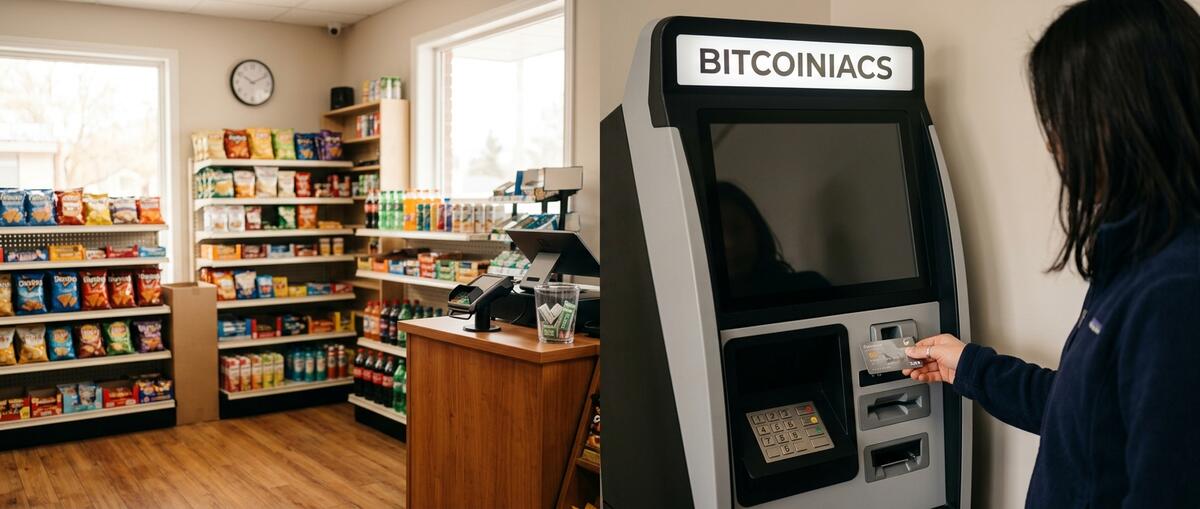
If you want to buy Bitcoin with a debit card in Canada, you are not alone — it is one of the most common questions Canadian crypto buyers ask. The idea of swiping your card and receiving Bitcoin instantly is appealing. In practice, buying Bitcoin with a debit card in Canada involves more steps, higher fees, and more restrictions than you might expect. This guide covers which providers accept debit cards, what you will pay, how to avoid bank blocks, and when you are better off using cash at a Bitcoin ATM.
Table of Contents
- Can You Buy Bitcoin with a Debit Card in Canada?
- How to Buy Bitcoin with a Debit Card: Step by Step
- Debit Card Fees and Limits for Bitcoin Purchases
- Why Banks Block Debit Card Crypto Purchases
- Debit Card vs Other Bitcoin Payment Methods
- Buying Bitcoin at Bitcoiniacs
- Frequently Asked Questions
Can You Buy Bitcoin with a Debit Card in Canada?
Yes, you can buy Bitcoin with a debit card in Canada, but the options are more limited than you might think. Unlike Interac e-Transfer or bank wire, debit card purchases go through a card payment network (Visa, Mastercard, or Interac Flash), which adds processing layers, fees, and potential restrictions that both your bank and the crypto provider impose.
The main factors that determine whether you can use your debit card are:
- Your bank’s policy: Some Canadian banks block debit card transactions to crypto platforms entirely. Others allow them but flag them for manual review.
- The crypto provider: Not all platforms accept debit cards. The ones that do typically charge higher fees to cover card-processing costs.
- Your card type: Visa debit cards are more widely accepted than Mastercard debit or Interac Flash for crypto purchases.
- Purchase amount: Debit card purchases are usually capped at lower amounts than e-Transfer or wire transfers.
How to Buy Bitcoin with a Debit Card: Step by Step
Step 1: Find a Provider That Accepts Debit Cards
Not every Canadian crypto platform accepts debit cards. The ones that do are typically larger online exchanges that have merchant card-processing accounts. Look for platforms that explicitly state they accept Visa debit or Mastercard debit. Avoid peer-to-peer marketplaces where someone asks you to send card details directly — those are almost always scams.
Step 2: Create and Verify Your Account
As with any regulated Canadian crypto service, you must verify your identity before you can buy. This means uploading a government-issued ID and proof of address. This is a legal requirement under FINTRAC anti-money-laundering rules. Do not skip this step — no legitimate Canadian platform will let you buy Bitcoin with a debit card without identity verification.
Step 3: Link Your Debit Card
Once verified, navigate to the platform’s payment methods section and select “Debit Card” or “Card Payment.” You will need to enter your card number, expiry date, and CVV. Some platforms also require a billing address match with your bank. The platform may place a small temporary hold (under $2) to verify the card is active, which is refunded after confirmation.
Step 4: Place Your Order
Enter the amount of Bitcoin you want to buy. The platform will show you the current exchange rate, the card-processing fee, and the total in Canadian dollars. Review the all-in cost carefully — debit card fees can add 2% to 5% on top of the spread. If the rate looks unreasonable, consider a different payment method.
Step 5: Withdraw to Your Wallet
After the purchase, move your Bitcoin to a wallet you control. Leaving coins on an exchange exposes you to counterparty risk. Hardware wallets offer the strongest security for larger amounts, while mobile wallets are convenient for smaller holdings. Never leave significant value on a platform after buying.
Debit Card Fees and Limits for Bitcoin Purchases
The cost of buying Bitcoin with a debit card is higher than most other payment methods because of the multiple fees stacked on top of each other.
Fee Breakdown
- Card-processing fee: Usually 2% to 3% of the transaction amount. This is charged by the card network and passed through by the platform.
- Platform spread: 1% to 2% above the market rate, depending on the provider. This is how the platform makes money on the trade.
- Foreign exchange fee: If the platform processes the transaction in a foreign currency, your bank may charge an additional 2.5% conversion fee.
- Bank fee: Some Canadian banks charge a cash-advance or card-transaction fee for crypto purchases, though this is rare for debit cards.
Total all-in cost: expect to pay 4% to 8% above the market Bitcoin price when using a debit card. This is significantly higher than Interac e-Transfer (1% to 3%) or cash at a Bitcoin ATM (varies by operator).
Purchase Limits
Debit card purchases are typically capped at lower amounts than other methods. Common limits include:
- Per transaction: $500 to $2,500, depending on the platform and your verification level.
- Daily limit: $1,000 to $5,000 across all debit card transactions.
- Monthly limit: $5,000 to $20,000 for fully verified accounts.
These limits are lower than Interac e-Transfer limits because card-processing networks consider crypto a higher-risk category. If you need to buy more Bitcoin than your card limit allows, splitting the purchase across multiple days or switching to e-Transfer is the practical solution.
Why Banks Block Debit Card Crypto Purchases
One of the most frustrating experiences when trying to buy Bitcoin with a debit card in Canada is having the transaction rejected by your bank. This happens more often than many people realize.
Common Reasons for Blocks
- Risk-flagging algorithms: Banks use automated systems that flag transactions to known crypto merchants. If the merchant code (MCC) is associated with crypto, the system may block the transaction automatically.
- Internal bank policies: Some Canadian banks have publicly stated they do not support crypto purchases through debit cards. Others quietly block them without clear communication.
- Fraud prevention: A first-time debit card purchase at a crypto platform can trigger fraud alerts because it looks unusual compared to your normal spending pattern.
- Exceeding daily limits: Your bank’s own debit card daily spending limit may be lower than what the crypto platform allows.
What to Do If Your Bank Blocks the Transaction
- Call your bank: A quick call to the fraud department can often resolve the block. Explain that you are making a legitimate purchase and ask them to authorize future transactions.
- Use a different bank: If your bank consistently blocks crypto purchases, consider opening an account at a more crypto-friendly institution.
- Use Interac e-Transfer instead: E-Transfers are less likely to be blocked because they are person-to-person transfers, not card-present transactions. For online purchases, e-Transfer is often the path of least resistance.
- Buy with cash at a Bitcoin ATM: Cash transactions bypass banks entirely. Visit a Bitcoiniacs ATM location for instant, no-bank-involvement purchases. This is the most reliable workaround when card payments fail.
Debit Card vs Other Bitcoin Payment Methods
How does buying Bitcoin with a debit card stack up against other methods available to Canadians?
Debit Card vs Interac e-Transfer
Interac e-Transfer is cheaper (1% to 3% all-in vs 4% to 8% for debit cards) and less likely to be blocked by banks. It also supports higher limits. Debit cards offer instant processing, while e-Transfer takes 15 to 30 minutes. For most routine purchases, e-Transfer is the better choice. Debit cards only make sense when you need Bitcoin immediately and cannot wait for an e-Transfer to clear.
Debit Card vs Credit Card
Credit card purchases come with additional risks. Many Canadian banks treat crypto purchases as cash advances, which means interest accrues from day one at a higher rate. Credit cards also carry the risk of overspending with borrowed money — Bitcoin volatility does not reduce your credit card balance. Debit cards avoid the debt trap but still carry higher fees than non-card methods. For a detailed comparison, see our guide on buying Bitcoin with a credit card.
Debit Card vs Cash at a Bitcoin ATM
Cash transactions at a Bitcoin ATM offer privacy and reliability that debit cards cannot match. There is no bank to block the transaction, no card network to approve, and no processing fees beyond the ATM operator’s markup. Cash purchases are also instant — you walk in, insert cash, and receive Bitcoin in your wallet within minutes. For those who value speed, privacy, and certainty, cash at a Bitcoin ATM is often the superior choice. The trade-off is that ATM fees can be higher than online exchange fees, and you need to carry cash to the machine.
Buying Bitcoin at Bitcoiniacs
Bitcoiniacs is a trusted Canadian Bitcoin service with physical ATM locations and an online platform. For buying Bitcoin with a debit card, Bitcoiniacs offers several advantages. Bitcoiniacs ATM locations support cash purchases, which are the most reliable alternative when your debit card is blocked or you want to avoid bank involvement entirely. The online platform also supports other funding methods that may be more cost-effective than debit cards for larger purchases.
If you prefer the convenience of card payments, check directly with the Bitcoiniacs platform for the most up-to-date information on supported payment methods. For a full list of cash-based ATM locations, visit the Bitcoiniacs ATM locations page to find a machine near you. Each location lists the available services, hours, and supported transaction types.
For those who also want to sell Bitcoin, Bitcoiniacs supports two-way transactions — you can buy and sell at the same location. This makes it a convenient full-service option for Canadians who want to manage their Bitcoin in one place.
Frequently Asked Questions
Can I buy Bitcoin with a debit card without ID?
No. Canadian regulations require all crypto providers to verify your identity before processing any transaction, regardless of payment method. You must provide government-issued ID and proof of address. Even Bitcoin ATMs in Canada require ID for transactions above certain thresholds. Buying Bitcoin anonymously with a debit card is not possible on regulated Canadian platforms.
Which debit cards work for buying Bitcoin in Canada?
Visa debit cards are the most widely accepted for Bitcoin purchases in Canada. Mastercard debit is accepted by some platforms but less common. Interac Flash debit is rarely supported for crypto purchases. Check with your specific provider to confirm which card networks they accept before attempting a purchase.
Why does my bank block debit card crypto purchases?
Banks block debit card crypto purchases for several reasons: automated fraud-detection systems flag the merchant category code for crypto, internal bank policies restrict crypto transactions, or your daily spending limit is too low. The most effective solution is to call your bank’s fraud department to authorize the transaction, or switch to a bank that supports crypto purchases.
Are debit card Bitcoin purchases safe?
Debit card purchases are safe when you use a regulated, FINTRAC-registered crypto platform. The risk is not in the card transaction itself but in the platform you use. Only use platforms registered as money services businesses with FINTRAC, which are subject to compliance and security requirements. The Canada Revenue Agency offers a cryptocurrency guide for understanding your tax obligations when buying or selling. Also review investment scam warnings from the Competition Bureau to recognize common fraud patterns.
Final Thoughts
Buying Bitcoin with a debit card in Canada is possible but comes with higher fees, lower limits, and the risk of bank blocks. For most Canadians, Interac e-Transfer or cash at a Bitcoin ATM offer better value and reliability. If you do use a debit card, choose a registered platform, verify the all-in cost before purchasing, and withdraw your Bitcoin to a private wallet immediately after the trade. Whether you buy online or at a Bitcoiniacs ATM, the Financial Consumer Agency of Canada provides useful guidance on digital currency risks that every buyer should read before their first purchase. Always buy responsibly, use a FINTRAC-registered provider like those listed in the MSB registry, and store your Bitcoin securely.