


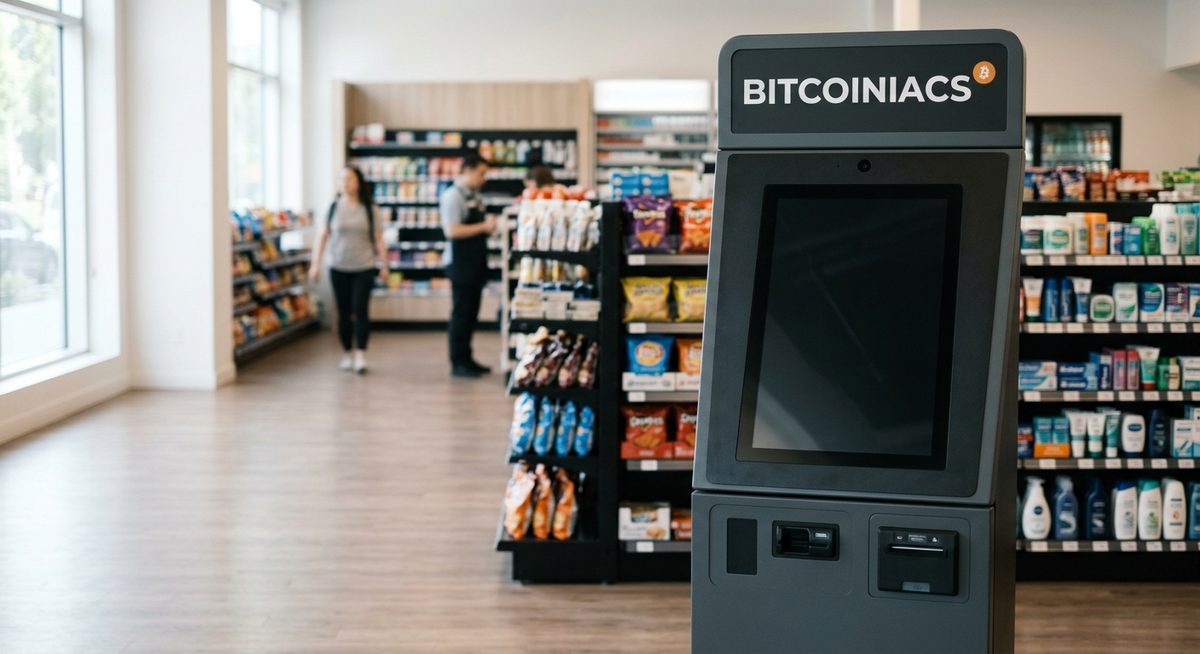
Buy Bitcoin in British Columbia with cash at a real storefront, not a website. Bitcoiniacs operates 16 machines across the province, from Vancouver and Victoria on the coast to Kelowna, Nanaimo and the Fraser Valley in the interior. A Bitcoin ATM lets you walk in with Canadian bills, show a government photo ID, scan a wallet QR code, and have Bitcoin delivered to your phone before you leave the store. This guide covers where the machines are, what the purchase costs, what to bring, and how to keep records the Canada Revenue Agency will accept later.
Table of Contents
- Where to Buy Bitcoin in British Columbia
- What It Costs to Buy Bitcoin in British Columbia
- What to Bring: ID and a Wallet
- The Coast and the Interior: Where to Buy Bitcoin Locally
- Keeping Records the CRA Will Accept
- Frequently Asked Questions
Where to Buy Bitcoin in British Columbia
Bitcoiniacs has been buying and selling crypto for cash since 2013, and British Columbia is where the footprint is densest. Sixteen active machines are spread across six regional clusters, so there is almost always one within a short drive no matter where on the island or the mainland you live. Every location, address, and buy/sell capability is listed on the Bitcoiniacs Bitcoin ATM locations page.
Greater Vancouver and the Fraser Valley
Metro Vancouver has the widest selection, with machines in Vancouver, Richmond, Burnaby, Surrey, New Westminster, Delta, North Vancouver, Maple Ridge, and Coquitlam-adjacent areas. The Vancouver proper locations sit on commercial streets with easy street parking: one on Howe Street, one on Nelson Street in the West End, and one on Nanaimo Street in East Vancouver. If you want the wider Vancouver buy-side overview before you head out, our Buy Bitcoin Vancouver page walks through the local options and what to expect.
Vancouver Island
Island coverage runs from Victoria up to Nanaimo. The Victoria machine is inside Xing Fu Tang on Broughton Street downtown, easy to pair with a meal. Nanaimo is served by the Affirmation Coffee location on Bowen Road. Island residents often ask whether an ATM exists at all in their town before they ask about fees. City business hours and regional service information for Nanaimo are published on the City of Nanaimo website if you want to check the surrounding area.
Interior, Kootenays, and the North
Kelowna is the hub for the Okanagan, served by the Hashtag Convenience machine on Enterprise Way. Kamloops and Prince George are not currently on the map, so residents there either drive to Kelowna or use an online exchange. The Kelowna Bitcoin ATM page has the exact address and store details.
What It Costs to Buy Bitcoin in British Columbia
The number people want first is the all-in cost, and it is the one most operators bury. When you buy with cash, you are paying two separate things at once: the operator’s fee, and the spread between the machine’s buy price and the actual market rate. The fee is a percentage of your transaction. The spread moves with the market and is the reason two machines can quote different amounts for Bitcoin seconds apart.
This matters more than it sounds. The Bank of Canada describes the Canadian financial system as built around banks, credit unions, and regulated clearing and settlement infrastructure. A Bitcoin ATM sits entirely outside that structure. It is a private retail transaction with a floating exchange rate, which is why no Canadian ATM can promise you the exact market price and no regulator sets a ceiling on what an operator may charge.
Always Read the Quote Before You Insert Cash
Every machine displays the rate and the total cost on screen before the bill acceptor opens. Read it. If the effective cost looks high, you can walk away and lose nothing. The worst outcome in the whole process is inserting cash before reading the screen, because most machines will not reverse a completed purchase. A common Canadian comparison point is the spread on a regulated online exchange, which is typically much tighter, at the cost of a bank-linked account and a settlement wait.
Small and Large Transactions Are Not Equal
Because the fee is percentage-based, a small purchase carries a proportionally heavier load. Someone putting $20 through a machine with a flat low fee still loses a meaningful slice of that twenty dollars. The same buyer making a larger purchase keeps more of their money in Bitcoin. If you are new and want to test the process, start small, but understand the arithmetic first. Borrowing or buying on credit to fund a purchase is a bad trade, and no fee structure makes it a good one.
What to Bring: ID and a Wallet
Two things, no more. A valid government-issued photo ID, and a wallet that can display a receiving address as a QR code. That is genuinely it. You do not need a bank account, you do not need a credit card, and you do not need to have bought crypto before.
The Wallet Step Is Where Most Mistakes Happen
Your phone’s camera reads the QR code on the machine’s screen, or the machine’s camera reads the QR code on your phone. Either direction works, but the failure mode is identical: if the code is not read cleanly, the machine may deliver your Bitcoin to the wrong address, or your transaction may sit unconfirmed. Before scanning anything, open your wallet, confirm you are on the Bitcoin network and not a testnet, and confirm the currency shown is BTC. Our walkthrough on using a Bitcoin ATM for the first time covers the full sequence, including the parts that are easy to rush.
ID Requirements
Expect a photo ID check on larger purchases and on repeat visits. A driver’s licence, provincial photo card, passport, or federally issued identity document are the usual categories accepted. The name on the ID should match the name you use on the account. Operators must identify their customers, which is why a machine in a convenience store still asks who you are. Without acceptable ID you cannot complete a large transaction, so check before you leave home.
The Coast and the Interior: Where to Buy Bitcoin Locally
Distance genuinely changes the calculus in BC. On the mainland, driving twenty minutes to a machine is unremarkable. In the Kootenays, on the Sunshine Coast outside the Vancouver mainland cluster, or up the Island, a round trip can eat a meaningful share of the transaction. A rule of thumb: if the drive is more than forty minutes each way, calculate whether your purchase is large enough that the fee is still your main cost rather than fuel and time. If it is not, buying in Vancouver while you are already there is the cheaper decision.
There is a second factor specific to the province. Some Canadian banks have tightened their policies on crypto-linked activity, and a remote BC community may have no nearby branch at all. The ATM model sidesteps both issues, which is why it works in places where an online exchange requiring a bank transfer does not.
Keeping Records the CRA Will Accept
Buying Bitcoin is not a taxable event. Disposing of it generally is. The Canada Revenue Agency’s guide to reporting crypto-asset transactions is explicit that buying and holding on its own does not trigger reporting, while selling, trading, or spending is a disposition. Most people buying at an ATM are accumulating, so the obligation is to keep records rather than to file anything yet.
For each purchase, keep the machine receipt, the CAD amount you paid, the BTC amount credited, the rate quoted, the timestamp, your wallet address, and the transaction ID. The Bitcoin blockchain explorer lets you paste that transaction ID and confirm the amount actually arrived on-chain, which turns a piece of paper into a verifiable record. If the machine printed a QR code on the receipt, that is your fastest route to the transaction in an explorer.
Keep those records for at least six years. When you eventually sell, half of any capital gain is taxable and your adjusted cost base is what you paid at the machine. Without the receipts, reconstructing that number years later is genuinely difficult. A photo of the receipt on the day of purchase is sufficient.
A Quick Scam Check
Nobody legitimate will approach you offering guaranteed returns, urgent instructions to send funds to a specific wallet address, or a request for your seed phrase or a one-time verification code. No operator, no government, and no support line ever asks for those. If someone does, that is the whole answer to the situation: end the conversation.
Frequently Asked Questions
Is there a Bitcoin ATM in my town, or do I have to drive?
This is the most common question we get, and the honest answer varies by where you are in BC. Vancouver, Richmond, Burnaby, Surrey, Delta, New Westminster, North Vancouver, Maple Ridge, Victoria, and Nanaimo all have a machine within the local area. Kamloops and Prince George currently do not. Check the locations page before you make the drive, because the nearest machine to you may be a two-hour round trip rather than a five-minute walk.
Why did I put in $20 and only received $13 worth of Bitcoin?
You were not short-changed. The gap is the operator’s fee combined with the spread between the machine’s rate and the market rate, and on a small transaction the fixed component dominates. The arithmetic is unforgiving: if $7 of costs attach to a $20 purchase, 35 percent of your money has gone before you own anything. This is the strongest argument for making larger purchases rather than repeated small ones, and for always reading the on-screen quote before inserting cash.
What ID do I need, and do I need a bank account?
A government-issued photo ID is required, and you do not need a bank account. That second point is the one people are most surprised by, given how many crypto services assume a linked bank connection. A driver’s licence or passport is generally what you will be asked for. Bring it with you before you travel to the machine, not after.
The ATM scanned my QR code but my wallet shows nothing. What happened?
Most often nothing is wrong. Bitcoin transactions broadcast immediately but are not final until they are included in a block, which takes minutes under normal conditions and longer during a busy period. Confirmations are counted on a blockchain explorer using the transaction ID from your receipt. If it shows confirmations and your balance has not moved, the issue is in your wallet app rather than the transaction, and refreshing the wallet usually resolves it. If the explorer shows no transaction at all, take the receipt to the store immediately.
I have an old ATM receipt from years ago. Is it still worth anything?
Yes, and keep it. A receipt from an ATM purchase is your best evidence of what you paid and when, which is the foundation of any adjusted cost base you report later. It does not expire. If you bought from an operator that no longer operates a nearby machine, the receipt is still valid proof of the transaction, and it pairs directly with a blockchain explorer lookup of the address and date.
Why won’t the machine read my wallet’s QR code?
Three usual causes. Your wallet may be showing a Lightning address, which an on-chain ATM cannot process. Your screen brightness may be too low, which makes the camera miss the code. Or the wallet app may have switched to a test network. Turn brightness to maximum, confirm the network is set to Bitcoin mainnet, and use a receive address for the Bitcoin chain rather than a Lightning address.
British Columbia has sixteen Bitcoiniacs machines across the mainland, Vancouver Island, and the Okanagan. Check the full location list with addresses before you leave, and read the on-screen quote before you feed in any cash.