


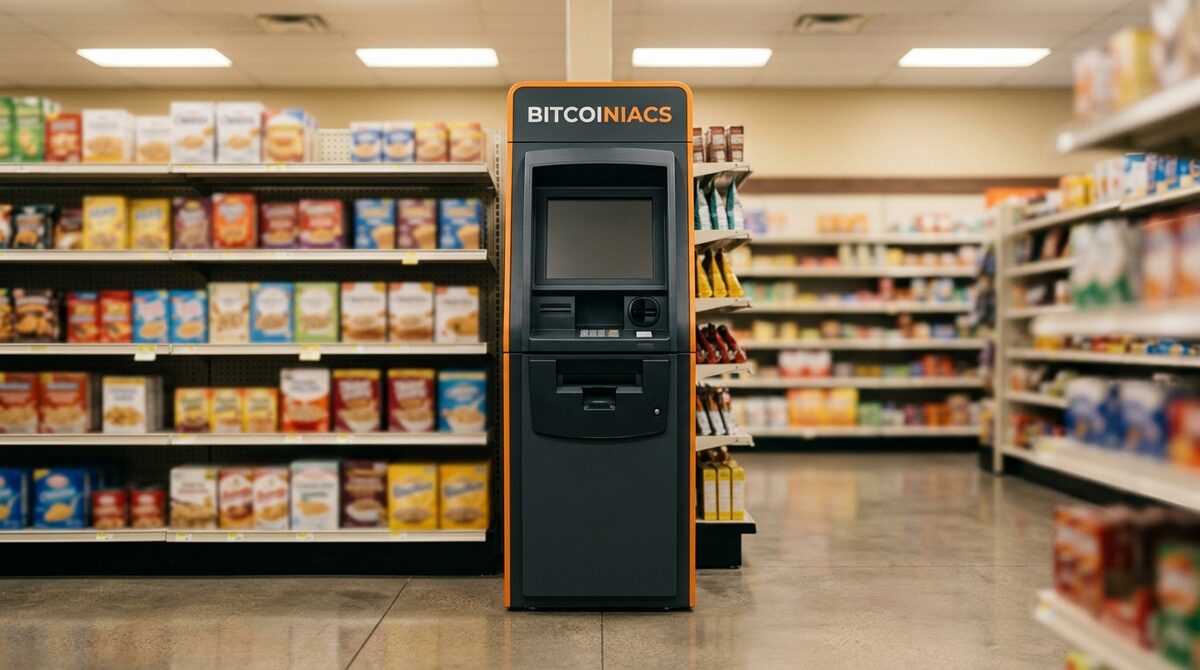
If you want to buy Bitcoin in Mississauga with cash, the fastest route is a machine you can walk up to in person — no bank transfer sitting in limbo, no three-day hold on a first-time exchange deposit. Plenty of people here have hit the same wall: an exchange asks for a void cheque, a bank flags the purchase as suspicious, and a simple $200 buy turns into a week of back-and-forth. A Bitcoin ATM skips that. You bring cash and a wallet, and you walk out holding Bitcoin in an address only you control. This guide covers the Bitcoiniacs machine in Mississauga, what the transaction looks like, what it costs, what ID you need, and the mistakes that cost first-timers money.
Table of Contents
- Where To Buy Bitcoin In Mississauga
- How A Bitcoin ATM Transaction Works, Step By Step
- Bitcoin ATM Fees And Limits In Ontario
- ID Requirements And Canadian Crypto Rules
- Choosing A Wallet Before You Leave Home
- Staying Safe At The Machine
- Frequently Asked Questions
Where To Buy Bitcoin In Mississauga
The Bitcoiniacs machine serving Mississauga is inside Red Apple Convenience at 5700 Mavis Rd, Mississauga, ON L5V 2N6. That puts it in the Mavis and Britannia area, walking distance from the plaza parking lot and a short drive from Heartland, Meadowvale and central Mississauga. It is a purchase machine — you can buy Bitcoin with cash there, and the payout side (selling Bitcoin back for cash) runs through other locations in the network.
Two practical notes. The machine lives inside a retail business, so it follows that store’s open hours rather than running 24/7 — worth checking if you are heading out late. And cash-loaded machines are physical hardware that occasionally goes offline for servicing, so confirming availability first saves a wasted trip on a larger purchase.
Other Options Around The GTA
Mississauga is not an island. If Mavis Road is out of the way, there are also machines in North York, Richmond Hill and Peterborough, and every active machine is mapped on the Bitcoiniacs ATM locations page with addresses and buy/sell capability listed. Anyone heading downtown instead can use the buy Bitcoin in Toronto guide. For hours, map pin and directions to this specific machine, see the Red Apple Convenience Mississauga location page.
Why People Choose Cash Over An Exchange
Speed is the usual answer. An online exchange needs a funded account, and funding means a transfer that can take days to clear on a new profile. A cash purchase settles in one visit. The second reason is more mundane: some Canadian banks treat crypto purchases as high-risk and decline them outright. Cash sidesteps the bank entirely. The trade-off is cost, covered below.
How A Bitcoin ATM Transaction Works, Step By Step
If you have used a bank ATM, the physical experience is familiar. The logic underneath is different: you are not withdrawing from an account, you are buying an asset and sending it to an address you own.
- Start the session. Tap the screen and choose to buy Bitcoin.
- Verify yourself. Enter a mobile number and complete the ID step the machine prompts for. This is a regulatory requirement in Canada, not an upsell.
- Show the machine your wallet address. Open your Bitcoin wallet app, tap Receive, and hold the QR code up to the scanner. The machine reads the address off your screen.
- Feed in your cash. Bills go in one at a time. The running total appears on screen along with the amount of BTC you will receive at the current quoted rate.
- Confirm and take the receipt. Once you confirm, the machine broadcasts the transaction to the Bitcoin network. Keep the receipt — it has the details you will want if you ever need support or a tax record.
What Happens After You Walk Away
Your Bitcoin shows up in your wallet as an unconfirmed transaction within a minute or two, then confirms as miners include it in a block. Blocks arrive roughly every ten minutes on average, though a congested network stretches that. The funds are yours the moment the transaction hits an address you hold the keys for — confirmations are the network agreeing on history, not permission to own it. If your app looks empty, check the transaction ID from your receipt on a public block explorer before assuming anything went wrong.
Bitcoin ATM Fees And Limits In Ontario
Be clear-eyed about cost. A cash machine is a convenience product, and it is priced like one. The all-in cost of a Bitcoin ATM purchase has three parts, and confusing them is where most of the complaints on forums come from.
- The operator fee. A percentage of your purchase, shown on the machine before you confirm. This covers cash handling, machine servicing, compliance and insurance.
- The spread. The difference between the machine’s quoted rate and the reference market price. Every venue that sells you Bitcoin has a spread — an online exchange included.
- The network fee. Paid to Bitcoin miners, not to the operator, so your Bitcoin actually moves. It fluctuates with how busy the network is that hour.
The network fee is the part that surprises people. A frequent complaint is putting in $100 and seeing less than $100 of Bitcoin land in the wallet. Part of that gap is the operator fee and spread, disclosed on screen; part is the miner fee. Read the confirmation screen before pressing the button — it shows the exact BTC amount you are agreeing to.
Daily And Per-Transaction Limits
Every Canadian machine has limits, tied to the verification tier you have completed — a phone-verified session has a lower ceiling than a fully verified account. That is compliance architecture, not an arbitrary restriction: anti-money-laundering reporting thresholds mean higher-value transactions require more identity information. Planning a purchase over a few thousand dollars? Sort verification out in advance.
ID Requirements And Canadian Crypto Rules
Anyone working from a 2015 forum thread about anonymous Bitcoin ATMs has a badly outdated map. Since June 2020, Canadian crypto businesses are regulated as money services businesses and must register federally, which brings identity verification, record keeping and reporting obligations. The framework is public at FINTRAC’s money services business guidance.
In practice, at a Mississauga machine: bring a valid government-issued photo ID and a phone you can receive a text on. A driver’s licence works. A provincial photo card works. Expired ID does not. The machine handles verification on-screen, and a legitimate operator will never ask you to email a photo of your ID to a personal address or send it over a messaging app.
Tax Records Are Your Responsibility
Buying and holding Bitcoin is not a taxable event in Canada. Disposing of it can be — selling for dollars, swapping for another coin, or spending it. So the paperwork starts at the purchase, not the sale. Keep the CAD amount paid, the BTC received, the quoted rate, fees, timestamp, wallet address and transaction ID; a photo of the receipt in a dated folder is enough. Ontario residents should also skim the Ontario Securities Commission investor warnings and alerts before any crypto purchase.
Choosing A Wallet Before You Leave Home
This is the step people skip, and it is the one that causes real losses. The machine sends Bitcoin to whatever address you scan. If that address belongs to someone else, the Bitcoin is theirs, permanently. There is no reversal, no chargeback and no fraud department that can claw it back.
Install a reputable self-custody wallet before you drive to Mavis Road. Write the recovery phrase on paper, store it somewhere only you can reach, and never type it into a website, chat window or support form. If you are nervous, a $20 test buy that lands correctly is cheap confidence. Our full walkthrough of wallet types and backups is in the guide to storing Bitcoin safely in Canada.
Hot Wallet Or Hardware Wallet
For a first purchase of a couple hundred dollars, a well-reviewed mobile wallet is fine. Once holdings reach an amount you would be genuinely upset to lose, move to a hardware wallet where the keys never touch an internet-connected device. “Would losing this ruin my month?” is a reasonable dividing line.
Staying Safe At The Machine
Bitcoin ATMs are safe to use. What is not safe is being talked into using one by a stranger. Fraudsters like cash machines precisely because the payment is fast and final, and the pattern is consistent enough to spot from a distance.
- Nobody legitimate demands payment in Bitcoin. Not the CRA, not a police officer, not a utility company, not a court. Anyone insisting otherwise is running a script.
- Urgency is the tell. “Do it in the next twenty minutes or you’ll be arrested” is not how any real agency operates.
- Never send to a wallet address someone else gives you. If you are on the phone while standing at a machine, and the person on the line supplied the address, stop and hang up.
- No guaranteed returns. A trading group promising fixed weekly profits is not an investment, and a romantic interest who wants you to fund a “platform” is not a romantic interest.
- Seed phrases and one-time codes stay with you. Nobody needs them. Ever.
If something feels wrong, walk away and report it. The Canadian Anti-Fraud Centre tracks these scams nationally, and Peel Regional Police handle local reports. City service information and community resources for residents are available through the City of Mississauga.
Frequently Asked Questions
How does buying Bitcoin at a Bitcoin ATM actually work?
You verify your identity on the machine, let it scan the receive QR code from your own wallet app, insert cash, then confirm. The machine broadcasts the Bitcoin to your address and prints a receipt. The difference from a bank ATM is that the Bitcoin goes to a wallet you control, so install that wallet before you arrive.
Do all Bitcoin ATMs in Canada require ID?
Yes. Canadian crypto operators are registered money services businesses and are legally required to verify customers. The amount of information scales with the size of the transaction — small purchases need less than large ones — but there is no compliant no-ID machine in Canada in 2026. Any machine claiming otherwise should be treated as a red flag, not a bargain.
I put in $100 and less than $100 of Bitcoin arrived. Is that normal?
Normal, yes. Three things stack: the operator fee, the spread between the quoted rate and market price, and the miner network fee. The operator fee and rate appear on screen before you confirm. Network fees move with congestion, which is why the same purchase costs slightly different amounts on different days.
Can I sell Bitcoin for cash, or do Canadian machines only let you buy?
It depends on the machine. Many Canadian Bitcoin ATMs are buy-only, including the Mississauga machine on Mavis Road. Others are two-way: you send Bitcoin and collect cash. Check the buy and sell flags on the location list before travelling — the GTA has two-way machines, and larger cash-outs run through the exchange service.
What if my bank blocks crypto purchases entirely?
This is one of the main reasons cash machines exist. A Bitcoin ATM purchase does not touch your bank account, so an institution that declines exchange transfers or flags crypto merchants is not part of the transaction. Bring cash, complete verification at the machine, and the purchase settles independently of your bank’s policies.
Buying Bitcoin in Mississauga is not complicated. Install a wallet you control, bring valid ID and cash to the machine on Mavis Road, read the confirmation screen, and keep the receipt. Do those four things and you are done in minutes, with Bitcoin sitting in an address nobody else can touch. Skip the wallet step or let a stranger dictate where the coins go, and no machine in the country can undo it for you.