


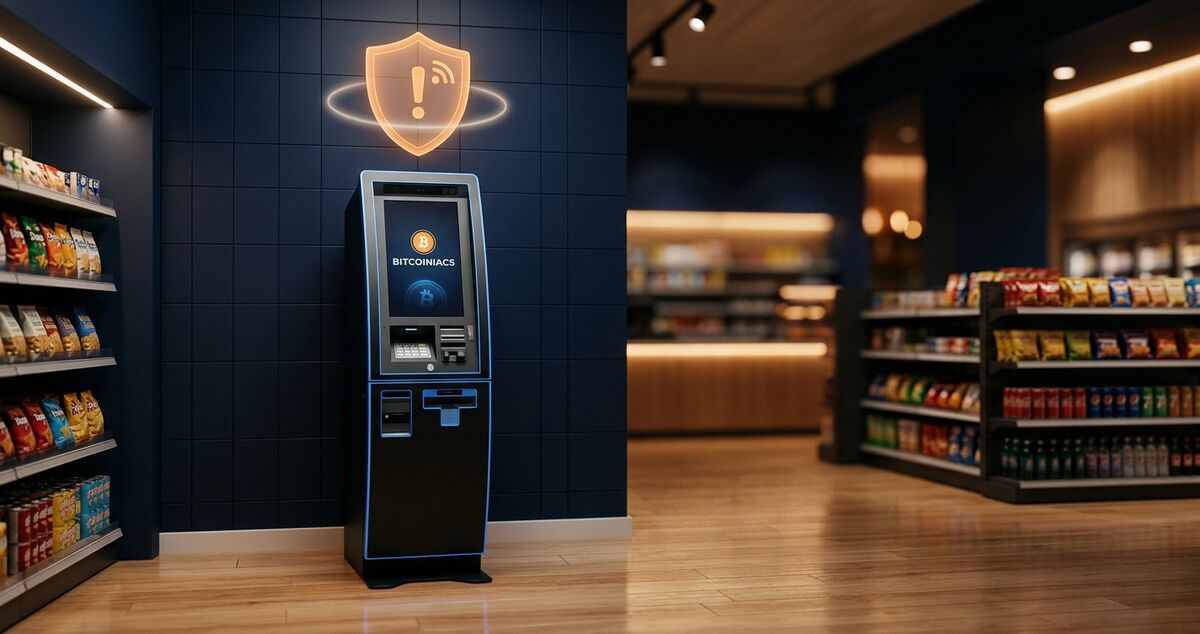
A bitcoin ATM scam doesn’t look like a hack or a heist. It looks like a normal machine in a corner store, and the scam happens before your money reaches the screen — usually through someone on the phone telling you what to type. Canada has more crypto ATMs per person than anywhere else in the world, and CBC News reported in 2025 that fraudsters increasingly use these machines to drain victims within minutes. Spotting the pattern is the most useful skill you can bring to a bitcoin ATM.
This guide covers how a bitcoin ATM scam actually works, the common versions circulating in Canada, the warning signs to check before you insert a single bill, and what to do if you’ve already been caught. The machine itself is rarely the problem — the instructions are.
Table of Contents
- How Bitcoin ATM Scams Work
- Common Bitcoin ATM Scams in Canada
- Warning Signs of a Bitcoin ATM Scam
- How to Protect Yourself When Using a Bitcoin ATM
- Buying Bitcoin Safely in Canada
- Frequently Asked Questions
How Bitcoin ATM Scams Work
The key thing to understand is that in almost every bitcoin ATM scam, the machine does exactly what it’s supposed to do. It converts cash to cryptocurrency and sends it to whatever address the user scans. It has no way of knowing whether that address belongs to the person standing there. Scammers don’t attack the machine — they attack the instructions.
The typical pattern looks like this. A scammer contacts the victim by phone, text, or a messaging app, posing as a government agency, a bank’s fraud department, a utility company, a tech support line, or even a romantic interest. The story always ends the same way: the victim needs to make an urgent payment, and the scammer walks them through it step by step. In a bitcoin ATM scam, that step-by-step walk includes the victim withdrawing cash, driving to the nearest bitcoin ATM, and — this is the critical part — scanning a QR code that the scammer sent them.
That QR code points to the scammer’s own bitcoin wallet. The moment the cash goes in, the machine converts it and sends it to that address — no bank to call, no dispute process, and the transaction is final within minutes. Fraud agencies in Canada and abroad have warned about exactly this combination — pressure, cash withdrawal, and a provided QR code — for years.
A secondary pattern involves the receipt: some victims photograph it for the scammer, handing over transaction and wallet details, or surrender a one-time code without knowing what it authorizes. Once you understand the pattern, every variety of bitcoin ATM scam is a costume change on the same script.
Why scam victims choose Bitcoin ATMs
Scammers steer victims toward bitcoin ATMs for practical reasons: the machines take cash, the transaction becomes irreversible within minutes, and the victim does the whole thing alone, with no bank employee asking why they’re withdrawing thousands of dollars for a stranger. If someone ever instructs you to use one of these machines, that instruction is the scam.
Common Bitcoin ATM Scams in Canada
Canadian police forces and fraud reporters describe the same few scenarios over and over. The details change — the fake agency, the fake emergency — but the mechanism is always a cash deposit into a wallet the victim doesn’t control.
Government and police impersonation
The victim gets a call that appears to come from the RCMP, the CRA, Service Canada, or their local police. The caller claims their identity was used in a crime or there’s a warrant with their name on it — and the only way to fix it immediately is to “secure” their money. That step is the tell: withdrawing cash and depositing it at a bitcoin ATM. Real police never take payment this way and never ask you to move money at all.
Bank fraud department scam
This one is nastier because it’s wrapped in protective language: your account has been “compromised,” the story goes, and the bank needs you to withdraw your funds and convert them to bitcoin so they can be held safely during the investigation. Sometimes the caller even spoofs your bank’s phone number. Converting savings to cryptocurrency with a QR code the caller supplies is the whole scam.
Romance and pig-butchering scams
Over weeks or months, someone builds an online relationship, then introduces a “trading opportunity.” Early deposits appear to show profits on a fake dashboard, designed to unlock larger deposits. Eventually the victim is sent to a bitcoin ATM to top up the “investment.” The relationship is real; the platform, the profits, and eventually the person are not.
Emergency and impersonation-of-a-loved-one scams
A text from a “child” or “grandchild” on a new number claims they’re in trouble — arrested, stuck abroad — and needs money immediately and quietly. Bitcoin ATMs are the payment method they insist on because they’re fast and irreversible. Any urgent, secretive money request through a QR code is an impersonation scam until proven otherwise; a call to the person’s real number breaks it instantly.
Fake operators and skimming hardware
The rarest category involves the machines themselves: QR-code stickers pasted over the machine’s real code, or a lone “operator” taking cash at an unbranded location. It’s uncommon with established operators, which is why the Canadian Anti-Fraud Centre advises reporting anything that looks tampered with. Before scanning, confirm the on-screen address matches what you expect — a sticker swap changes the destination silently.
The “investor” who needs you to buy for them
Someone offers to buy your Bitcoin “at a premium,” or asks you to act as the cash buyer at an ATM while they handle “the technical side.” You feed in the cash; the deal was fake from the start. The British Columbia Securities Commission regularly warns investors about schemes that route retail cash purchases through intermediaries for exactly this reason.
Warning Signs of a Bitcoin ATM Scam
Fraudsters rely on urgency to keep victims from thinking. Slowing down alone breaks most scams, but these signs are near-conclusive evidence that the caller is not protecting your money:
- Someone remote is instructing you through the machine. A legitimate bitcoin ATM transaction is self-directed and private. If anyone is coaching you in real time, by call, text, or shared screen, stop.
- You’re told to scan a QR code you were sent. The machine generates your destination options itself. Any QR code arriving by text, email, or a messaging app kicks the funds to whoever sent it.
- The story involves government agencies, police, banks, or lawyers demanding payment in crypto. None of these institutions accept bitcoin for fines, taxes, or “safekeeping,” and none will tell you to use a bitcoin ATM.
- Urgency, secrecy, or threats. “Your account will be frozen in one hour,” “don’t tell anyone,” “the warrant goes through tonight” — manufactured deadlines are the pressure that makes victims skip the call to verify.
- You’re asked for your PIN, a one-time code, an ID photo over the phone, or a receipt photo. Legitimate operators never need a code spoken to a caller, and a receipt photo handed to a stranger does the fraudster’s work for them.
- “Guaranteed returns” or a trading platform that must be funded in cash. Guaranteed anything is a red flag. Dashboards showing profits you can’t withdraw are props.
One more sign sits outside the phone call: the fee screen. If the machine you’ve walked up to quotes an exchange spread wildly out of line with normal Canadian operator fees, pause — it’s worth knowing what bitcoin ATM fees you should actually pay in Canada so an outlier rate registers as suspicious rather than normal.
How to Protect Yourself When Using a Bitcoin ATM
Protection is mostly a short checklist that happens before you’re in front of the machine:
- Hang up and verify. If any phone call or message is pressuring you toward a bitcoin ATM, end the conversation and call the organization back on a number you look up yourself. Government agencies and banks do not take crypto payments — that fact alone ends these attempts.
- Never send bitcoin to an address you didn’t choose. Addresses typed or QR-scanned from a text message belong to whoever sent the message. If you didn’t initiate the transaction for your own wallet, the cash isn’t yours for long.
- Use an operator you can identify. Use machines from named, registered operators, and be suspicious of hardware missing branding, stuck in an unlit corner, or showing signs of tampering.
- Know the KYC reality. In Canada, bitcoin ATM operators register as money services businesses and must identify customers and report certain transactions under FINTRAC rules — the same framework covered in our guide to bitcoin ATM ID requirements in Canada. ID asks at the machine are normal and even a small reassurance that you’re dealing with a compliant operator — not a scam.
- Verify what you bought. Confirm the machine’s transaction on the blockchain — our guide on how to verify a bitcoin transaction walks through checking a transaction ID and confirmations.
- Keep your receipt. It records the amount, the fee, the time, and the transaction ID — the exact things you’ll need for support, tracking, and taxes if anything goes sideways.
- Transfer to your own wallet. If you’re buying to hold, know the ATM’s usual flow — insert cash, confirm, receive — and plan to move the funds into a wallet you control rather than leaving them on a receipt.
If you’ve already been scammed
Move fast, and don’t be ashamed — these scripts are engineered to work on smart, careful people. Keep every receipt, text, call log, and the wallet address involved. Report to your local police, then to the RCMP’s National Cybercrime Coordination Centre reporting portal, which feeds the Canadian Anti-Fraud Centre’s central repository. Include the transaction ID; in some cases operators can flag a suspicious transaction while police investigate. And afterward, be wary of anyone promising to “recover” the crypto for a fee — that’s the same fraud wearing a recovery costume.
Buying Bitcoin Safely in Canada
None of this means bitcoin ATMs are something to avoid. They fill a real role for people who want to buy bitcoin with cash in one quick, private, self-directed transaction. The difference between a scam and a normal purchase comes down to one question: who decided where the bitcoin goes? In a legitimate purchase, the answer is you. In a bitcoin ATM scam, it’s someone on the other end of a phone line.
If you’re buying for yourself, plan the destination address before you leave home, set a fee expectation, and walk away if anything looks off. Our Bitcoiniacs ATM locations across Canada page lists every operating machine with its store address, so you can visit a known location rather than trusting whatever machine you stumble across. Once you’re holding bitcoin, sending your purchase to a wallet you control is the single best next step.
Frequently Asked Questions
Do all bitcoin ATMs require ID verification?
Canadian operators verify customers to comply with federal money services business rules — usually a phone number with a one-time code at minimum, and ID checks at higher amounts. A machine that demands no identification at all is a sign to walk away: it’s both a compliance failure and a magnet for fraud. An ID step at a named operator is expected, not a scam.
Are bitcoin ATM fees really that high?
Fees vary a lot by operator, and stories about extreme percentages circulate widely on Reddit. Established Canadian operators publish their rates — lower than the horror stories, higher than online exchanges. Knowing the normal range ahead of time means a wildly out-of-range rate registers as suspicious, which is one more way to spot a bad or fake machine.
How do I know the QR code at a bitcoin ATM isn’t a scam?
Ask where the QR code came from. If you scanned your own wallet app for the deposit, that’s a normal transaction. If the QR code was texted, emailed, or relayed through a messaging app — especially by whoever is coaching you through the machine — it goes to their wallet, not yours.
Can police trace a bitcoin ATM transaction?
Yes, more than most people expect. Transactions hit a public blockchain ledger, and registered Canadian operators keep customer and transaction records that regulators can compel. A bitcoin ATM transaction isn’t invisible — it’s pseudonymous but traceable. For victims, that’s good news: your transaction ID is evidence police can follow.
Can I get my money back after a bitcoin ATM scam?
Normally no — bitcoin transactions don’t reverse, which is exactly why scammers like these machines. What you can do is report immediately to police and the Canadian Anti-Fraud Centre with your receipts and transaction IDs, and stay alert for follow-up scams targeting fraud victims. Recoveries do happen, but they come from fast reporting, not from anyone who guarantees recovery for a fee.
The machine isn’t the threat — the script is. Buy for yourself, verify the destination, use named operators, and walk away from anything that arrives as a set of instructions from a stranger. The safest bitcoin ATM scam defense is the simplest one: if someone else has a plan for your money at that machine, it was never your transaction anyway.