


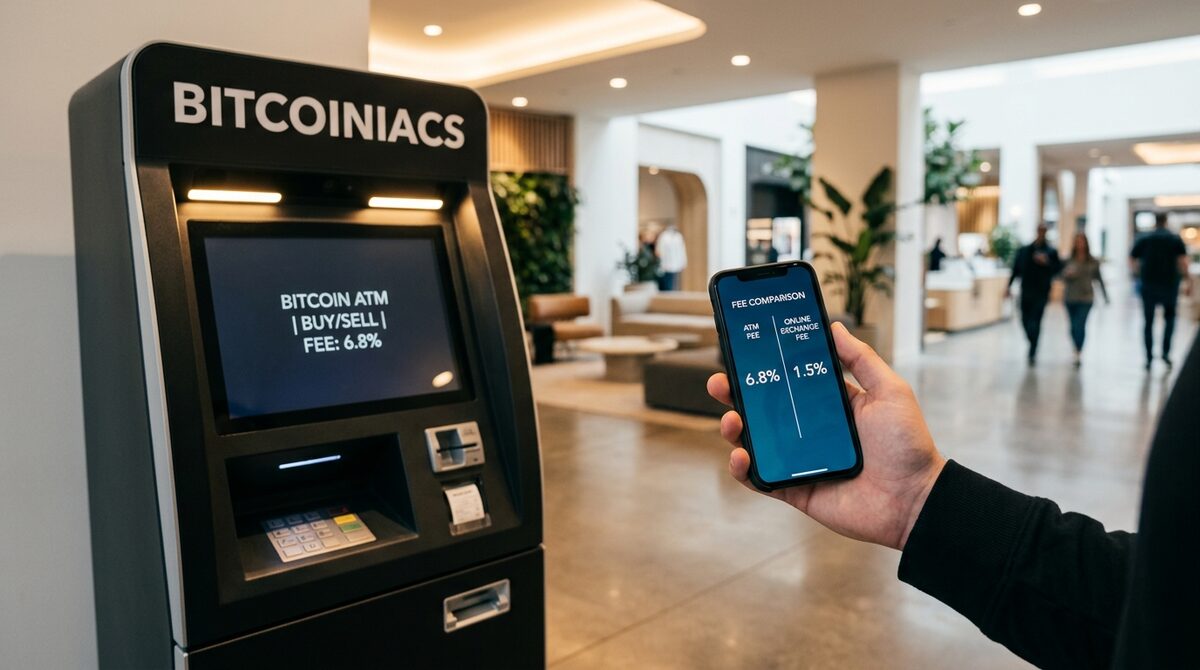
If you have ever stood in front of a Bitcoin ATM in Canada, stared at the screen, and thought “is this percentage normal?” you are not alone. Bitcoin ATM fees in Canada vary more than almost any other cost in the crypto space, and the price you see before you tap “buy” is not always the price the machine charges you. This guide covers what you actually pay in 2026, why the number moves, and how to read the screen so you never get surprised at the end.
By the end you will know how Bitcoin ATM fees in Canada are calculated, what the typical range looks like for both buying and selling, where the hidden spread lives, and how to compare an ATM quote to a spot price in about ten seconds. We will also touch on the regulatory layer, because in Canada a Bitcoin ATM is a registered money services business under federal rules, and that affects how fees are disclosed on screen.
Table of Contents
- How Bitcoin ATM Fees in Canada Are Calculated
- Typical 2026 Fee Ranges at Canadian Bitcoin ATMs
- The Spread: The Fee Most People Miss
- Buying vs Selling Fees and Daily Limits
- How to Compare an ATM Quote to the Real Bitcoin Price
- Frequently Asked Questions
How Bitcoin ATM Fees in Canada Are Calculated
Every Bitcoin ATM in Canada charges two things at once, and most people only see one of them.
The first is the transaction fee, a percentage added on top of the amount you insert. The machine shows this number as a flat line item before you confirm: “Fee: X%”. This is the part operators are required by FINTRAC’s compliance guidance to disclose clearly during the transaction flow.
The second is the spread, the gap between the price the ATM uses and the real market price at that second. If Bitcoin is trading at $100,000 on a major exchange and the ATM is pricing your purchase at $107,000, the 7% gap is part of what you pay, even though the screen may not label it as a fee. According to independent fee trackers like Coincub’s Bitcoin ATM fee analysis, the transaction fee is usually between 5% and 20%, and the spread is on top of that.
So when you ask “what are Bitcoin ATM fees in Canada,” the honest answer is: whatever the screen says, plus whatever the spread is at the moment you tap buy. Most reputable Canadian operators keep the combined cost between 8% and 14%. Anything consistently above 20% is a sign to walk away, and anything consistently below 5% is a sign the spread is doing the work silently.
Typical 2026 Fee Ranges at Canadian Bitcoin ATMs
Looking at the Canadian market in 2026, a few patterns hold.
Most independent Canadian operators, including Bitcoiniacs, sit in the 8% to 13% all-in range for buys and 4% to 8% for sells. Large US-headquartered networks operating in Canada (Bitcoin Depot, CoinFlip) often advertise 15% to 20% headline rates, with the spread sometimes narrowing for repeat customers. Smaller convenience-store machines and one-off operators in less-trafficked neighbourhoods can run higher because they handle fewer transactions per day, so each one covers more of the fixed cost of the hardware and the cash float.
Canada is still one of the densest Bitcoin ATM markets per capita in the world. According to the Bank of Canada’s 2025 staff discussion paper on cryptoasset ownership, roughly 10% of Canadians own Bitcoin as of the 2023 Bitcoin Omnibus Survey, one reason competition for transaction volume at the machine level stays high and keeps fees from drifting further upward. You can browse the live footprint of one operator on the Bitcoiniacs ATM locations page to see how dense the Canadian network is.
If you want a single number to anchor expectations, plan on roughly 10% all-in for a buy and 6% all-in for a sell at a well-run independent Canadian machine. That covers the visible fee and a fair spread, consistent with what operators report and what customers actually receive.
The Spread: The Fee Most People Miss
The spread is the part that catches people out. It is the difference between the Bitcoin price the ATM uses and the price on a major exchange at the same second, and it is built into the rate the machine offers you. You do not see it as a line item, which is why so many people walk away thinking they paid 8% when they actually paid 12%.
A quick way to see the spread in action: pull up a price tracker on your phone (Coinbase, Kraken, or any major exchange app), screenshot the live Bitcoin price, and compare it to the rate displayed on the ATM screen. If the ATM rate is 5% to 10% above the exchange price on a buy, that is the spread doing its work. If the spread is more than 10%, the machine is charging a hidden fee on top of its visible fee, and you are paying closer to 20% all-in. The Wikipedia entry on Bitcoin ATMs has a good general overview of how operators structure both fees and spreads.
The spread exists because the operator keeps a Bitcoin float ready to send the moment your cash clears, and that float has to be rebalanced constantly. It compensates for the cost of holding inventory and the risk of price moving in the few minutes between your cash going in and your Bitcoin going out. Legitimate cost, but it should be small, not the dominant part of what you pay.
Buying vs Selling Fees and Daily Limits
The fee structure is not symmetric. Sells almost always carry a lower all-in cost than buys, for two reasons.
First, the operator is buying your Bitcoin rather than selling it, taking on less price risk because the cash float is already in place. Second, the disclosure burden is the same, but customer flow is faster without a card or wallet input step. Across the Canadian market, a typical sell all-in cost lands between 4% and 8%, while a typical buy all-in cost lands between 8% and 14%. The spread depends on the operator, the city, and the time of day.
Daily limits are separate from fees. Under Canadian federal rules, a Bitcoin ATM is a money services business, and at higher transaction tiers the operator has to verify your identity in line with Bitcoin ATM daily limits in Canada. Most Canadian machines allow small buys with just a phone number and a wallet QR code, then require government ID once a transaction crosses the $1,000 mark, with full reporting kicking in at $10,000. The ID requirement does not change the percentage, but it adds a few minutes to the transaction at higher amounts.
How to Compare an ATM Quote to the Real Bitcoin Price
This is the part most guides skip, and it is the most useful ten seconds you can spend before any ATM transaction.
Open a major exchange app on your phone before you walk up to the machine. Note the current Bitcoin price in Canadian dollars. Then look at the ATM screen. The ATM shows a quote in the form of “X CAD = Y BTC” or “1 BTC = Z CAD”. The all-in cost is the gap between the ATM’s effective rate and the exchange rate, expressed as a percentage. If the ATM shows 1 BTC = $107,000 and the exchange shows 1 BTC = $100,000, you are paying 7% on that transaction, before any visible service fee. Add the visible service fee and you have your real all-in cost.
If the all-in cost is more than 15% on a buy, consider walking away and using a different machine, or check the Bitcoiniacs sell Bitcoin or ATM locations page to find a more transparent quote in your city. A fair machine in 2026 should never make you feel like you are guessing. The screen should show the percentage, the spread, and the final amount of Bitcoin, all before you commit cash.
One last note: never let anyone rush you through a Bitcoin ATM transaction. If the screen is asking you to send Bitcoin to an address you did not expect, or if someone is coaching you over the phone, stop. Real Bitcoin ATM fees in Canada are disclosed on the screen, and a real operator will never pressure you. The Bitcoiniacs scams guide covers patterns that target ATM users.
Frequently Asked Questions
What percentage do Bitcoin ATMs in Canada charge in 2026?
Most Canadian Bitcoin ATMs in 2026 charge an all-in cost of 8% to 14% for a buy and 4% to 8% for a sell. The all-in cost includes the visible transaction fee and the spread built into the exchange rate. Independent Canadian operators like Bitcoiniacs tend to sit at the lower end of that range, while large US networks often sit higher. Reddit users on r/BitcoinBeginners have reported individual machines charging 17% or more, a sign the spread is doing a lot of the work.
Why are Bitcoin ATM fees so high compared to crypto exchanges?
Bitcoin ATM fees are higher than exchange fees because the operator is doing more work per transaction. The machine has to accept physical cash, count it, verify it, send Bitcoin from a hot wallet, comply with FINTRAC reporting rules, keep a cash and Bitcoin float, and service the physical location. An exchange processes a digital transfer with no cash handling, so its cost per transaction is much lower. You are paying for the convenience of turning Canadian dollars into Bitcoin in minutes, with no signup, no bank link, and no waiting for a wire to clear.
Is there a way to avoid the spread on a Bitcoin ATM?
You cannot fully avoid the spread because it is built into the rate the machine offers you, but you can minimize it. Check the live Bitcoin price on a major exchange on your phone, compare it to the ATM quote, and look for machines where the spread is below 5%. Reddit users on r/Bitcoin have documented flat fees as low as $3 on smaller transactions, which is a fairer way to think about cost for first-time buyers than a percentage. The Bitcoin transaction itself, paid to miners, is separate and usually under $5 on the Bitcoin network in 2026.
Do Bitcoin ATM fees differ between buying and selling?
Yes, and the difference is significant. Sells almost always cost less than buys because the operator is taking less price risk on the cash side, and the transaction is simpler: a wallet QR code, a Bitcoin send, and a cash dispense. In Canada you can expect to pay roughly 4% to 8% all-in on a sell and 8% to 14% on a buy at a typical independent machine. Some Reddit users on r/BitcoinBeginners have reported 25% effective rates on small buys at machines with high percentage fees and a wide spread, which is why comparing to a live price quote before transacting matters.
Are Bitcoin ATM fees tax-deductible in Canada?
Bitcoin ATM fees are not directly tax-deductible, but they reduce your cost basis (or increase your proceeds) when you eventually dispose of the Bitcoin, which affects your capital gain or loss. The CRA treats crypto as property, and the folio on property investments covers how cost basis is calculated. Keep your ATM receipt, the timestamp, the exchange rate at the time, and the wallet address.
Bitcoin ATM fees in Canada in 2026 are reasonable when you understand what you are paying for. The visible fee covers the operator’s cost of running the machine, the spread covers the price risk of holding a Bitcoin float, and the all-in cost should land between 8% and 14% on a buy and 4% to 8% on a sell. Compare the ATM quote to a live exchange price on your phone, walk away from anything above 15% all-in, and keep the receipt for tax time.