


How long does a Bitcoin transaction take? On paper the answer looks tidy: the Bitcoin network aims to add a new block roughly every ten minutes, and a payment is normally treated as settled once it appears inside one. In real life the wait runs from a couple of minutes to several hours, because block spacing is random and the queue of waiting transactions shifts hour by hour. For Canadians buying through a Bitcoin ATM or an online exchange there is a second layer of timing as well — the gap between handing over cash and seeing coins confirmed on-chain. This guide walks through realistic timeframes, explains why they move, and shows you what to check when a transfer is running late.
Table of Contents
- How Long Does a Bitcoin Transaction Take in Practice?
- Why Speed Depends on the Mempool and Your Fee
- How Many Bitcoin Confirmations Do You Need?
- Bitcoin ATM Purchases: When Speed Works Differently
- What to Do When a Bitcoin Transaction Is Stuck
- Frequently Asked Questions
How Long Does a Bitcoin Transaction Take in Practice?
Ten minutes is the design average, not a guarantee. Blocks are found by miners on a random schedule, so one can land thirty seconds after the previous block and the next can take close to an hour. A transaction paying a competitive fee usually gets included in the next block or two, which puts most everyday transfers somewhere in the ten to forty minute range. When the network is busy, the same payment can sit for hours without anything being technically broken.
The milestone that matters for most retail use is the first confirmation. Before it, a payment is valid but not yet locked in: a miner could still leave it out of a block, and the coins remain spendable by the sender in a replacement scenario. That is why a wallet can show “sent” within seconds while the receiving side still shows “pending” — the network has simply not voted yet.
If you are buying in person, the clock starts at the machine. Our step-by-step walkthrough on how to use a Bitcoin ATM covers the cash-in flow from quote to wallet, including why the machine holds a price for only a short window before it sends coins.
Three different things get called “done”
It helps to separate broadcast, inclusion, and finality. Broadcast means your wallet told the network about the payment. Inclusion means a miner put it in a block. Finality is a judgment call: a merchant or exchange deciding the payment is deep enough in the chain that reversing it is impractical. Most confusion about slow Bitcoin comes from mixing those three up.
Why Speed Depends on the Mempool and Your Fee
The mempool is the waiting room. Every unconfirmed transaction sits there until a miner selects it for a block, and blocks have a size limit, so the network can only clear so much at once. Miners generally pick the most profitable transactions first, which means your position in line is set by how much you paid per unit of transaction data — a measure usually expressed as sats per vbyte. When the queue is short, even a modest fee clears quickly. When it is long, cheap transactions wait and expensive ones overtake them.
Transaction size matters as much as the fee rate. A payment that combines several small deposits into one spend is physically larger than a simple single-input payment, so it costs more to move. The Bitcoin developer documentation on transactions explains how inputs, outputs, and weight determine that size.
It is also worth separating the network fee from the price you pay to acquire coins. The mining fee is a small amount paid to the network to move bitcoin between addresses. The spread or service fee charged by a provider is a completely different line item. We break both apart in our guide to Bitcoin transaction fees in Canada, including which layer you can actually influence and which one you cannot.
Why fees spike without warning
Demand for block space is bursty. A wave of large transfers, an exchange running a batch payout, or a moment of market volatility can fill the mempool within minutes. Nothing about the Bitcoin protocol slows down or breaks in those moments — the clearing price for block space simply rises, and payments priced below it wait.
How Many Bitcoin Confirmations Do You Need?
One confirmation is plenty for a small purchase. Each additional block stacked on top of the one holding your transaction makes a reversal exponentially harder, which is why the informal rule of thumb has always been that larger amounts deserve deeper confirmation counts. Many exchanges credit deposits after two or three blocks; some ask for more. Merchants selling low-value items frequently accept the payment as soon as it is broadcast, accepting a small risk in exchange for speed.
The Bitcoin.org FAQ lays out the confirmation convention in plain language: waiting for a handful of blocks has long been the community standard for treating a large payment as settled, while small payments are routinely accepted with far less. If a receiving service quotes you a specific number, treat that service’s rule as the one that governs your transfer.
Zero-confirmation payments, briefly explained
A zero-confirmation payment is one accepted before any block includes it. It works well for small retail amounts because the merchant is trading a tiny theoretical risk for speed at the counter. It is not a sensible arrangement for expensive goods, and it is never a reason to hand over a private key or a one-time code to anyone.
Bitcoin ATM Purchases: When Speed Works Differently
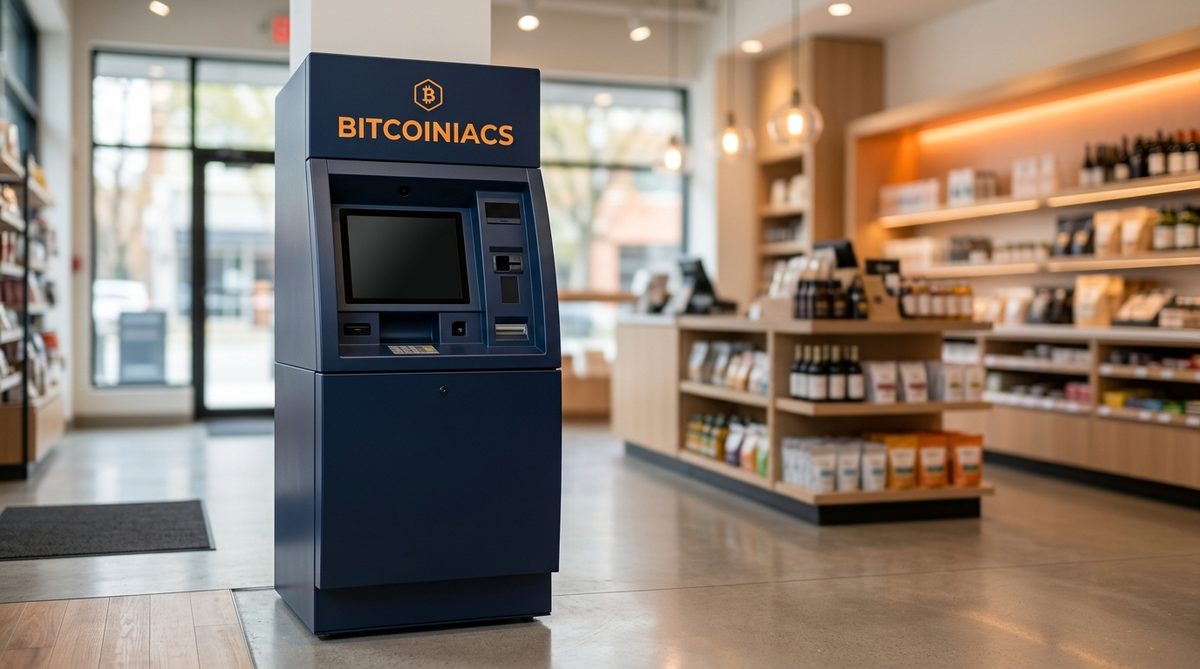
A Bitcoin ATM is a cash machine, not a bank terminal, and the timing has two parts. The first part happens at the machine: you insert cash, choose an amount, and scan the receive address from your wallet. The second part happens on-chain: the operator sends bitcoin from its own wallet to yours, and that transfer waits in the same mempool as any other payment. Depending on how the operator queues withdrawals, your coins can arrive quickly and then still take one or more blocks to confirm.
That second step is where most confusion comes from. People assume the machine hands over confirmed coins the way an ATM dispenses cash from a ledger that already exists. It does not. What you get is a broadcast transaction, and confirmation depends on network conditions after the fact. You can find our machines and operating hours through the Bitcoiniacs Bitcoin ATM locations directory.
If you would rather not wait on a walk-in purchase at all, a desk-based route through the Bitcoiniacs crypto exchange desk lets you arrange the purchase in advance so the on-chain leg is started at a time that suits you rather than at a kiosk on a busy Saturday.
Your wallet choice changes your wait
Scan the wrong kind of address and the wait becomes permanent. Bitcoin, Bitcoin Cash, and Ethereum addresses are not interchangeable, and a wallet that mixes them up can leave funds unreachable. Before you buy, confirm your wallet is showing an address for the right network and that you control the private keys or seed phrase — a custodial app is fine for small amounts, but a self-custody wallet gives you control over how the transaction is priced and sent later.
What to Do When a Bitcoin Transaction Is Stuck
First, get the transaction ID from your wallet and look it up in a public block explorer. If it appears with zero confirmations, it is in the mempool and simply waiting. If it does not appear at all, your wallet may not have broadcast it. Neither situation means the coins are gone, and neither is fixed by sending a second payment to the same address.
Second, check what your wallet supports. Some wallets let you replace a pending transaction with a higher-fee version, and some let you attach a follow-up spend that pays a miner to confirm both together. If your wallet supports neither, the realistic options are to wait for the queue to clear or to contact whoever sent the payment if it was not you.
Third, ignore anyone who approaches you with an offer to recover or unstick funds. Nobody legitimate needs your seed phrase, your one-time codes, or a transfer to a third-party address to help. The Ontario Securities Commission’s investor caution page sets out the pressure tactics to watch for, and the pattern is consistent: urgency, a guarantee of returns, and a request for access to your wallet or accounts. A slow transaction is a network condition, not an emergency that justifies handing over credentials.
Keep records as you go. For tax purposes you will want the Canadian dollar amount, the bitcoin amount, the quote and fees, the timestamp, your wallet address, the transaction ID, and the account statement showing the purchase. The Canada Revenue Agency’s crypto-asset guidance explains why buying and holding is treated differently from disposing of coins. Building a clean record at purchase time is far easier than reconstructing it months later while a transaction is still pending.
Frequently Asked Questions
How long do bitcoin transactions usually take?
The design target is one block every ten minutes, so a well-priced transaction typically confirms within one to two blocks — often under forty minutes. During quiet periods it can land in a few minutes; during heavy congestion the same transaction can wait hours. The honest answer is that the average is about ten minutes per block, and your specific payment is somewhere around that average with plenty of variance.
My transaction has been pending for over 24 hours. Is it lost?
Not lost. An unconfirmed transaction has not been included in a block, which means the coins are still in the sending wallet and no other transaction has spent them. Long waits usually mean the fee was priced too low for the queue at that moment. In most cases it either confirms once traffic clears or drops out of the mempool entirely and returns to your spendable balance.
Why did a low fee leave my payment stuck?
Because miners fill blocks with the most profitable transactions first. If the fee you set per unit of data sits below the current clearing rate, everyone above you gets picked and you keep waiting. This is not a penalty and no support agent can override it — the only fixes are raising the fee through a replacement transaction, combining it with a follow-up spend, or waiting for demand to fall.
Can I speed up a transaction that has already been sent?
Sometimes. If the original transaction was sent with replacement enabled, your wallet can rebroadcast it with a higher fee and miners will prefer the new version. Otherwise you can try attaching a child transaction that boosts the effective fee for both. If your wallet does neither, there is no lever to pull, and sending more bitcoin to the same address will not help.
Does buying at a Bitcoin ATM avoid transaction delays?
It changes where the delay sits, rather than removing it. The cash-to-quote part at the machine is immediate, but the bitcoin still has to travel from the operator’s wallet to yours on-chain, and that leg waits in the mempool like any other payment. Treat the machine step and the confirmation step as two separate clocks.
Bitcoin settlement time is a trade-off, not a defect. Confirmation is slow by design because no single party gets to decide what counts, and that trade-off is exactly what makes the network resistant to tampering. Once you know which clock you are watching — broadcast, first block, or deep confirmation — a pending payment stops feeling like something has gone wrong and starts looking like the network doing its job. If you are buying in Canada and want the timing explained before you commit cash, our team is happy to walk through it.