


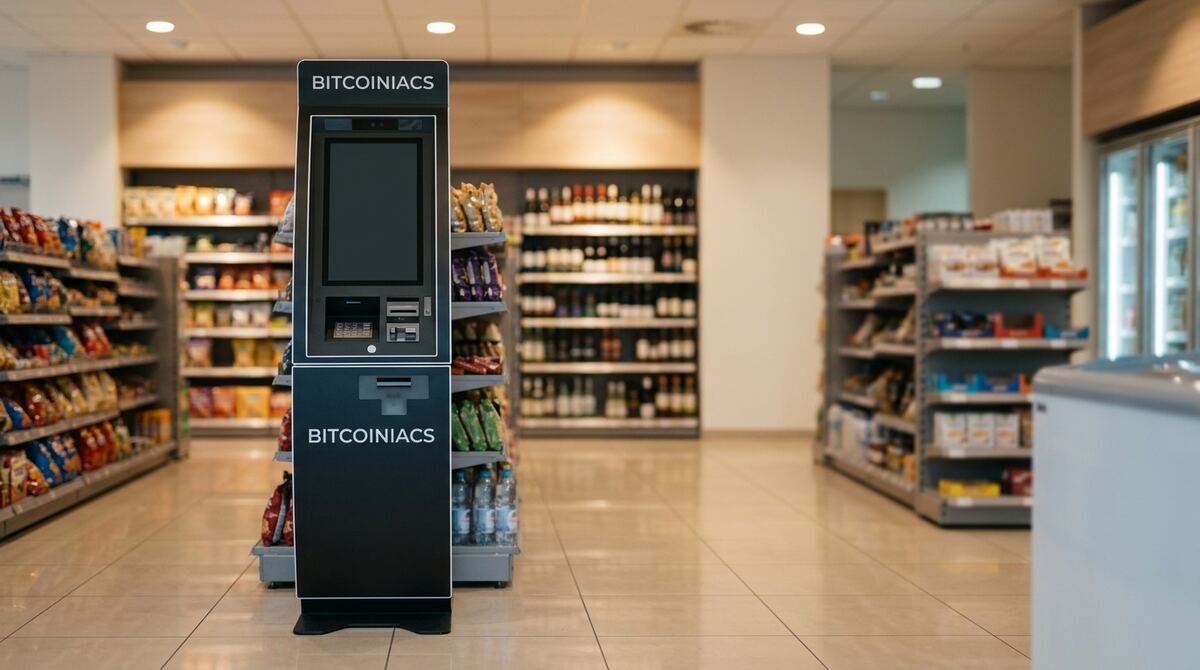
Buy bitcoin without a bank account in Canada is not a loophole or a workaround. It is an ordinary, legal cash purchase that happens thousands of times a day at Bitcoin ATMs across the country. The Bank of Canada found that bank notes were still used for about 20% of point-of-sale purchases in 2024, and a steady share of adults either cannot easily open a bank account or would rather not route every dollar through one. If you are new to Canada, paid in cash, rebuilding after a banking problem, or simply private about your money, you can still own bitcoin. This guide covers how cash purchases actually work, what identification you will be asked for, what the purchase really costs, and how to keep the coins safe afterwards.
Table of Contents
- Why Canadians Buy Bitcoin Without a Bank Account
- How to Buy Bitcoin Without a Bank Account in Canada
- What ID You Need at a Bitcoin ATM in Canada
- Cash vs Bank Transfer: What Changes Without a Bank Account
- Fees, Limits, and Staying Safe
- Frequently Asked Questions
Why Canadians Buy Bitcoin Without a Bank Account
The reasons people walk up to a cash machine instead of opening an exchange app are practical, not exotic. A newcomer who landed three weeks ago may not have a Canadian bank account yet, and a newly opened account is often restricted from crypto purchases for the first several months. Someone whose account was closed after a fraud flag, a bankruptcy, or a dispute can be shut out of the banking system for years. Tradespeople, restaurant staff, and gig workers paid partly in cash may not want to wait for a transfer to clear. Others simply want the purchase to stay between them and the machine.
Cash has not disappeared in this country. The Bank of Canada’s Methods-of-Payment Survey reports that bank notes were used for roughly 20% of point-of-sale purchases in 2024 and accounted for 11% of transaction value, while the average Canadian carried about $156 in cash. That is a large and completely ordinary slice of the economy, and Bitcoin ATMs exist because the demand behind those notes is real.
Cash is not the same as anonymous
One clarification before anything else. Paying with cash at a Bitcoin ATM does not make a transaction anonymous or exempt from reporting rules. Canadian Bitcoin ATM operators are money services businesses. They verify identity, keep records, and file reports above set thresholds. What cash buys you is simplicity and immediacy, not invisibility.
How to Buy Bitcoin Without a Bank Account in Canada
Buying with cash is a three-part process. Set up a wallet, bring cash to a machine, then complete the purchase on screen. None of those steps requires a bank account, a credit check, or a linked card.
Step 1: Set up a wallet first
You need a Bitcoin wallet before you reach the machine, because the ATM has to send the coins somewhere. A phone wallet is fine for a first purchase. Install it from the official app store listing, then write the recovery phrase on paper and store that paper somewhere safe. Never photograph the phrase, never type it into a website, and never share it with anyone who offers to “help.” Whoever holds that phrase holds the bitcoin.
Step 2: Bring cash and find a machine
Bitcoin ATMs take Canadian bank notes. They do not accept debit cards or credit cards, and they cannot pull funds from an account, which is exactly why they work for someone without a bank. If you have never used one, our step-by-step guide to using a Bitcoin ATM walks through the screen flow from scanning your wallet to watching the confirmation arrive.
Step 3: Complete the purchase
At the machine you scan your wallet’s receive QR code, insert your notes, confirm the rate shown on screen, and wait for the transaction to be broadcast to the network. Coins normally land in your wallet within minutes, though a confirmation or two may be needed before some apps display the balance. If cash is going to be your main rail, the guide to buying Bitcoin with cash in Canada goes deeper into limits, receipts, and what each step costs.
What you still cannot do without a bank account
Be realistic about the limits. Selling a large position for a deposit, funding an online exchange, and receiving an Interac e-Transfer all need banking rails. Cash in and cash out at a two-way ATM is the alternative path, and it caps how much you can move in a day.
What ID You Need at a Bitcoin ATM in Canada
This is the part people get wrong. You do not need a bank account, but you do need identification. That requirement comes from federal anti-money-laundering law, not from the operator’s personal preference. FINTRAC’s guidance on verifying the identity of persons sets out the accepted methods, including government-issued photo identification and a dual-process method that combines two reliable sources of information.
In practice, most Canadian Bitcoin ATMs ask for a government photo ID such as a provincial driver’s licence, a provincial photo card, or a passport, and may also ask for a mobile number. Thresholds vary by operator and province, with lighter checks on small purchases and full verification on larger ones. For a breakdown of typical limits and accepted documents, see ID requirements at Bitcoin ATMs in Canada.
What “no bank account” actually changes
Almost nothing about identification. An ID document proves who you are. A bank account proves where your money sits. They are separate things, and an operator verifying your identity is checking the first one. Being unbanked is not a barrier to buying, and it is not treated as suspicious on its own.
If you do not have Canadian photo ID yet
Newcomers waiting on a provincial card should ask before travelling. A foreign passport is commonly accepted as government-issued photo identification, but acceptance is decided by the operator and can differ from machine to machine. A quick call or message ahead of time saves a wasted trip.
Cash vs Bank Transfer: What Changes Without a Bank Account
Without a bank account, the funding rails most people use to buy bitcoin are closed off. Interac e-Transfer needs a bank or credit union account. Pre-authorized debits need an account. Card purchases need a card, and Canadian issuers decline crypto transactions as a risk category often enough that a card is unreliable even when you have one. What remains is cash, and cash is the one rail that asks nothing of your banking history.
The trade-off is price and speed in opposite directions. A Bitcoin ATM is immediate: no verification queue, no waiting on a transfer to settle, no account to be approved for. In exchange, the machine sells at a spread above the live market rate, and that spread is how the operator covers the hardware, the cash logistics, the retail space, and compliance. Compare the all-in cost, not just the headline rate, and never fund a purchase with borrowed money or a cash advance.
Your tax obligations do not change
A cash purchase is still a purchase. When you later sell, spend, or swap that bitcoin, the disposal has tax consequences. The CRA’s guidance on reporting income from crypto-asset transactions explains that using crypto to pay for goods or services is treated as a barter transaction, and that capital gains or business income from a disposition must be reported.
Keep your own records
Because no bank statement will ever show this purchase, your records are the only paper trail you will have. Keep the CAD amount, the BTC amount, the quoted rate, the fees, the timestamp, the receiving wallet address, and the transaction ID. Photograph the receipt the machine prints and file it with your tax documents. Six years of clean records turns a stressful audit question into a two-minute answer.
Fees, Limits, and Staying Safe
Know the two numbers before you insert money: the buy rate and the daily cap. Ask what rate the machine is quoting and compare it against a live market quote on your phone. Then ask what your limit is for the day and whether verifying more information would raise it. Operators are required to apply limits, and those limits exist to protect customers as much as to satisfy regulators. Do not split purchases across machines or days to stay under a threshold, because structuring is itself a reportable pattern.
Scam warning signs
Bitcoin ATM fraud is one of the most common ways Canadians lose money to crypto scams, and it follows a script. Someone you met online, a caller claiming to be from a government agency, a bank, or tech support tells you a payment is required in bitcoin, stays on the phone with you, and talks you through the machine step by step. Stop immediately if anyone asks you to send bitcoin to a wallet address they provided, asks for your recovery phrase, asks for a one-time code, or creates urgency about a payment. The Canadian Anti-Fraud Centre documents these patterns and accepts reports. No legitimate tax agency, utility, police service, or bank collects payment in bitcoin.
When you are ready, find the Bitcoiniacs ATM location nearest you, check the hours, and bring the cash you intend to spend plus a government photo ID.
Frequently Asked Questions
Do all Bitcoin ATMs require ID?
In Canada, yes, at least for anything beyond a small purchase. Operators are money services businesses under federal rules, so they must verify identity once a transaction crosses the reporting threshold. Below that threshold, verification can be lighter, but the exact cut-off differs between operators and provinces. Assume you will need a government photo ID and bring one. It is the single most common reason a first visit fails.
Can I buy bitcoin with paper cash in Canada?
Yes. Cash is the standard funding method at a Bitcoin ATM, and it is the reason those machines exist. You insert Canadian bank notes directly into the machine, the coins are sent to the wallet address you scan, and no bank account or card is involved at any point. It is also the fastest rail available, because nothing has to clear through a financial institution.
Can I buy bitcoin in Canada with no ID at all?
Not reliably. Regulated Canadian operators cannot skip identity verification entirely, and any service claiming otherwise is either operating outside the rules or setting up a scam. If you have no Canadian photo ID yet, a foreign passport is often accepted. Ask the operator before you travel to a machine rather than assuming.
Why would anyone use a Bitcoin ATM instead of an exchange?
Three reasons come up constantly: cash, speed, and access. Exchanges require a funded bank account, a verification review that can take days, and in many cases a declined card when you try to deposit. A Bitcoin ATM takes notes, sends coins within minutes, and never asks about your banking history. The trade-off is a higher spread, which is the price of immediacy.
My bank declined my crypto purchase. What are my options now?
Bank declines on crypto transactions are common and usually policy rather than a mistake on your part. Switching banks can work, but it means waiting for new cards and re-verifying accounts. Buying with cash at a Bitcoin ATM sidesteps the problem entirely because no card and no account is involved. If you are declined repeatedly, that is the simplest route to a completed purchase.
Not having a bank account closes some doors in Canada, but it does not close this one. Cash in, coins out, at a machine that takes minutes. Do the wallet setup properly, bring photo ID, understand the spread before you commit, and keep a receipt for every purchase. That is the whole method, and it works the same way whether you are three weeks into a new country or twenty years past your last bank statement.