


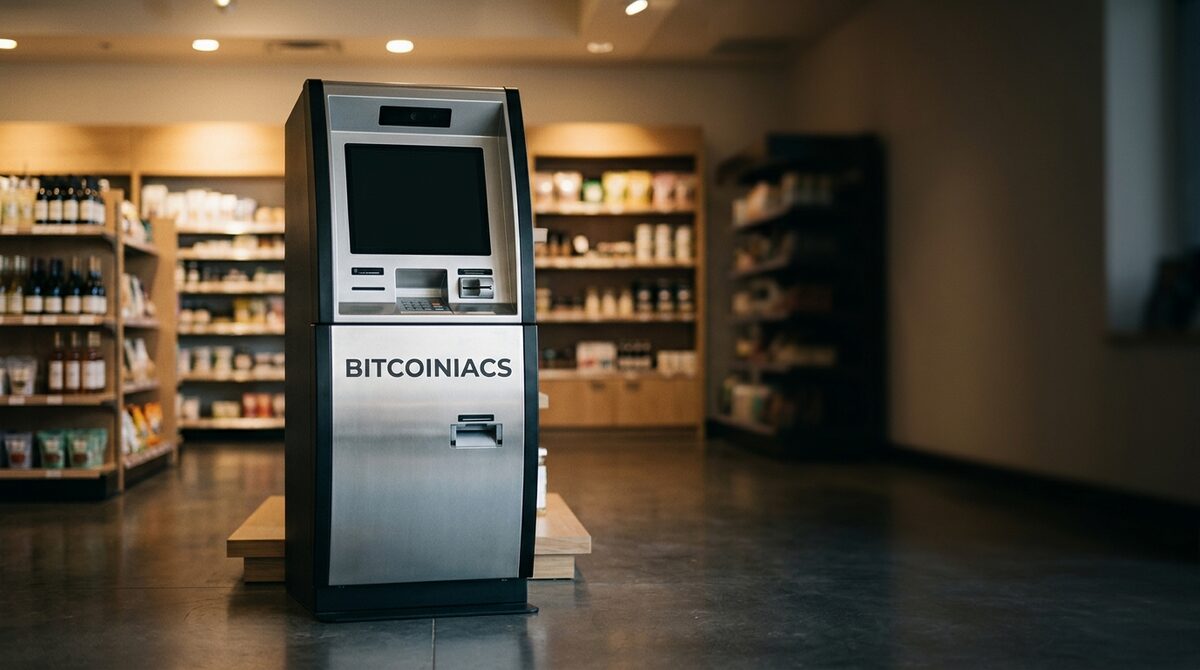
If you want to buy Bitcoin in Delta BC without waiting days for a bank transfer or sitting in an exchange verification queue, a cash machine is the fastest route. Delta is really three communities in one — North Delta, Ladner and Tsawwassen — and only one Bitcoin ATM sits inside the city limits, at the Silver Moon Store on 120 Street. That single machine is enough to turn cash into Bitcoin in a few minutes, but only if you know what to bring, what it costs, and what to do with the coins afterwards. This guide covers the machine, the steps, the fees, the limits and the safety rules that matter in Delta.
Table of Contents
- Where to Buy Bitcoin in Delta BC
- How to Buy Bitcoin at a Delta ATM Step by Step
- Bitcoin ATM Fees and Limits in Delta
- Buying Bitcoin in Delta Safely
- Taxes and Records When You Buy Bitcoin in Delta BC
- Frequently Asked Questions
Where to Buy Bitcoin in Delta BC
The Bitcoiniacs machine inside the Silver Moon Store at 8603 120 Street is the only Bitcoin ATM operating in Delta. It sits in North Delta along the Scott Road corridor, a few minutes from the Alex Fraser Bridge and a short drive from both Ladner and Tsawwassen. Full hours, a map pin and directions are on the Bitcoiniacs Silver Moon Store ATM in Delta location page.
What the Delta Machine Actually Does
This location is a buy-only machine. You feed it Canadian cash, tell it which wallet address should receive the Bitcoin, and it broadcasts the coins to the Bitcoin network on your behalf. There is no option to sell Bitcoin for cash at this specific kiosk, so if you are looking to convert coins back into banknotes you will need to travel to a two-way machine in Surrey, Richmond or Vancouver — the full list is on the Bitcoiniacs ATM locations page.
Because it is a cash machine, it does not accept debit cards, credit cards or Interac e-Transfer. You bring banknotes. That matters for two reasons: cash purchases avoid the card-network fees and cash-advance interest that come with credit cards, and they avoid the foreign exchange markup some issuers add when a crypto provider bills in another currency.
Getting There From Ladner, Tsawwassen and North Delta
From North Delta you are already there — 120 Street is the main north-south spine of the community. From Ladner, take Highway 17 north and cross onto the Scott Road corridor. From Tsawwassen, the same route adds roughly ten minutes. Transit users can reach the corridor on the 319 and 312 routes that run along Scott Road. If you are new to the area, the City of Delta publishes community pages for Ladner, Tsawwassen and North Delta that map out each town centre.
Plan your visit for store hours rather than a quiet afternoon. The machine lives inside a working retail shop, so a staff member is usually nearby if a step does not go the way you expected.
How to Buy Bitcoin at a Delta ATM Step by Step
The whole transaction takes about five minutes once you have a wallet ready. The order of operations below is what keeps it that short.
- Install a wallet before you leave home. You need an app or device that can receive Bitcoin and show you a receiving address. Do this at home on wifi, not standing in front of the machine on mobile data.
- Open the wallet and copy your receiving address. Confirm the first and last four characters match after you paste. Bitcoin addresses cannot be reversed, so a wrong character sends your coins to a stranger.
- Bring clean Canadian banknotes. The machine reads paper currency. Wrinkled, torn or taped bills may be rejected.
- Start the transaction and follow the on-screen prompts. The machine will display the rate it is applying before you commit. Read it, then decide.
- Scan your wallet’s QR code or paste the address. Check the address on the screen against the address in your wallet one more time.
- Feed the cash and confirm. The machine counts the notes and shows the total.
- Wait for the confirmation. Your wallet will show the coins once the transaction is broadcast and confirmed by the network.
Before You Leave Home: The ID Question
Canadian Bitcoin ATMs are operated by businesses regulated under federal anti-money-laundering rules, which means identification requirements are set by law rather than by the shop owner’s mood. Small transactions below the verification threshold usually go through without showing ID, while larger ones require a scan of a government photo ID. The exact thresholds and accepted documents are explained in our guide to ID requirements at Canadian Bitcoin ATMs. Bring your driver’s licence or passport anyway — if the machine asks, you will be glad you did.
Bitcoin ATM Fees and Limits in Delta
Every Bitcoin ATM charges for the convenience of instant cash-to-Bitcoin settlement, and the total cost has more than one layer. Understanding the layers is how you avoid surprises:
- Provider fee or spread. The machine applies its own rate, which sits above the global spot price. This is the machine operator’s revenue.
- Network fee. A small amount of Bitcoin is consumed to get your transaction mined into a block.
- Issuer costs. Not applicable here, because the Delta machine takes cash. If you were paying by credit card elsewhere, you could add processor fees, foreign exchange and possible cash-advance interest.
The honest way to compare is to look at the amount of Bitcoin you receive for a fixed amount of cash, then compare that against what the same money would buy at the spot rate. The machine shows you its rate before you confirm, so the comparison takes ten seconds. Our breakdown of Bitcoin ATM fees in Canada explains how those layers stack up on a typical purchase.
Limits work in two directions. The machine enforces a per-transaction maximum, and the operator enforces daily and rolling limits per customer. Separately, Canadian law requires money services businesses to report large virtual currency transactions to FINTRAC once a transaction reaches the reporting threshold — the large virtual currency transaction reporting guidance sets that threshold at $10,000 in Canadian funds. If you plan to buy more than a machine’s single-transaction cap, expect to split it across days rather than trying to force it through in one visit.
Buying Bitcoin in Delta Safely
Bitcoin ATMs have become a favourite tool of fraudsters, and almost every victim story follows the same script: someone is told to hurry, told the money is guaranteed, and told to keep it secret. A legitimate transaction never involves any of those three things.
- Urgency is the tell. A caller claiming to be police, the CRA, your bank’s fraud department, a utility or a tech support line who insists you pay in Bitcoin immediately is running a scam. Real institutions do not demand Bitcoin, and no government agency collects taxes in Bitcoin.
- Nobody legitimate asks for your seed phrase. Your twelve or twenty-four word recovery phrase is the wallet. Anyone who asks for it — support agent, “wallet validator”, online form — is stealing from you.
- One-time codes belong to you alone. A verification code sent to your phone is a key to your account, not a payment method to read out loud.
- Send only to addresses you control. If a stranger or an investment platform supplies the wallet address, the coins are gone the moment they leave the machine.
- Guaranteed returns do not exist. Anyone promising fixed daily profits on Bitcoin is describing a Ponzi structure, not an investment.
Before you use any machine, you can confirm that the operator is actually registered to provide money services in Canada. FINTRAC maintains a public Money Services Business Registry where you can look up a company name and see its registration status. The BC Securities Commission’s investor education site also maintains a plain-language list of fraud warning signs worth reading before any crypto purchase.
Taxes and Records When You Buy Bitcoin in Delta BC
Buying Bitcoin with cash is not itself a taxable event in Canada. Disposing of it is — selling, trading, or spending it to buy goods and services can trigger a capital gain or loss, and the Canada Revenue Agency expects you to be able to show your cost basis when that happens.
That makes record keeping part of the purchase, not an afterthought. For every ATM transaction, keep:
- The amount of Canadian dollars you inserted
- The amount of Bitcoin you received, in BTC or sats
- The rate the machine quoted and the fee it charged
- The date and timestamp of the transaction
- The wallet address that received the coins
- The transaction ID from the machine receipt or your wallet
- Any receipt, email confirmation or bank statement that supports the purchase
A photo of the machine receipt plus a screenshot of the transaction in your wallet takes twenty seconds and answers most questions later. If you buy regularly, keep the records in one folder rather than scattered across camera rolls.
Frequently Asked Questions
Do all Bitcoin ATMs in Canada require ID?
No, but most will require it at some point. Machines generally let smaller cash purchases through without identification, then ask for a government photo ID once a transaction or a rolling daily total passes the verification threshold set by federal anti-money-laundering rules. In practice that means a modest first purchase is usually frictionless, while a larger one involves scanning your driver’s licence or passport at the machine.
How long does it take for the Bitcoin to arrive after I pay?
Usually a few minutes, occasionally longer. Once the machine broadcasts your transaction, the coins are visible in your wallet almost immediately as an unconfirmed balance, and they become confirmed once the Bitcoin network mines them into a block. Network congestion is the variable — when the mempool is busy, confirmation can take considerably longer even though your transaction was sent right away.
Why would anyone use a Bitcoin ATM instead of an online exchange?
Speed and privacy of process. An exchange requires an account, identity verification, a funding method and a waiting period before you can trade; a cash machine turns banknotes into Bitcoin in one visit with no bank account involved. People use them for immediate purchases, for buying in cash without linking a bank account, and because they are the only option when a bank transfer is not practical.
Are Bitcoin ATM fees really that high?
They are higher than an online exchange, and that is the trade-off for instant cash settlement. The headline number people quote usually lumps the operator’s rate spread together with the network fee, which is much smaller. The practical approach is to compare the Bitcoin you receive for a fixed cash amount against the spot price, and to keep transactions reasonable in size so the fixed cost of the visit does not dominate the purchase.
What should I do if my ATM transaction is taking a long time?
First check your wallet’s transaction list — if the transaction appears as unconfirmed, the machine did its job and the network is simply busy. Wait for a confirmation rather than starting a second purchase, because buying again sends new coins to the same address and makes the original payment look unresolved when it is not. If nothing appears in your wallet at all after a reasonable wait, bring your receipt and the receiving address back to the store and contact the operator with the transaction details.
Delta’s single Bitcoin ATM covers the whole city well enough for a cash purchase, and knowing the steps in advance is what makes it a five-minute errand instead of a frustrating one. Bring cash, bring a wallet address you control, check the rate on screen before you confirm, and keep the receipt. That is the entire formula for buying Bitcoin in Delta BC without a surprise at the end.