


UTXO stands for Unspent Transaction Output. In plain terms, it is a specific piece of bitcoin you received from somewhere that has not been spent yet. Once you spend it, the piece is consumed entirely and replaced by new UTXOs covering whatever you paid and whatever change you got back.
Why does my wallet have dozens of UTXOs and is that bad?
It is not automatically bad, but it has consequences. Each incoming payment creates a new UTXO, so regular small deposits pile up. When you later send bitcoin, every input adds vbytes and pushes the fee upward. A wallet holding its value in one piece sends the same payment for less total fee. For casual holders it is a mild inefficiency; for heavy daily spenders it becomes worth consolidating.
What is Bitcoin dust?
Dust refers to UTXOs so small that spending them costs more in transaction fees than they are worth. If a UTXO holds 500 sats and spending it costs 2,000 sats in fees, its best use is to sit there until fees collapse or you are willing to take a loss on moving it once to clean up. Dust accumulates through micro-deposits and change churn. It is not lost, only uneconomical to move at current fee rates.
Do UTXOs affect my privacy in Canada?
Yes, significantly. Every UTXO is publicly visible on the blockchain with its full spending history. Reusing the same address for many receipts links them together and makes your overall balance easy to track, and anything you send from those UTXOs inherits the same visible history. Anyone in your country can run analytics on a wallet by piecing together its UTXOs, Use fresh addresses, and treat privacy as a habit rather than a setting.
The Bitcoin UTXO model is the backbone of every wallet you will ever use. It explains your balance, your fees, your dust, and your privacy footprint with one framework instead of five separate answers. Once you can picture your holdings as discrete pieces rather than a bank-style number, everything else about Bitcoin transactions, from change addresses to coin control, starts making intuitive sense without memorization. And when you are ready to build a position one piece at a time, a cash purchase at a Bitcoiniacs ATM creates exactly the kind of fresh UTXO that is easy to move into secure storage later.
Yes, functionally it is the same number. Your wallet balance is only a display figure that adds up all the UTXOs your wallet controls. At 0.05 BTC on screen you might own five pieces of 0.01, or one of 0.05, or three of 0.017, 0.02, and 0.013 plus change. The balance view is a summary. The UTXO view is what actually exists on-chain.
What does UTXO stand for, in simple terms?
UTXO stands for Unspent Transaction Output. In plain terms, it is a specific piece of bitcoin you received from somewhere that has not been spent yet. Once you spend it, the piece is consumed entirely and replaced by new UTXOs covering whatever you paid and whatever change you got back.
Why does my wallet have dozens of UTXOs and is that bad?
It is not automatically bad, but it has consequences. Each incoming payment creates a new UTXO, so regular small deposits pile up. When you later send bitcoin, every input adds vbytes and pushes the fee upward. A wallet holding its value in one piece sends the same payment for less total fee. For casual holders it is a mild inefficiency; for heavy daily spenders it becomes worth consolidating.
What is Bitcoin dust?
Dust refers to UTXOs so small that spending them costs more in transaction fees than they are worth. If a UTXO holds 500 sats and spending it costs 2,000 sats in fees, its best use is to sit there until fees collapse or you are willing to take a loss on moving it once to clean up. Dust accumulates through micro-deposits and change churn. It is not lost, only uneconomical to move at current fee rates.
Do UTXOs affect my privacy in Canada?
Yes, significantly. Every UTXO is publicly visible on the blockchain with its full spending history. Reusing the same address for many receipts links them together and makes your overall balance easy to track, and anything you send from those UTXOs inherits the same visible history. Anyone in your country can run analytics on a wallet by piecing together its UTXOs, Use fresh addresses, and treat privacy as a habit rather than a setting.
The Bitcoin UTXO model is the backbone of every wallet you will ever use. It explains your balance, your fees, your dust, and your privacy footprint with one framework instead of five separate answers. Once you can picture your holdings as discrete pieces rather than a bank-style number, everything else about Bitcoin transactions, from change addresses to coin control, starts making intuitive sense without memorization. And when you are ready to build a position one piece at a time, a cash purchase at a Bitcoiniacs ATM creates exactly the kind of fresh UTXO that is easy to move into secure storage later.
Under the hood, a Bitcoin transaction has two lists. Inputs are references to earlier, unspent outputs you control. Outputs are new locked chunks: one going to your recipient and one going back to you as change. The fee is simply the difference between what was consumed and what was produced.
Here is the rule that surprises everyone: a UTXO must be spent in its entirety. If you want to send 300,000 sats and your only UTXO holds 1,000,000 sats, your wallet builds a transaction with two outputs. The first sends 300,000 sats to your recipient. The second sends roughly 699,000 sats back to one of your own addresses as change, minus the miner fee. That change output is a brand-new UTXO that belongs to you and sits in your wallet until you next spend.
This also explains transaction fees better than any surface explanation. The fee scales with transaction size, and transaction size scales mostly with how many inputs you consume. Paying with one UTXO makes a small transaction. Paying with fourteen UTXOs makes a big one that costs more to broadcast. Our guide on Bitcoin transaction fees in Canada digs into that mechanic in detail, and the UTXO model is the foundation underneath it.
UTXO Example: A Canadian ATM Purchase in Action
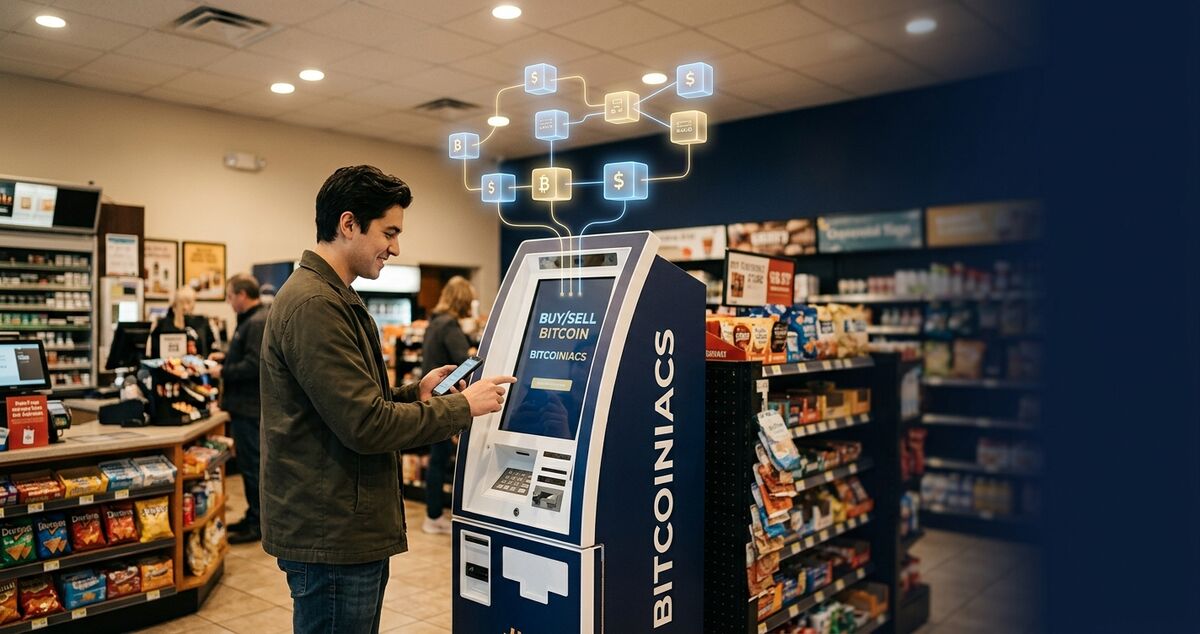
Suppose you are visiting a Bitcoiniacs ATM location and you insert $100 in Canadian cash to buy bitcoin. The network does not know you are Canadian, does not know you prefer cash, and does not care about any “Bitcoiniacs account.” It sees one transaction leaving the operator’s hot wallet with a new output locked to your wallet address for however much bitcoin $100 buys at the current rate. When the transaction confirms, that output is your UTXO. Your wallet detects it and your balance ticks up by exactly that amount.
Now imagine the same thing happens three Saturdays in a row. Each visit creates its own transaction and each transaction creates its own output. You now hold three separate UTXOs, each valued at whatever $100 worth of bitcoin cost that day, and your wallet displays them as one balance. Nothing was merged in the meantime because the Bitcoin network has no merge operation to run. It never merges anything. Consolidation is deliberately left to you, which brings us to the dust problem.
The same logic applies in reverse when selling. If you have read the guide to selling bitcoin for cash in Canada, you have seen this from the other side: the UTXO you present to the ATM is the one that gets consumed, and whatever change you keep comes back as a fresh UTXO with new ownership conditions attached.
Bitcoin Dust: Small UTXOs and Your Accumulating Balance
Dust is bitcoin in pieces so small that spending them costs more in fees than they are worth. There is a formal threshold, but the intuitive definition carries most of the weight: if the output is worth less than the fee required to spend it later, it is essentially frozen. River’s UTXO explainer frames dust this way: dust is bitcoin that has become uneconomical to use.
How does a wallet end up dusty? Two main paths. The first is receiving tiny amounts repeatedly, from small purchases, micro-payments, or faucet-style apps, without ever consolidating. The second is change output churn, where frequent small spenders generate lots of small change UTXOs over time. Both produce a wallet holding hundreds of individually owned pieces that must each be presented as an input whenever the wallet spends.
Enter vbyte fees. A transaction’s fee is calculated per virtual byte, and every additional input adds vbytes. A wallet with forty dust UTXOs sending a simple payment would need a transaction stuffed with forty input signatures, and that transaction can easily cost more than any of the individual pieces it carries. This is why some wallets quietly avoid dust or warn you about it, and it is why a balance that looks healthy on screen may be awkward in practice. The River deep dive on Bitcoin’s UTXO model covers vbyte math in more depth if you want the full walk-through.
UTXO Consolidation: When It Makes Sense
Consolidation means sending several UTXOs to one of your own addresses in a single transaction so they come out the other side as one bigger UTXO. It costs one transaction’s worth of fees today and buys you lower fees on every future spend, because your wallet will stop stuffing dozens of inputs into your payments.
Three guidelines. First, consolidate when the mempool is quiet so the fee you pay is modest. Second, consolidate toward bigger UTXOs, not toward one trillion tiny ones; a wallet with a handful of larger chunks is simpler and cheaper to manage than a swamp of dust. Third, when you buy bitcoin in cash at an ATM and intend to hold for years, consider consolidating occasionally rather than letting every $50 purchase linger as its own output forever. Frequent small purchases add friction later, whether you eventually transfer everything to a hardware wallet, send it to an exchange, or cash out. The same goes if you are learning how to transfer bitcoin to a wallet after buying, since a move of many small UTXOs costs more than a move of one consolidated chunk.
Why UTXOs Matter for Privacy
Because UTXOs are individually wrapped, each piece carries its own life story. Once a piece is spent, it is spent, and its history on block explorers is public. Activities like mixing, peeling chains, and chain analysis all operate on this granularity. Regulators, exchanges, and analytics firms all reason in terms of UTXOs, not balances, so they can see exactly which pieces travelled where.
For Canadian users the practical takeaways are simple. Do not reuse one address for years, use fresh addresses by default, keep personal and business spending in separate wallets, and never treat a receiving address like an account number.
Frequently Asked Questions
Is my wallet balance the same as my UTXO total?
Yes, functionally it is the same number. Your wallet balance is only a display figure that adds up all the UTXOs your wallet controls. At 0.05 BTC on screen you might own five pieces of 0.01, or one of 0.05, or three of 0.017, 0.02, and 0.013 plus change. The balance view is a summary. The UTXO view is what actually exists on-chain.
What does UTXO stand for, in simple terms?
UTXO stands for Unspent Transaction Output. In plain terms, it is a specific piece of bitcoin you received from somewhere that has not been spent yet. Once you spend it, the piece is consumed entirely and replaced by new UTXOs covering whatever you paid and whatever change you got back.
Why does my wallet have dozens of UTXOs and is that bad?
It is not automatically bad, but it has consequences. Each incoming payment creates a new UTXO, so regular small deposits pile up. When you later send bitcoin, every input adds vbytes and pushes the fee upward. A wallet holding its value in one piece sends the same payment for less total fee. For casual holders it is a mild inefficiency; for heavy daily spenders it becomes worth consolidating.
What is Bitcoin dust?
Dust refers to UTXOs so small that spending them costs more in transaction fees than they are worth. If a UTXO holds 500 sats and spending it costs 2,000 sats in fees, its best use is to sit there until fees collapse or you are willing to take a loss on moving it once to clean up. Dust accumulates through micro-deposits and change churn. It is not lost, only uneconomical to move at current fee rates.
Do UTXOs affect my privacy in Canada?
Yes, significantly. Every UTXO is publicly visible on the blockchain with its full spending history. Reusing the same address for many receipts links them together and makes your overall balance easy to track, and anything you send from those UTXOs inherits the same visible history. Anyone in your country can run analytics on a wallet by piecing together its UTXOs, Use fresh addresses, and treat privacy as a habit rather than a setting.
The Bitcoin UTXO model is the backbone of every wallet you will ever use. It explains your balance, your fees, your dust, and your privacy footprint with one framework instead of five separate answers. Once you can picture your holdings as discrete pieces rather than a bank-style number, everything else about Bitcoin transactions, from change addresses to coin control, starts making intuitive sense without memorization. And when you are ready to build a position one piece at a time, a cash purchase at a Bitcoiniacs ATM creates exactly the kind of fresh UTXO that is easy to move into secure storage later.
A Bitcoin UTXO guide for Canadians starts here, because your wallet balance is not what you think it is. If you have 0.05 BTC in a wallet app, you do not actually have a balance column somewhere. You own one or more discrete, unspent pieces of bitcoin called UTXOs, and understanding them explains why transactions work the way they do, why fees vary so much between two people sending the same amount, and why small ATM purchases add up differently than you might expect.
UTXO stands for Unspent Transaction Output. Every payment you receive, whether from an exchange withdrawal, a friend, or a Bitcoin ATM, arrives as its own separate UTXO. Your wallet adds them up to display a balance, but underneath, Bitcoin has no accounts and no balances at all. There are only individual pieces of bitcoin waiting to be spent. This guide walks through the model with Canadian examples, from a cash purchase to dust and consolidation.
Table of Contents
- What Is a Bitcoin UTXO?
- Bank Accounts vs the Bitcoin UTXO Model
- UTXO Example: A Canadian ATM Purchase in Action
- Bitcoin Dust: Small UTXOs and Your Accumulating Balance
- UTXO Consolidation: When It Makes Sense
- Why UTXOs Matter for Privacy
- Frequently Asked Questions
What Is a Bitcoin UTXO?
A UTXO is a discrete chunk of bitcoin that exists in a specific output of a past transaction and can be spent exactly once in a future one. Think of it like a banknote in your physical wallet with its own unique denomination and serial number. When you spend it, the entire note is presented, consumed, and replaced by new notes covering whatever you paid and whatever change you received back. The Lightspark UTXO glossary uses this exact banknote analogy for the same reason.
Bitcoin does not track your holdings the way a bank tracks a chequing account. There is no ledger row that says your wallet holds 0.05 BTC. Instead, the blockchain stores every transaction output ever created, and your wallet scans that history to find the outputs it controls. The Wikipedia entry on unspent transaction outputs calls them discrete objects that are either intact or already spent, which is exactly the mental shift new users need. A UTXO cannot be partially spent. Spend 0.01 BTC out of a 0.05 BTC UTXO and the whole 0.05 gets consumed, producing two new outputs: one for your recipient and one for whatever change remains.
Each UTXO is locked to conditions defined by its output script, and in practice that means your keys. To spend it, your wallet produces a digital signature that unlocks the output. If you have read our guide on the Bitcoin private key, this is where the rubber meets the road: whoever controls the private key controls every UTXO locked to it, and there is no way to unlock half of one.
Bank Accounts vs the Bitcoin UTXO Model
In a bank, you send $75 from a $1,000 balance and the row updates: $1,000 minus $75 equals $925. The bank owns the ledger, adjusts the figure, and you trust their arithmetic. Bitcoin has no authority to adjust anything. The entire network computes balances from the same shared history every time.
Under the hood, a Bitcoin transaction has two lists. Inputs are references to earlier, unspent outputs you control. Outputs are new locked chunks: one going to your recipient and one going back to you as change. The fee is simply the difference between what was consumed and what was produced.
Here is the rule that surprises everyone: a UTXO must be spent in its entirety. If you want to send 300,000 sats and your only UTXO holds 1,000,000 sats, your wallet builds a transaction with two outputs. The first sends 300,000 sats to your recipient. The second sends roughly 699,000 sats back to one of your own addresses as change, minus the miner fee. That change output is a brand-new UTXO that belongs to you and sits in your wallet until you next spend.
This also explains transaction fees better than any surface explanation. The fee scales with transaction size, and transaction size scales mostly with how many inputs you consume. Paying with one UTXO makes a small transaction. Paying with fourteen UTXOs makes a big one that costs more to broadcast. Our guide on Bitcoin transaction fees in Canada digs into that mechanic in detail, and the UTXO model is the foundation underneath it.
UTXO Example: A Canadian ATM Purchase in Action
Suppose you are visiting a Bitcoiniacs ATM location and you insert $100 in Canadian cash to buy bitcoin. The network does not know you are Canadian, does not know you prefer cash, and does not care about any “Bitcoiniacs account.” It sees one transaction leaving the operator’s hot wallet with a new output locked to your wallet address for however much bitcoin $100 buys at the current rate. When the transaction confirms, that output is your UTXO. Your wallet detects it and your balance ticks up by exactly that amount.
Now imagine the same thing happens three Saturdays in a row. Each visit creates its own transaction and each transaction creates its own output. You now hold three separate UTXOs, each valued at whatever $100 worth of bitcoin cost that day, and your wallet displays them as one balance. Nothing was merged in the meantime because the Bitcoin network has no merge operation to run. It never merges anything. Consolidation is deliberately left to you, which brings us to the dust problem.
The same logic applies in reverse when selling. If you have read the guide to selling bitcoin for cash in Canada, you have seen this from the other side: the UTXO you present to the ATM is the one that gets consumed, and whatever change you keep comes back as a fresh UTXO with new ownership conditions attached.
Bitcoin Dust: Small UTXOs and Your Accumulating Balance
Dust is bitcoin in pieces so small that spending them costs more in fees than they are worth. There is a formal threshold, but the intuitive definition carries most of the weight: if the output is worth less than the fee required to spend it later, it is essentially frozen. River’s UTXO explainer frames dust this way: dust is bitcoin that has become uneconomical to use.
How does a wallet end up dusty? Two main paths. The first is receiving tiny amounts repeatedly, from small purchases, micro-payments, or faucet-style apps, without ever consolidating. The second is change output churn, where frequent small spenders generate lots of small change UTXOs over time. Both produce a wallet holding hundreds of individually owned pieces that must each be presented as an input whenever the wallet spends.
Enter vbyte fees. A transaction’s fee is calculated per virtual byte, and every additional input adds vbytes. A wallet with forty dust UTXOs sending a simple payment would need a transaction stuffed with forty input signatures, and that transaction can easily cost more than any of the individual pieces it carries. This is why some wallets quietly avoid dust or warn you about it, and it is why a balance that looks healthy on screen may be awkward in practice. The River deep dive on Bitcoin’s UTXO model covers vbyte math in more depth if you want the full walk-through.
UTXO Consolidation: When It Makes Sense
Consolidation means sending several UTXOs to one of your own addresses in a single transaction so they come out the other side as one bigger UTXO. It costs one transaction’s worth of fees today and buys you lower fees on every future spend, because your wallet will stop stuffing dozens of inputs into your payments.
Three guidelines. First, consolidate when the mempool is quiet so the fee you pay is modest. Second, consolidate toward bigger UTXOs, not toward one trillion tiny ones; a wallet with a handful of larger chunks is simpler and cheaper to manage than a swamp of dust. Third, when you buy bitcoin in cash at an ATM and intend to hold for years, consider consolidating occasionally rather than letting every $50 purchase linger as its own output forever. Frequent small purchases add friction later, whether you eventually transfer everything to a hardware wallet, send it to an exchange, or cash out. The same goes if you are learning how to transfer bitcoin to a wallet after buying, since a move of many small UTXOs costs more than a move of one consolidated chunk.
Why UTXOs Matter for Privacy
Because UTXOs are individually wrapped, each piece carries its own life story. Once a piece is spent, it is spent, and its history on block explorers is public. Activities like mixing, peeling chains, and chain analysis all operate on this granularity. Regulators, exchanges, and analytics firms all reason in terms of UTXOs, not balances, so they can see exactly which pieces travelled where.
For Canadian users the practical takeaways are simple. Do not reuse one address for years, use fresh addresses by default, keep personal and business spending in separate wallets, and never treat a receiving address like an account number.
Frequently Asked Questions
Is my wallet balance the same as my UTXO total?
Yes, functionally it is the same number. Your wallet balance is only a display figure that adds up all the UTXOs your wallet controls. At 0.05 BTC on screen you might own five pieces of 0.01, or one of 0.05, or three of 0.017, 0.02, and 0.013 plus change. The balance view is a summary. The UTXO view is what actually exists on-chain.
What does UTXO stand for, in simple terms?
UTXO stands for Unspent Transaction Output. In plain terms, it is a specific piece of bitcoin you received from somewhere that has not been spent yet. Once you spend it, the piece is consumed entirely and replaced by new UTXOs covering whatever you paid and whatever change you got back.
Why does my wallet have dozens of UTXOs and is that bad?
It is not automatically bad, but it has consequences. Each incoming payment creates a new UTXO, so regular small deposits pile up. When you later send bitcoin, every input adds vbytes and pushes the fee upward. A wallet holding its value in one piece sends the same payment for less total fee. For casual holders it is a mild inefficiency; for heavy daily spenders it becomes worth consolidating.
What is Bitcoin dust?
Dust refers to UTXOs so small that spending them costs more in transaction fees than they are worth. If a UTXO holds 500 sats and spending it costs 2,000 sats in fees, its best use is to sit there until fees collapse or you are willing to take a loss on moving it once to clean up. Dust accumulates through micro-deposits and change churn. It is not lost, only uneconomical to move at current fee rates.
Do UTXOs affect my privacy in Canada?
Yes, significantly. Every UTXO is publicly visible on the blockchain with its full spending history. Reusing the same address for many receipts links them together and makes your overall balance easy to track, and anything you send from those UTXOs inherits the same visible history. Anyone in your country can run analytics on a wallet by piecing together its UTXOs, Use fresh addresses, and treat privacy as a habit rather than a setting.
The Bitcoin UTXO model is the backbone of every wallet you will ever use. It explains your balance, your fees, your dust, and your privacy footprint with one framework instead of five separate answers. Once you can picture your holdings as discrete pieces rather than a bank-style number, everything else about Bitcoin transactions, from change addresses to coin control, starts making intuitive sense without memorization. And when you are ready to build a position one piece at a time, a cash purchase at a Bitcoiniacs ATM creates exactly the kind of fresh UTXO that is easy to move into secure storage later.