


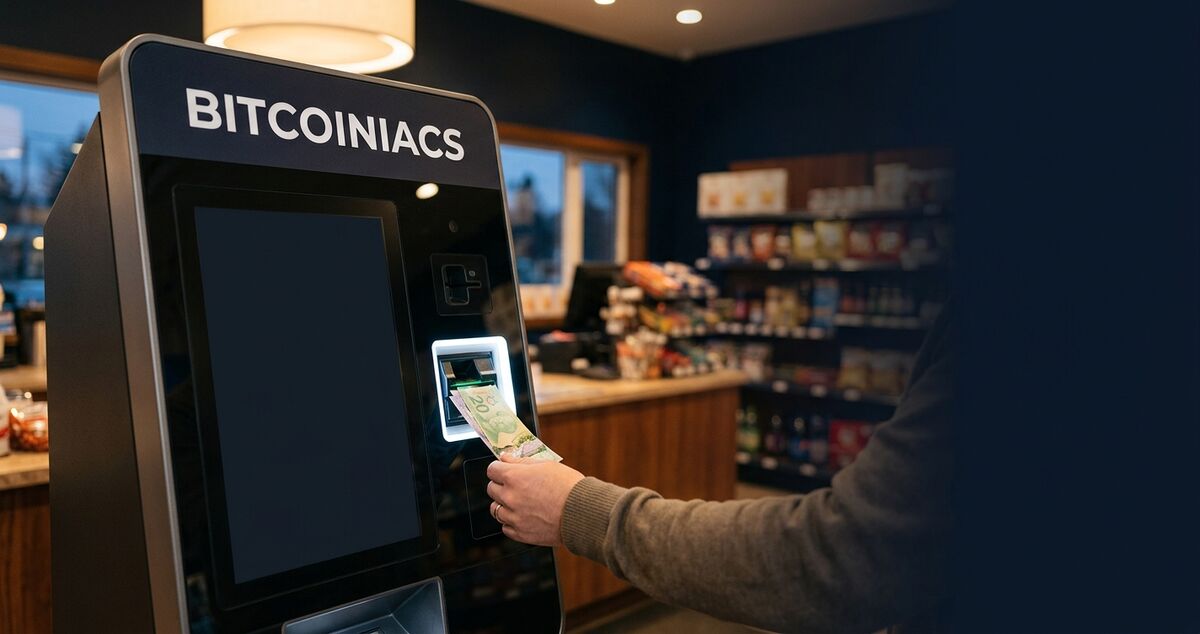
Buy Bitcoin with cash in Canada through a Bitcoin ATM and the transaction stays simple, private-ish, and fast. You walk up, scan a wallet QR code, insert Canadian bills, and the machine sends BTC to your wallet once compliance checks pass. This 2026 guide walks through exactly how a cash purchase works at a Bitcoiniacs ATM, what ID and limits to expect, how fees and spreads add up, and where the common scams and tax pitfalls sit so you can do it cleanly the first time.
Table of Contents
- How Cash Bitcoin Purchases Work at a Canadian ATM
- What to Bring: ID, Wallet, and Daily Limits
- Fees, Spreads, and What a Cash Purchase Actually Costs
- Where to Buy Bitcoin with Cash Across Canada
- Scams to Watch For and Records the CRA Expects
- Frequently Asked Questions
How Cash Bitcoin Purchases Work at a Canadian ATM
A Bitcoin ATM is a vending-machine-style kiosk that sells Bitcoin in exchange for cash. The machine accepts Canadian bills, runs the buyer through identity verification under Canadian FINTRAC money-services-business rules, and broadcasts the BTC transaction to the network. The coins land in your self-custody wallet, not on a centralized exchange.
For a deeper look at how every operator in the country is regulated, the FINTRAC MSB requirements page is the official source.
The flow is consistent across machines. You tap “Buy Bitcoin,” scan the QR code of the wallet you control, decide how much cash to insert, and complete the on-screen identity step. When the machine accepts the bills, the BTC is sent from the operator’s hot wallet to your address. The screen prints a receipt with the amount, the network fee, the timestamp, and a transaction ID you can paste into any block explorer to confirm receipt.
Why cash, why an ATM
Some Canadians can’t move money from their bank to a crypto exchange. Banks block certain merchants, joint accounts have daily e-Transfer limits, and Interac e-Transfer windows can close late at night. A cash purchase at a Bitcoiniacs ATM sidesteps the bank rail entirely. You bring your own cash, the ATM does the rest, and the BTC lands in your own wallet within minutes.
The Bank of Canada has flagged that cryptocurrencies sit outside the traditional banking model and carry their own volatility and custody risk, which is exactly the trade-off to understand before you put cash in. The cash-at-an-ATM route is not a loophole around regulation. It is just a different on-ramp that uses physical currency instead of a bank transfer, and the same FINTRAC money-services-business rules apply to every operator in the country. For the macro framing, the Bank of Canada’s “Money in a Digital World” briefing is the standard Canadian reference.
What to Bring: ID, Wallet, and Daily Limits
You need three things: a government-issued photo ID, a Bitcoin wallet that can show a QR code, and enough Canadian cash to clear the machine’s minimum. Bitcoiniacs requires a valid passport, driver’s licence, or provincial photo card, and the name on the ID must match the wallet ownership you declare at the screen.
ID and KYC at the screen
For smaller amounts the machine may accept a phone number and a one-time SMS code. Above the no-KYC threshold it will ask for a government ID scan and a selfie. Bitcoiniacs posts a full breakdown of what to bring, including which documents clear the highest tier, in the Bitcoin ATM ID requirements guide. The federal Financial Consumer Agency of Canada also publishes a plain-language primer on what crypto-asset service providers can and cannot do with your data (FCAC, Crypto assets).
Daily limits and what to expect
Limits depend on how much identity you complete at the machine. A basic SMS-verified purchase caps well below a fully verified transaction, which itself caps below a fully registered and approved account. Limits reset on a rolling 24-hour basis. If you’re planning a larger cash purchase, complete the higher KYC tier in advance, or split the purchase across a couple of days within the rolling window.
Fees, Spreads, and What a Cash Purchase Actually Costs
The price you see on a Bitcoin ATM screen is rarely the same as the spot price on a major exchange. The difference has two parts. First, a percentage fee the operator charges for the service. Second, a spread between the BTC rate the machine uses and the public market rate. Both numbers should be shown on screen before you insert the bills, and the final receipt itemizes them.
Always read the screen’s final quote before pushing bills in. Most machines show the BTC amount you will receive, the network fee, and a countdown timer. If the timer expires or the rate moves noticeably, the machine re-quotes and you can cancel. If the screen hides the spread, treat that as a reason to use a different machine.
Realistic fee ranges at a Canadian Bitcoin ATM
Public Reddit discussions of Canadian Bitcoin ATM fees cluster in the 6% to 12% all-in range for small purchases, and 4% to 8% for larger ones, on top of the BTC network fee shown on the receipt. Smaller bills drag the percentage up because the flat network fee hits a smaller base. Larger bills stretch the percentage down.
How to keep the all-in cost honest
Compare the BTC amount the machine quotes against the same amount on a major public price index before pushing cash in. If the machine’s rate is more than a few percent below that index, you’re paying a hidden spread on top of the displayed fee. Bitcoiniacs publishes the operator fee schedule and the spread policy on the buy Bitcoin page, so you can size the actual cost before you walk in.
Where to Buy Bitcoin with Cash Across Canada
Bitcoiniacs operates Bitcoin ATMs in British Columbia, Alberta, Ontario, New Brunswick, Nova Scotia, and Yukon. Locations are in convenience stores, coffee shops, and vape shops. Each address, store name, and operating hours is listed in the ATM locations directory at /bitcoiniacs-atm-locations/, with the buy and sell flags shown for every machine.
Typical city coverage
Major Western Canadian cities (Calgary, Red Deer, Airdrie, Vancouver, Surrey, Burnaby, Richmond, New Westminster, North Vancouver, Victoria, Nanaimo, Kelowna, Delta, Maple Ridge) and major Ontario cities (Toronto, North York, Mississauga, Richmond Hill, Peterborough) all host at least one Bitcoiniacs ATM, plus Whitehorse, Fredericton, and a Nova Scotia location. If you can walk or drive to a major urban area in those provinces, you can usually reach a machine within a short trip.
Cash in, Bitcoin out, in about five minutes
Plan a clean first visit: bring valid photo ID, install a self-custody wallet on your phone before you arrive, fund the wallet with a small test amount first to confirm you control the address, then go to the machine. The whole flow from “I want to buy Bitcoin” to “BTC is in my wallet” usually takes under ten minutes, including the on-screen ID step.
Want to do the opposite later? The same network has a sell side, listed on the sell Bitcoin page. Not every machine buys and sells, so check the location’s flags before you drive over with a wallet to cash out.
Buy Bitcoin with Cash in Canada: Scams to Avoid and Records to Keep
Cash + urgency + an unfamiliar machine is a classic combination scammers exploit. The Competition Bureau of Canada publishes a list of common red flags to watch for (Competition Bureau, Investment scams). If a stranger is telling you to put cash into a Bitcoin ATM right now, promising guaranteed returns, or asking you to send BTC to a third-party address, stop. Walk away.
Scam signals to refuse on the spot
Pressure to act in minutes, a story about a sweepstakes win or a “government seizure” that has to be paid in Bitcoin, anyone asking for your seed phrase or one-time code, anyone telling you which wallet address to send BTC to, anyone offering to meet you at the ATM and stand next to you while you insert cash. These are all standard scam scripts, and the right move is to leave.
What the CRA expects you to keep
Buying and holding Bitcoin is not, by itself, a taxable event in Canada. Disposing of it (selling, swapping, using it to buy something) is. The CRA publishes a plain-language crypto-asset guide and explains what counts as a disposition (CRA, Information for crypto-asset users and tax professionals). For every cash purchase, keep the receipt, the wallet address, the BTC amount, the quoted CAD price, the fees, the timestamp, the on-chain transaction ID, and a copy of the bank or wallet statement that shows the disposition if you sell later.
If you’re not sure whether your situation triggers a tax event, talk to a Canadian tax professional who handles crypto. The general guidance above is not personal tax advice.
Frequently Asked Questions
Can I buy Bitcoin with cash in Canada without giving my name?
Only for very small amounts, and only at the SMS-verified tier. Every Canadian Bitcoin ATM is registered as a money-services business and must report large or suspicious transactions to FINTRAC. Above the SMS tier, the machine collects a government photo ID and a selfie. If complete anonymity is the goal, an ATM is not the right tool.
How much do Bitcoin ATMs in Canada actually charge?
Most Canadian Bitcoin ATMs charge an operator fee in the 6% to 12% range for small cash purchases, plus the BTC network fee, plus any spread between the quoted rate and the public market rate. The exact number depends on the machine and the size of the purchase. Always read the final quote on screen before you insert cash.
What do I need to bring for a first-time cash purchase?
A government-issued photo ID (passport, driver’s licence, or provincial photo card), a self-custody Bitcoin wallet installed on your phone with a working receive address, and enough Canadian cash to clear the machine’s minimum. The wallet must be one you control. If you don’t have one yet, install and test it before you walk up to the machine.
Is buying Bitcoin with cash at an ATM safe?
The transaction itself is as safe as the operator and the wallet you use. Stick to machines run by registered Canadian operators, use a self-custody wallet you control, never share your seed phrase or one-time code with anyone, and never send BTC to a wallet address someone else gives you. The bigger risk at a cash ATM is the social engineering around the transaction, not the technology.
Can I also sell Bitcoin for cash at a Bitcoiniacs ATM?
Many Bitcoiniacs ATMs are two-way, but not all. The location directory shows a buy flag and a sell flag for every machine. If a “sell Bitcoin for cash” run is what you need, check the flag for the specific address before you drive over.
Buy Bitcoin with cash in Canada at a Bitcoiniacs ATM when the bank rail is the bottleneck, you want to keep the workflow simple, and you have a self-custody wallet ready. Bring ID, read the on-screen quote, keep the receipt, and treat every unsolicited “send Bitcoin here” message as a scam until proven otherwise. That is the entire playbook.