


If you run a Canadian business and want to accept bitcoin payments in Canada, the mechanics are simpler than most merchants expect. The hard part is everything around the sale: how you price it, what you report, and whether you keep the coins or turn them into dollars. A customer can pay in seconds from a phone wallet, and you can end up holding either bitcoin or a Canadian-dollar deposit depending on the setup you choose. This guide covers how to accept bitcoin payments in Canada in 2026, from checkout options and all-in costs to CRA reporting, FINTRAC rules, and the practical ways to handle volatility and fraud.
Table of Contents
- How to Accept Bitcoin Payments in Canada: Step by Step
- What It Costs to Accept Bitcoin at a Canadian Business
- Bitcoin and Canadian Taxes: What Merchants Must Report
- Do You Need to Register with FINTRAC?
- Managing Volatility and Fraud Risk
- Frequently Asked Questions
How to Accept Bitcoin Payments in Canada: Step by Step
There is no single switch that turns on Bitcoin at a store. The work breaks into four decisions, and each one gets easier once you understand what you are trading off.
Step 1: Decide Whether You Keep Bitcoin or Convert It
This choice shapes everything else. If you keep the bitcoin, you are running a small treasury and you carry price risk until you sell. If you convert to Canadian dollars, you treat bitcoin like any other payment rail and your books look like a card sale. Most merchants who are not deliberately building a bitcoin position choose to convert, at least at the start, because it keeps accounting predictable and removes the question of what the coins are worth at year end.
Step 2: Choose Between Your Own Wallet and a Payment Processor
A payment processor gives customers a checkout page or terminal, quotes a Canadian-dollar amount, and settles dollars to your bank, usually for a percentage fee plus a bit of spread. A self-custody wallet gives you the coins directly with no monthly cost, but you handle pricing, invoicing, and conversion yourself. Neither approach is wrong. Processors suit retail counters and online stores that want the payment to feel ordinary. A wallet suits businesses whose customers already hold bitcoin and are happy to scan a QR code.
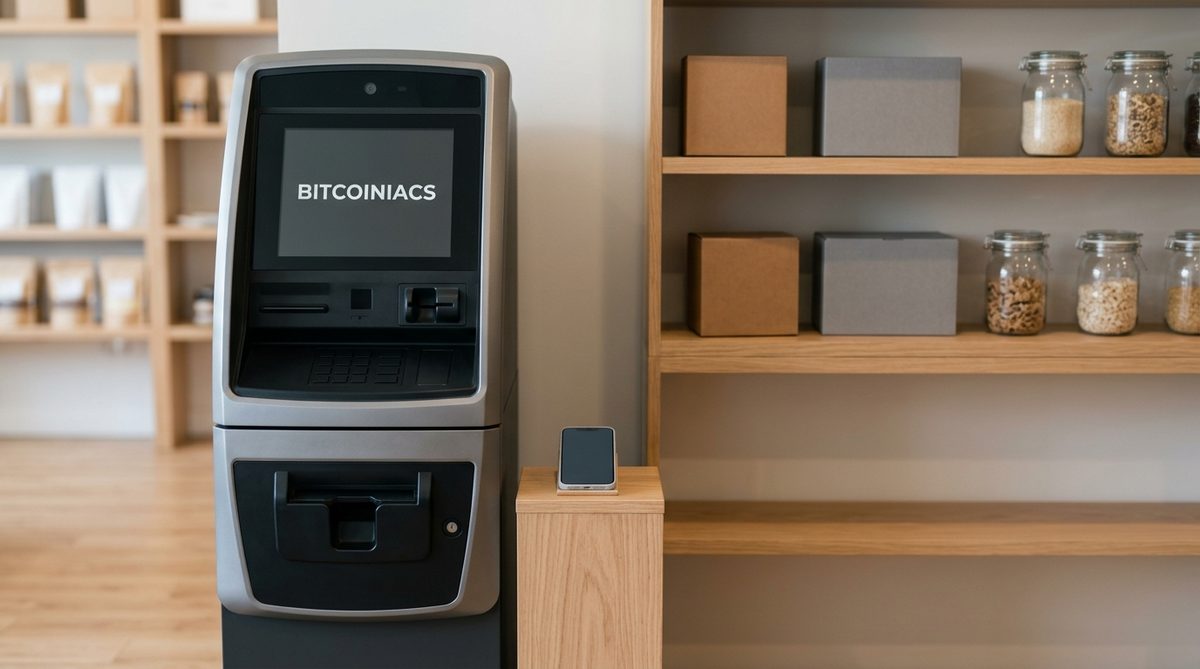
If some of your customers would rather pay in cash and buy the bitcoin themselves, they can use a machine instead. Point them to our Bitcoiniacs Bitcoin ATM locations, where they can turn cash into bitcoin on the spot and then pay you however you normally take payment.
It helps to know the backdrop. Payments in Canada are shifting steadily toward digital rails, and the Bank of Canada tracks that evolution closely in its digital currencies and fintech research. Bitcoin is one option inside that shift, not a replacement for the Canadian dollar at your till.
Step 3: Price in Canadian Dollars and Lock the Rate
Always quote the customer in Canadian dollars, never in bitcoin. Set a short window, roughly 60 to 120 seconds, for the payment to arrive at the quoted rate, and re-quote if the window lapses. Without that rule, a slow afternoon can cost you money simply because the price moved while a customer stood at the counter deciding.
Step 4: Train Staff and Keep the Receipt Flow Simple
Staff need to know three things: how to show the QR code or open the terminal, what to do when a payment arrives with fewer confirmations than you expected, and who to call when something looks off. Write it down. Post a small sign that says you accept bitcoin. Print or email a receipt that lists the CAD amount, the bitcoin amount, the rate used, the time, and the transaction ID, because you will need every one of those fields at tax time.
What It Costs to Accept Bitcoin at a Canadian Business
Bitcoin is often described as cheap to accept, and the network itself is, but the full cost depends on the path a payment takes.
Network Fees Belong to the Customer
On-chain, the sender pays a miner fee, not the merchant. That fee rises when the network is busy and falls when it is quiet. On the Lightning Network, a layer built on top of Bitcoin that settles small payments quickly, fees are typically tiny and well suited to coffee-sized purchases.
Processor Fees and Spread
If you use a processor, expect a percentage of each sale plus a spread on the conversion rate. No two providers price the same way, so ask for the all-in number on a $500 sale rather than trusting the headline rate. Compare that against the card fees you already pay, and keep in mind that crypto payments do not carry chargebacks, which matters for high-value or custom orders.
Cashing Out Without a Processor
If you would rather hold the coins and convert on your own schedule, you can skip the processor entirely. Bitcoiniacs runs a crypto payment cash-out for retail stores and restaurants that turns accepted coins into cash, so you keep control of the timing and the rate instead of paying a fee to be settled automatically.
Bitcoin and Canadian Taxes: What Merchants Must Report
Accepting bitcoin is a barter transaction for tax purposes. You sold goods or services for value, and that value is measured in Canadian dollars on the day of the sale, whatever the coin does afterward.
GST/HST Applies to the Sale, Not Just the Bitcoin
If you sell a taxable good or service, GST/HST applies whether the customer paid with a card or with bitcoin. You calculate the tax on the fair market value in Canadian dollars at the time of the sale, then remit it as usual. The CRA’s crypto-asset guidance for users and tax professionals explains the treatment, and its GST/HST for businesses hub covers registration, collection, and remittance.
Income, Capital Gains, and Record Keeping
How you report the bitcoin afterward depends on how you hold it. Coins held as inventory and then sold are generally business income. Coins held as an investment and later sold can produce a capital gain or loss. The CRA expects books and records that show the Canadian-dollar value on the day you received each payment, the value on the day you disposed of it, and the fees on both sides of the transaction.
In practice, keep the CAD amount, the BTC amount, the quoted rate, your fee, the timestamp, the receiving wallet address, and the transaction ID for every sale, stored with the invoice in one place. Rebuilding a year of transactions after the fact is far more work than saving a line at the moment of the sale.
Do You Need to Register with FINTRAC?
The short answer is probably not, if you are only accepting bitcoin for your own goods and services. FINTRAC registration generally applies to money services businesses, meaning firms that exchange or transfer virtual currency for the public as a service.
The line matters. A coffee shop that lets customers pay in bitcoin is a merchant taking payment. A business that offers to exchange Canadian dollars for bitcoin, or to move bitcoin on behalf of clients, is likely engaged in dealing in virtual currency and may need to register as a money services business under the Proceeds of Crime (Money Laundering) and Terrorist Financing Act. Third-party processors usually carry that obligation themselves, but you should confirm your own position with a qualified advisor. FINTRAC publishes a money services businesses hub that explains who must comply and what the obligations involve.
Managing Volatility and Fraud Risk
Volatility is the obvious risk and the easiest one to neutralize. If you convert incoming bitcoin to Canadian dollars the same day, the price barely has time to move against you. Watch live rates on the Bitcoiniacs crypto exchange page before you set a daily conversion routine, and keep only a small working balance if you want to hold some bitcoin on purpose. Anything larger is an investment decision rather than an operational one.
Online sellers have their own version of this. A platform can hold your payouts for days, so Bitcoiniacs offers a crypto payment cash-out for online stores that handles platform payouts the same way a retail counter handles a till.
Fraud deserves the same attention. Two schemes show up repeatedly. In the first, a buyer overpays on purpose and asks you to refund the difference in cash or by transfer, then reverses or never truly completes the bitcoin payment. In the second, a screenshot of a payment is offered as proof of settlement. A screenshot proves nothing; only a confirmed transaction on the blockchain proves that value moved. Wait for confirmation before goods leave the counter, and never refund a difference against a payment you cannot verify.
The familiar rules still apply inside a business. Never share a wallet seed phrase or private key with anyone, including someone claiming to be support. Never read a one-time code to a caller. Treat urgency as a warning sign, and decline any request to send bitcoin to an address a stranger supplied.
Frequently Asked Questions
How do I accept Bitcoin payments at my small business in Canada?
Start by deciding whether you keep the bitcoin or convert it, then pick either a processor that settles dollars to your bank or a wallet you control. Price in Canadian dollars, set a short quote window, and train staff on the confirmation step. Most Canadian small businesses that accept bitcoin keep it simple: one QR code at the counter, one receipt format, and a same-day conversion habit.
Do I need a payment processor, or can I just give customers a wallet address?
You can accept payments straight to your own wallet with no processor and no monthly fee. What you give up is convenience: you handle the rate quotes, the invoices, and the conversion yourself, and you watch the wallet for incoming funds. A processor earns its fee by turning all of that into a normal checkout and a bank deposit, which is often worth it for a busy counter or an online store.
What should I do with the Bitcoin after a customer pays?
Most merchants convert it to Canadian dollars quickly, because that removes price risk and keeps the books straightforward. If you prefer to hold some, hold a small amount deliberately and treat the rest as operating funds. Whatever you choose, record the Canadian-dollar value on the day you received the payment, since that number drives both your revenue and your eventual gain or loss.
How is accepting Bitcoin taxed in Canada, and do I charge GST/HST?
You must charge GST/HST on taxable sales regardless of how the customer paid, calculated on the fair market value in Canadian dollars at the time of the sale. The bitcoin you keep is then either business income or a capital asset, depending on how you hold it. Keep the CAD amount, the BTC amount, the rate, the fees, and the transaction ID for every sale.
Is accepting Bitcoin risky because the price swings so much?
Only if you hold it for a while. The volatility risk sits entirely on the coins you keep, not on the sale, because the sale is already complete at the quoted Canadian-dollar price. Converting the same day, or within a day or two, removes almost all of that exposure. The larger operational risks are unverified payments and refund fraud, not the price chart.
Accepting bitcoin in Canada is not complicated once you treat it as a payment rail instead of a trading position. Price in dollars, settle on a schedule you choose, keep the receipts the CRA wants, and confirm every transaction before goods leave. Do that, and Bitcoin becomes one more way for customers to pay you, with none of the drama that shows up in the headlines. If you want help converting accepted coins into cash, Bitcoiniacs can handle that side of the counter.