


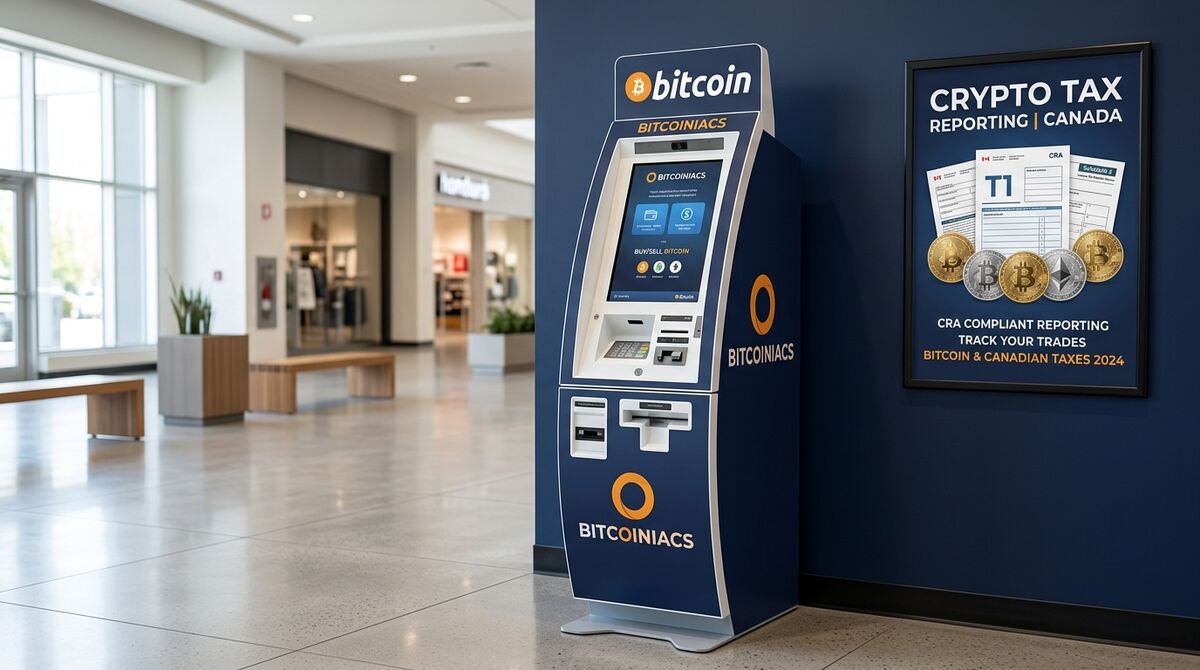
Crypto Tax Canada 2026: The Complete CRA Filing Guide
If you bought, sold, or swapped cryptocurrency in 2025, you owe crypto tax Canada reporting on your 2026 return. The Canada Revenue Agency treats every crypto disposition as a taxable event, and with registered exchanges and Bitcoin ATM operators like Bitcoiniacs now required to keep detailed transaction records, the CRA has more visibility into your crypto activity than at any point in history. Whether you made a profit, broke even, or took a loss, the rules apply.
The rules themselves haven’t changed dramatically from 2025, the CRA still treats crypto as a commodity, capital gains are still taxed at 50% inclusion, and business income is still fully taxable. What has changed is enforcement: registered Canadian crypto exchanges now report user activity under stricter disclosure rules, and Bitcoin ATM operators like Bitcoiniacs issue transaction records that the CRA can request directly.
This guide walks through how crypto is taxed in Canada in 2026, what triggers a taxable event, how to calculate what you owe, and the easiest ways to file. You’ll also find answers to the real questions Canadians are asking right now on Reddit, from audit timelines to first-time filers trying to clean up years of unfiled trades.
Table of Contents
- How the CRA Taxes Cryptocurrency in 2026
- What Counts as a Taxable Event
- How to Calculate Your Crypto Tax in Canada
- Bitcoin ATM Receipts and Why They Matter
- How to Report Crypto on Your 2026 Tax Return
- Frequently Asked Questions
Crypto Tax Canada: How the CRA Taxes Cryptocurrency in 2026
The Canada Revenue Agency classifies cryptocurrency as a commodity, not a currency. That single classification drives everything else: every time you dispose of crypto, selling it, trading it for another coin, using it to buy something, or gifting it, you’re triggering a taxable event under the Income Tax Act.
There are two ways the CRA taxes that event, depending on how often you trade:
- Capital gains, applies to most casual investors and long-term holders. Only 50% of your gain is included in taxable income, and it’s added at your marginal tax rate.
- Business income, applies to frequent traders, professional crypto operators, or anyone the CRA considers to be running a trading business. 100% of profits are taxed at your marginal rate, with no 50% inclusion.
The CRA’s own guidance page for crypto asset users spells out the framework in plain language, and it’s worth a read if you’re unsure which bucket you fall into. You can find the official page at the Canada.ca cryptocurrency tax guidance page.
The Income Tax Act has not created a separate “crypto tax”, your gains and losses flow through the same T1 return, on the same lines, as any other capital property. The difference is that the CRA has tightened reporting rules around digital assets specifically, and exchanges operating in Canada are now required to report certain user data.
Rates, Inclusion Rates, and the 2026 Numbers
For 2026, the federal capital gains inclusion rate remains at 50%, there was talk of bumping it to 66.7% in prior budgets, but as of the current filing year the rate has not changed. Combined with provincial tax, a Canadian in the top federal bracket (33%) living in a high-tax province can expect an effective crypto capital gains rate of roughly 26–27% on net gains.
If your activity is classified as business income, you’re paying your full marginal rate on the entire gain. A frequent trader in Ontario earning $80,000 in trading profits could see 40%+ of that disappear to tax, one of the reasons the CRA’s business-income classification matters so much.
What Counts as a Taxable Event
This is the part that catches most Canadians off guard. Buying Bitcoin is not a taxable event, you’re just acquiring property. The moment you dispose of it, though, the CRA expects you to calculate the gain or loss.
The five most common taxable events for Canadian crypto holders are:
- Selling crypto for fiat (CAD, USD), including cashing out at a Bitcoin ATM across Canada.
- Trading one crypto for another, swapping BTC for ETH is a disposition of the BTC, even though no fiat changed hands.
- Using crypto to buy goods or services, paying with Bitcoin at a merchant is a disposition.
- Gifting crypto, disposing of crypto to a non-arm’s-length person (like a spouse or adult child) at less than fair market value triggers a deemed disposition.
- Earning crypto as income, staking rewards, airdrops, mining payouts, and salary paid in crypto are 100% taxable as income at the time of receipt.
What does not trigger a taxable event: transferring crypto between your own wallets, holding crypto long-term without selling, or simply buying Bitcoin and letting it sit. If you bought $500 of Bitcoin at a Bitcoiniacs ATM in 2024 and have not sold or spent it, there is nothing to report on your 2026 return.
Common Non-Events Worth Knowing
Moving Bitcoin from a hot wallet to cold storage, or from one exchange to your personal wallet, is not a disposition, it’s a transfer. Same with receiving crypto as a true gift (you inherit the donor’s adjusted cost basis). And staking rewards that are locked and unsellable in a given tax year generally aren’t taxed until you can dispose of them, though this is an area where the CRA’s guidance is still evolving and you should consult an accountant if your situation is complex.
How to Calculate Your Crypto Tax in Canada
The CRA requires you to use one of three cost-basis methods to calculate gains and losses. The method you pick determines what your gain or loss is on any given sale, and you need to be consistent across all your crypto holdings.
- Adjusted Cost Base (ACB), the average price you paid across all units of the same crypto. Most common method for Canadians; works well for Bitcoin-only holders.
- First-In, First-Out (FIFO), assumes the first coins you bought are the first ones sold. Often produces a higher gain (because the earliest coins usually had the lowest cost basis).
- Superficial loss rule, applies when you sell crypto at a loss and rebuy the same asset within 30 days. The loss can be denied and added to the cost basis of the replacement units.
A simplified example: you bought 0.1 BTC at a Bitcoiniacs ATM in March for $9,000 CAD, then another 0.1 BTC in June for $11,000 CAD. Under ACB, your cost basis is $20,000 for 0.2 BTC ($100,000 average per BTC). If you sell Bitcoin in December for 0.2 BTC at $130,000 per BTC, your proceeds are $26,000 and your gain is $6,000, $3,000 of which (50%) is added to your taxable income.
If your transactions across multiple exchanges and wallets number in the hundreds or thousands, doing this by hand becomes impractical. Most Canadians use crypto tax software, Koinly, CoinTracker, and CoinLedger all handle Canadian reporting specifically. The Koinly 2026 Canada crypto tax guide has a useful walkthrough of how ACB calculations work in their software.
Bitcoin ATM Receipts and Why They Matter
One of the underrated advantages of buying Bitcoin through a registered Canadian MSB is the paper trail. Every transaction at a Bitcoiniacs ATM comes with a dated receipt that includes the CAD value at the time of purchase, the amount of Bitcoin sent, the wallet address, and a transaction ID. That receipt is your proof of cost basis.
If you bought Bitcoin across multiple ATMs over multiple years, those receipts are how you reconstruct your average cost basis under ACB. Without them, you may have to rely on blockchain explorers or exchange records, which, for cash transactions, often don’t exist. The CoinLedger guide on Canadian crypto tax reporting highlights receipt-keeping as one of the most overlooked parts of personal recordkeeping.
How the CRA Uses ATM Records
Registered Money Services Businesses in Canada are required to keep transaction records and report certain activity to FINTRAC. The CRA can request those records directly when auditing a taxpayer. If you bought Bitcoin at a Bitcoiniacs ATM in 2024 and didn’t declare a 2026 disposition, the ATM transaction is part of the matching record set the CRA can pull. That’s why keeping your receipts, or accessing your transaction history through your Bitcoiniacs account, is non-negotiable.
For more on how the broader regulatory framework interacts with crypto, the Department of Finance Canada crypto consultation page outlines the policy direction that has shaped reporting requirements over the last several years.
How to Report Crypto on Your 2026 Tax Return
Once you’ve calculated your gains and losses, reporting is straightforward:
- Capital gains go on Line 12700 of your T1 return, with detailed disposal information on Schedule 3 if your net gain exceeds the CRA’s reporting threshold.
- Capital losses can be carried back three years or forward indefinitely, offsetting future capital gains.
- Business income from crypto goes on Line 13499 (or the appropriate business income line if you have a registered business number).
- Crypto earned as income (staking, airdrops, mining) is reported as other income on Line 13000.
If you’re buying Bitcoin through a Vancouver Bitcoin ATM, or any Bitcoiniacs location, the transaction is treated like any other property acquisition. No tax is owed until you sell. When you do sell, the receipt from the original purchase is your cost-basis proof.
What If You Missed Past Years?
If you traded crypto in 2023, 2024, or 2025 and didn’t report it, you can file an adjustment through CRA My Account for any of the previous ten calendar years. Penalties and interest may apply, but the CRA is generally more lenient with taxpayers who come forward voluntarily than with those who are caught in an audit. Voluntary disclosures program (VDP) applications can sometimes waive penalties entirely, worth discussing with a Canadian tax accountant who handles crypto.
Frequently Asked Questions
How does the CRA find out about crypto gains?
Through three main channels. First, registered Canadian crypto exchanges are required to report user activity under the same rules that apply to other financial institutions. Second, the CRA can issue demands to Bitcoin ATM operators and Money Services Businesses for transaction records tied to a specific taxpayer. Third, third-party reporting, if you transfer CAD between your bank and an exchange, your bank may be asked to confirm those transfers. r/PersonalFinanceCanada has a detailed thread on this exact question with answers from Canadian accountants.
How do crypto taxes actually work for a Canadian who just bought some Bitcoin?
Buying Bitcoin itself is not a taxable event. You’re just acquiring a property at a specific cost. The tax only applies when you dispose of that Bitcoin, selling it for CAD, trading it for another crypto, or using it to buy something. At that point you calculate your gain or loss using your cost basis, and report 50% of any net gain as taxable income. The r/BitcoinCA thread on how taxes work for crypto gains has practical examples from Canadians in different provinces.
I never reported crypto gains for the past three years. What do I do?
You can amend prior-year T1 returns through CRA My Account, the “Change my return” option walks you through the adjustments. You’ll owe the back tax plus interest, and possibly penalties, but coming forward voluntarily is treated much more favourably than being caught in an audit. For situations involving large unfiled amounts, the Voluntary Disclosures Program can sometimes waive penalties entirely. The r/BitcoinCA discussion of catching up on unpaid crypto taxes is a good starting point before talking to a Canadian crypto-savvy accountant.
How far back can the CRA audit me for crypto?
The standard CRA audit window is three years from the date of your notice of assessment. If they find negligence or misrepresentation, that extends to six years. For fraud or unfiled returns, there is no limit, they can go back as far as your records exist. For most Canadians who made an honest mistake, the practical risk window is three to six years. The r/CryptoTax thread on multi-year audits shows what the experience looks like when the CRA does pursue back taxes.
What’s the best crypto tax software for Canadians in 2026?
Three options dominate the Canadian market: Koinly, CoinLedger, and CoinTracker. All three integrate with major exchanges, calculate ACB automatically, and generate T1-compatible reports. For Canadians with simple buy-and-hold strategies who just need Schedule 3 numbers, Wealthsimple Tax now has a dedicated crypto section. The r/CanadaFinance thread on Canadian tax filing software has current-year recommendations from users.
Crypto tax in Canada isn’t complicated once you understand the framework, buy is not a taxable event, sell is, and 50% of capital gains get added to your income at your marginal rate. Keep your Bitcoiniacs ATM receipts, track every disposal, and report on Schedule 3. If you traded across multiple exchanges, run your transactions through crypto tax software before filing. The CRA has the records, the reporting infrastructure is in place, and the audit window is real. Filing cleanly is the easiest path.