


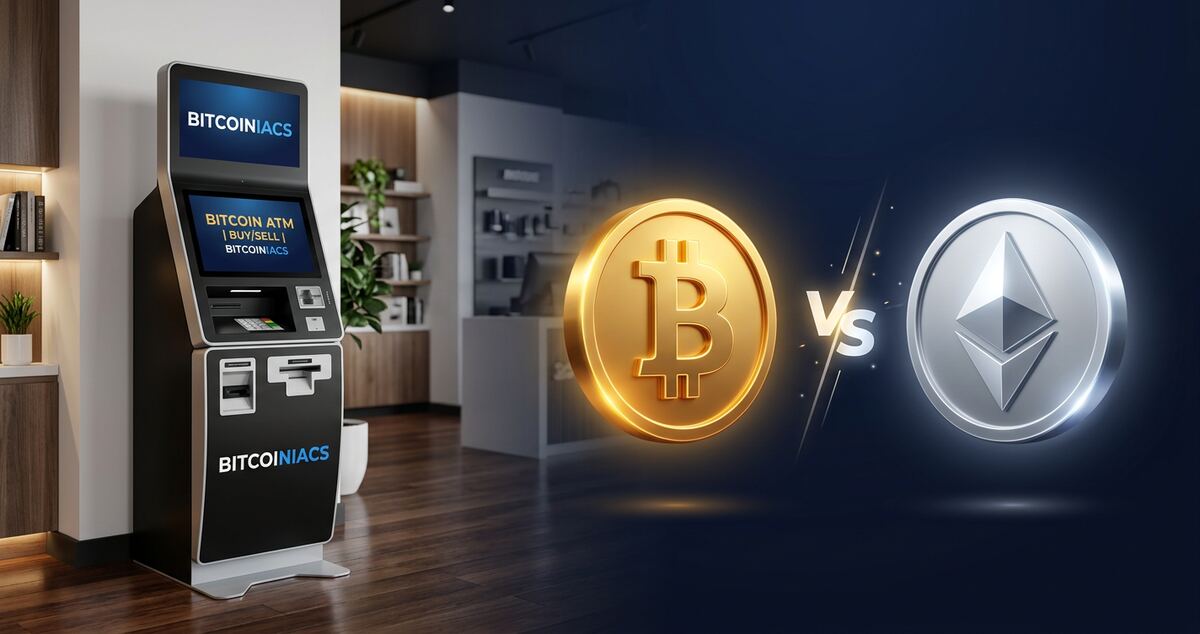
Bitcoin vs Ethereum is the most-asked question in Canadian crypto right now, and the answer in 2026 is less about which coin is “better” and more about which one fits what you are actually trying to do. Both are blue-chip assets, both trade on every major Canadian platform, and both can be bought with cash at a Bitcoiniacs Bitcoin ATM, but they were built for fundamentally different reasons. This guide breaks down the technology, the economics, the Canadian tax treatment, and the practical differences, then gives you a clear framework for deciding which (or both) belongs in your portfolio.
Table of Contents
- What Is Bitcoin vs Ethereum, Really?
- Technology Differences: Why Bitcoin and Ethereum Were Built Differently
- The Bitcoin Investment Case in 2026
- The Ethereum Investment Case in 2026
- Canadian Tax Treatment: Bitcoin vs Ethereum
- Which Should You Buy in Canada?
- Frequently Asked Questions
What Is Bitcoin vs Ethereum, Really?
Bitcoin and Ethereum are the two largest cryptocurrencies by market capitalization, and together they represent roughly 60% of the entire crypto market. But they were not built to do the same job.
Bitcoin, launched in 2009 by the pseudonymous Satoshi Nakamoto, was designed as a peer-to-peer electronic cash system, a decentralized alternative to government-issued money. Its core value proposition is scarcity: there will only ever be 21 million Bitcoin, and the supply schedule cannot be changed. Most holders treat it as “digital gold,” a long-term store of value protected from inflation and currency debasement.
Ethereum, launched in 2015 by Vitalik Buterin and a team of co-founders, was designed as a programmable blockchain, a global computer that runs decentralized applications (dApps), smart contracts, and tokenized assets. Its native asset, Ether (ETH), pays for the computational work required to run those applications. Ethereum is the backbone of decentralized finance (DeFi), stablecoins like USDC and USDT, and a growing share of real-world asset tokenization.
Put simply: Bitcoin is a savings network, and Ethereum is an infrastructure network. The “Bitcoin vs Ethereum” question is, at its core, a question about what role you want crypto to play in your financial life.
Technology Differences: Why Bitcoin and Ethereum Were Built Differently
Under the hood, the two networks make different engineering trade-offs. The most important differences for Canadian investors are consensus mechanism, transaction speed, and energy footprint.
Consensus Mechanism
Bitcoin still uses Proof of Work (PoW), where miners race to solve cryptographic puzzles to validate blocks. The network secures itself with raw computational power, a model that has proven extraordinarily resilient for 17 years but consumes a meaningful amount of electricity.
Ethereum completed its transition to Proof of Stake (PoS) in September 2022, an event known as “The Merge.” Under PoS, validators lock up (stake) ETH as collateral rather than burn energy on mining. According to the European Blockchain Observatory and Forum, The Merge reduced Ethereum’s energy consumption by approximately 99.95%. For ESG-conscious Canadian investors, that is a meaningful structural difference.
Speed and Fees
Bitcoin blocks are produced roughly every 10 minutes, with average transaction fees in the low single-digit dollars during normal congestion. Ethereum blocks land every 12 seconds, and average fees are typically lower for simple ETH transfers but spike higher when the network is busy with DeFi activity or NFT trading.
For a Canadian buying once a month and holding, both networks are functionally fast enough. For someone actively using DeFi, Ethereum’s higher throughput is a clear advantage.
Supply and Emissions
Bitcoin’s supply is capped at 21 million, with the last coin expected to be mined around the year 2140. New issuance is currently 3.125 BTC per block after the April 2024 halving and will continue to decline roughly every four years. Ethereum has no hard cap, but its post-Merge issuance is roughly 90% lower than before, and transaction fees are routinely burned, making ETH a potentially deflationary asset during periods of high network usage.
The Bitcoin Investment Case in 2026
Bitcoin’s investment case in 2026 rests on three pillars: scarcity, institutional adoption, and regulatory clarity.
On the institutional side, spot Bitcoin ETFs in Canada and the United States have unlocked billions in mainstream capital. Canadian-listed funds like Purpose Bitcoin ETF (BTCC) and Fidelity Advantage Bitcoin ETF (FBTC) have made it possible to hold Bitcoin inside a registered RRSP or TFSA through a brokerage, something Ethereum ETFs also offer, but the Bitcoin category is older and deeper.
On the regulatory side, the Canadian Securities Administrators (CSA) have generally treated Bitcoin as a commodity and approved it for ETF wrappers, exchange-traded products, and registered account holdings. That makes Bitcoin a relatively straightforward long-term hold for Canadian investors who want minimal friction.
If you want to buy Bitcoin in Canada without going through a brokerage, Bitcoiniacs operates a national network of Bitcoin ATMs where you can purchase BTC with cash and walk away with coins in your wallet in minutes. It is the simplest on-ramp for first-time buyers who want privacy, speed, and zero account-setup friction.
The Ethereum Investment Case in 2026
Ethereum’s investment case is fundamentally different. You are not just betting on a scarce digital asset, you are betting on a network that other applications are built on. That gives ETH a kind of utility-driven demand that Bitcoin does not have.
According to Messari’s network comparison data, Ethereum processes roughly 2.8 million transactions per day compared to Bitcoin’s ~770,000, and it hosts the majority of stablecoin volume, decentralized exchange liquidity, and real-world asset tokenization. Every time a USDC transfer settles, every time a tokenized money-market fund pays yield, every time a smart contract executes, Ethereum is the settlement layer, and ETH is what pays for that settlement.
Ethereum also pays holders a yield. Since the Merge, ETH can be staked at roughly 3–4% annual reward, which is paid out to validators for securing the network. For Canadian investors looking for crypto exposure that produces income while held, that is a structural advantage Bitcoin cannot match.
On the institutional side, spot Ether ETFs launched in Canada in 2024 and have steadily accumulated assets. VanEck’s 2026 comparison report notes that institutional flows into Ether products have accelerated as tokenization of traditional assets picks up.
Canadian Tax Treatment: Bitcoin vs Ethereum
One area where Bitcoin and Ethereum are identical: how the Canada Revenue Agency (CRA) treats them.
Both BTC and ETH are classified as commodities under Canadian tax law. Any time you dispose of them, selling for cash, swapping one crypto for another, or using them to buy something, you trigger a capital gain or loss. Half of any capital gain is taxable as income at your marginal rate. Per the CRA’s capital gains guidance, you are required to track the cost basis and disposal proceeds of every transaction, even small ones.
Staking rewards, airdrops, and mining income are taxed differently, generally as ordinary income at fair market value on the day you receive them. If you stake ETH, the rewards you earn are income, and the subsequent sale of those rewards is a separate capital gain event.
Bitcoin does not produce staking rewards, so the tax surface is generally simpler. Ethereum staking adds an annual income line to your tax return. For a deeper walkthrough of how to report these events to the CRA, see our Crypto Tax Canada 2026 guide.
Which Should You Buy in Canada?
There is no single right answer, but a useful framework separates the two by intent.
Buy Bitcoin if…
- You want the simplest, longest-standing crypto asset with the deepest liquidity
- You value predictable, declining supply over programmable utility
- You plan to hold for 4+ years and want the cleanest tax surface
- You want to use a Bitcoin ATM in Canada to acquire it with cash in minutes
Buy Ethereum if…
- You believe decentralized finance and tokenized real-world assets will keep growing
- You want to earn staking yield while holding (currently ~3–4% annualized)
- You are comfortable with a slightly more complex tax situation from staking rewards
- You use or plan to use DeFi protocols yourself
Buy both if…
Many Canadian crypto investors hold both. A common allocation is 60–80% Bitcoin for the store-of-value thesis and 20–40% Ethereum for the utility and yield thesis. That blend gives you exposure to two independent theses that often move at different times during a market cycle. The best Bitcoin wallet in Canada can hold both BTC and ETH in the same app, so managing a multi-asset portfolio is straightforward.
Once you have decided, the practical question is how to acquire it. Canadian exchanges like Shakepay, NDAX, and Coinbase work well for bank-funded purchases. For buyers who want cash, privacy, and speed, Bitcoiniacs Bitcoin ATMs operate in cities across British Columbia, Alberta, and Ontario and let you walk in with cash and walk out with crypto in your self-custody wallet. And if you ever need to convert back to CAD, you can sell Bitcoin for cash at any Bitcoiniacs location.
Frequently Asked Questions
Should I buy Bitcoin or Ethereum as a beginner in Canada?
Most beginners start with Bitcoin. It has the longest track record, the deepest liquidity, the simplest tax treatment, and the lowest technical learning curve. You can hold it without running a validator node, staking infrastructure, or interacting with smart contracts. Ethereum is a perfectly good second purchase once you are comfortable with the basics, especially if you want to explore staking or DeFi. Start small, learn by doing, and resist the urge to over-allocate before you understand the volatility.
Is Ethereum better than Bitcoin for long-term investment?
It depends on what you mean by “better.” Bitcoin has the stronger store-of-value narrative, fixed supply, and deeper institutional adoption. Ethereum has more utility, generates staking yield, and is the settlement layer for most decentralized applications. Historically, both have produced strong long-term returns, but Ethereum has had higher volatility and bigger drawdowns. Long-term Reddit investors often argue that holding both captures two independent theses without taking concentration risk in either.
Can I buy both Bitcoin and Ethereum with cash at a Bitcoin ATM?
Most Canadian Bitcoin ATMs, including the entire Bitcoiniacs network, primarily sell Bitcoin. A growing number now offer Ethereum and a handful of other major coins like Litecoin and Bitcoin Cash. Before visiting, check the specific ATM’s supported coins on the operator’s website or app. If you want BTC specifically, almost every Bitcoiniacs ATM supports it, and you can complete a purchase with cash in under five minutes. For Ethereum, an exchange or a Bitcoin ATM that lists ETH are your two main on-ramps.
Why would I invest in Bitcoin when Ethereum exists?
Because they do different jobs. Bitcoin is the most secure, most decentralized, and most censorship-resistant monetary network ever built, it is optimized for one thing: being a long-term store of value that nobody can inflate or seize. Ethereum is optimized for running applications and settling programmable transactions. Owning Ethereum does not replace owning Bitcoin any more than owning a tech stock replaces owning gold. Many investors hold both because the two theses are uncorrelated enough to provide real diversification within a crypto portfolio.
Which is safer to hold, Bitcoin or Ethereum?
Both are “safe” in the sense that they sit on top of battle-tested public blockchains with no central point of failure. The real risk is not the network, it is you. Most crypto losses come from lost private keys, phishing scams, exchange collapses, and poor storage decisions, not from chain failures. Whether you hold BTC or ETH, the same rule applies: withdraw to a self-custody wallet you control, never share your seed phrase, and never store meaningful amounts on an exchange long-term.
Whatever you decide, the Canadian crypto market in 2026 gives you more options than ever to buy, sell, and self-custody both Bitcoin and Ethereum. Whether you go through a regulated exchange or a cash Bitcoin ATM, do your own research, only invest what you can afford to lose, and store your coins in a wallet you control.