


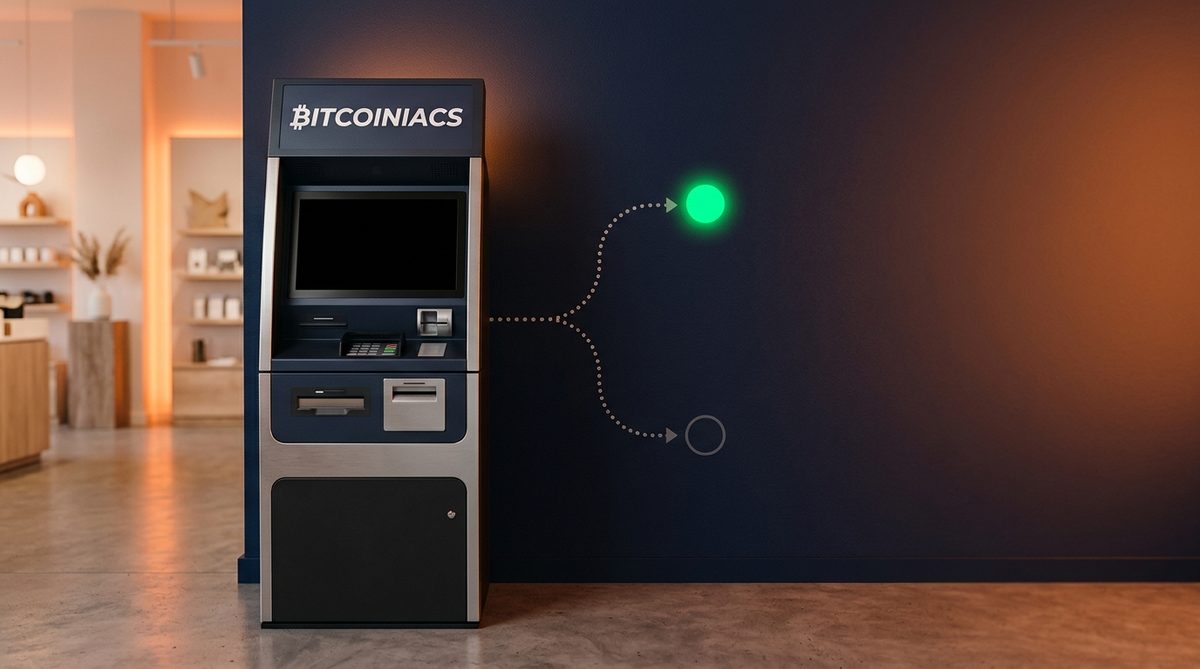
Send Bitcoin to the wrong address and there is no bank to call, no chargeback to file, and no support agent who can reach into the blockchain and pull the coins back. A confirmed Bitcoin transaction is final: the coins belong to whoever controls the receiving address, even if nobody meant for that address to receive them. It is one of the few corners of modern payments where a single wrong character can matter, which is why understanding the mechanics before you tap “send” is worth ten minutes of your day.
This guide covers what happens on-chain after a mistaken transfer, why most typos never leave your wallet, and the few situations where recovery is genuinely possible.
Table of Contents
- What Happens When You Send Bitcoin to the Wrong Address
- Bitcoin Address Checksums: Why Most Typos Never Leave Your Wallet
- Recovery Options: When Sent Bitcoin Can Come Back
- Clipboard Malware and Wrong-Address Scams
- How to Avoid Sending Bitcoin to the Wrong Address
- Frequently Asked Questions
What Happens When You Send Bitcoin to the Wrong Address
Bitcoin has no accounts and no accounts team. A wallet holds private keys, those keys control specific outputs on the blockchain, and a transaction is a signed instruction that reassigns some of those outputs to new ones. When you press send, your wallet builds that instruction, signs it, and broadcasts it to thousands of nodes. From that moment the transaction exists independently of you: it either gets mined into a block or it does not.
If the destination is a valid address, the network treats the payment as correct by definition. There is no “intended recipient” field and no flag that says this transfer was a mistake. The Bitcoin transaction structure is deliberately simple: inputs, outputs, amounts, and a signature. Everything a human considers context — the invoice you meant to pay, the friend you meant to tip — lives only in your head, not in the data miners validate.
The Transaction Confirms Anyway
Broadcast transactions wait in the mempool until a miner selects them. Once a block includes your transaction, it has one confirmation, and each subsequent block adds another. Wallets typically label a payment settled after one to three confirmations. A wrong-address send does not behave differently from a correct one: it confirms, it settles, and every node on the network treats it as legitimate.
Why Bitcoin Has No Undo Button
Card networks and banks can reverse a payment because a central operator keeps a ledger it can edit. Bitcoin’s ledger is replicated across thousands of independent machines, and its whole value proposition is that no single party can rewrite history. Rewriting it would take overwhelming the network, not calling it.
There is exactly one window where a send can still be altered: while it is unconfirmed. Wallets that support replace-by-fee (RBF) can replace a pending transaction with a new version, which is normally used to raise the fee on a stuck payment. Some wallets also let you cancel a pending send back to your own address. Once a miner includes the original transaction, that option is gone. Anyone who tells you they can reverse a confirmed Bitcoin payment is describing something that does not exist.
Bitcoin Address Checksums: Why Most Typos Never Leave Your Wallet
The scenario most people fear — typing one character wrong and watching funds vanish — is largely blocked by design. Bitcoin addresses are not raw strings. They are encoded with a checksum, a short mathematical fingerprint of the contents. Change any character and the checksum no longer matches, so the wallet, exchange, or ATM software rejects the address before a transaction is even built.
The odds of a one-character mistake producing another address with a valid checksum are roughly one in four billion. In practice a typo produces an error message, not a loss. The address encoding and checksum format is what makes that protection possible, and it is why you should worry far more about a copied address than a mistyped one.
Base58, Bech32, and the Checksum
Older Bitcoin addresses use Base58Check encoding, which excludes easily confused characters such as 0, O, I, and l. Modern addresses use Bech32, starting with bc1, with a stronger checksum. The full set of formats is covered in our guide to Bitcoin address types. For a normal user the takeaway is the same: valid-looking addresses have structure, and structure is what catches human error.
When a Wrong Address Is Still a Valid Address
The dangerous cases are not typos. They are valid addresses that are simply not the ones you intended, because a checksum only proves an address is well formed, never that it is the right recipient. Typical examples: pasting an old address from your clipboard history, paying an invoice from a business that has since changed its deposit address, and pasting an address that clipboard malware silently replaced. The network sees a perfectly good transaction in every case.
Recovery Options: When Sent Bitcoin Can Come Back
If You Control the Receiving Wallet
This is the best case and it is more common than people realise. If the address you sent to was generated by a wallet you own — a second device, an old app, a hardware wallet you have not opened in a year — the coins are yours. Restore that wallet from its recovery phrase and the balance appears. The same applies to a change address from your own wallet: the funds are already in your control.
If the Address Belongs to Someone You Know
If you sent to a friend, a merchant, or a service you have a relationship with, the coins are recoverable in practice, not by protocol. You can prove what happened by sharing the transaction ID from your wallet, and the recipient can send an equivalent amount back. Nothing forces them to return the funds — reputational trust is doing the work a bank would normally do.
If a Custodial Platform or Business Received It
Deposits that land at a custodial platform’s address can sometimes be credited to your account, if the platform can verify the funds arrived and that the send was yours. Support teams ask for the transaction ID, the sending address, timestamps, and screenshots. Outcomes vary: some platforms with clear policies help, others have no process for unsolicited deposits at all. If the address belongs to nobody — an unowned output — the coins are effectively unspendable, and no recovery service can change that, regardless of what it charges. If you want a walkthrough first, our guide on how to send Bitcoin from Canada covers the mechanics step by step.
Keep a record of whatever happens, including the transaction ID, the CAD value at the time, the amount of BTC, and the fee. A mistaken transfer that becomes a permanent loss has tax implications a qualified accountant can explain; do not rely on forum advice for that part.
Clipboard Malware and Wrong-Address Scams
Not every wrong-address story starts with human error. Clipboard hijackers watch what you copy and swap any Bitcoin address with one the attacker controls, sometimes matching the first and last few characters to defeat casual inspection. That is how a “valid” address you never typed ends up in a payment field.
The other half of the problem is the recovery scam, which targets people who are already in a bad spot. A stranger appears in your messages offering to trace or claw back sent Bitcoin for an upfront fee. They cannot, because confirmed transactions are not reversible. Treat any request for payment in advance, any demand for your seed phrase, any request for a one-time code from your email or authenticator, or any instruction to install “recovery software” as a second attempt to take your money. The Canadian Anti-Fraud Centre collects reports of exactly these schemes, and reporting matters even when the funds are gone. The same warning signs appear in our breakdown of Bitcoin ATM scams in Canada, where impostors pose as staff or as buyers to pressure people into sending coins they will never see again.
How to Avoid Sending Bitcoin to the Wrong Address
- Scan the QR code instead of typing, and read the first and last five characters of the address on the receiving device before confirming.
- Send a small test amount first when the payment is large or the recipient is new, then send the remainder once the test confirms.
- Save recurring recipients to an address book so you never paste from clipboard history again.
- Confirm the asset and network match the destination — a Bitcoin address expects Bitcoin, not a token built on another chain.
- Verify the address on the hardware wallet screen itself, since that display is not controlled by your computer.
- Keep your operating system and wallet software updated, and scan for malware if an address changes unexpectedly.
- At a Bitcoin ATM, spend thirty seconds comparing the printed or on-screen address with the destination in your wallet app before you complete the purchase.
If you would rather buy in person with a staff member nearby, our Bitcoiniacs ATM locations page lists every machine across Canada along with hours and the store each one sits in.
Frequently Asked Questions
What actually happens when you send Bitcoin to a wrong address?
The transaction is broadcast, mined, and confirmed like any other payment. Your wallet’s outputs are reassigned to the receiving address, and control of those coins passes to whoever holds that address’s private key. Nothing in the network records that the send was unintended, so it stands once confirmed.
I sent Bitcoin to the wrong address — is there anything I can do to get it back?
Three avenues exist, in order of likelihood. If the address belongs to a wallet you control, restore that wallet and the coins are yours. If it belongs to a person or business you know, ask them to return an equivalent amount and give them the transaction ID as proof. If it belongs to a custodial platform, open a support ticket immediately. If the address is unowned, the payment is effectively gone.
How likely is it to accidentally send BTC to an address that does not exist?
Very unlikely. Bitcoin addresses include a checksum, so a single-character error almost always produces an invalid address that software refuses to use. The probability that a typo survives the checksum is on the order of one in four billion. Real losses come from valid addresses that were not the intended destination.
Why can’t the coins just be returned to my wallet automatically?
Because the network has no concept of ownership beyond key control, and no central operator with authority to reverse a ledger entry. Returning coins requires the private key that controls the receiving address. If you hold it, you can move the funds. If someone else does, only they can, and only voluntarily.
Could malware be changing the address I paste?
Yes. Clipboard hijacking malware is designed to replace copied Bitcoin addresses with the attacker’s own, often matching the first and last characters so the swap is hard to spot. Compare the pasted address against the one on the receiving device, character for character at both ends.
Can a wallet cancel a Bitcoin transaction that is still pending?
Sometimes. While a transaction is unconfirmed you can replace it if your wallet supports replace-by-fee, either to pay a higher fee so it confirms sooner or to redirect it back to your own address. Once a miner includes it in a block, that window closes permanently.
Bitcoin rewards attention, and the address field is where that attention pays off most. A few seconds spent comparing a destination against the screen in front of you is the entire difference between a payment that works and a payment nobody can undo. Whether you are sending from a software wallet or buying in person at a Bitcoiniacs machine, slow down for that one field and the rest takes care of itself.