


If you want to cash out Bitcoin in Canada in 2026, you have more options than ever, and more ways to get the fees or tax treatment wrong. Whether you are turning a long-term holding into a down payment, converting trading profits into everyday spending money, or simply moving crypto back into Canadian dollars for safekeeping, this guide is for you. The catch is that each method has a different fee profile, processing time, and tax implication, and picking the wrong one can quietly cost you hundreds of dollars or trigger a compliance headache.
This guide walks through the four main ways to cash out Bitcoin in Canada: Bitcoin ATMs, Canadian-licensed exchanges, peer-to-peer platforms, and direct bank or wire transfers. We compare real-world fees, settlement times, and the CRA’s tax rules so you can pick the method that matches the size of your withdrawal and how urgently you need the funds.
Table of Contents
- How to Cash Out Bitcoin in Canada: What It Actually Means
- Method 1: Bitcoin ATM, Fastest Cash in Hand
- Method 2: Canadian Crypto Exchanges (NDAX, Bitbuy, Coinbase)
- Method 3: Peer-to-Peer and OTC Desks
- Method 4: Direct Bank Transfer and Wire Withdrawals
- CRA Tax Rules When You Cash Out Bitcoin in Canada
- Frequently Asked Questions
How to Cash Out Bitcoin in Canada: What It Actually Means
In the Canadian context, “cashing out Bitcoin” means converting your BTC balance into Canadian dollars (CAD) and moving those dollars into a form you can actually spend. That destination could be cash in your wallet, an Interac deposit in your chequing account, or a wire at your bank. The conversion step is the same regardless of method: you sell BTC on some venue and receive CAD in return. What changes is the venue, the fee, and how long the CAD takes to land somewhere useful.
Three things drive the cost of any cash-out: the spread between the BTC market price and the price you actually receive, the explicit transaction or withdrawal fee, and any FX or network fee in between. Canadian FINTRAC-registered businesses must identify you for any transaction over a regulated threshold, which is why most legal methods require some form of ID verification before you can move meaningful amounts.
Before choosing a method, decide three things: how much CAD you need, how quickly you need it, and how much personal information you are willing to share. A $200 weekend cash-out has very different answers than a $50,000 sale of a long-term position.
Method 1: Bitcoin ATM, Fastest Cash in Hand
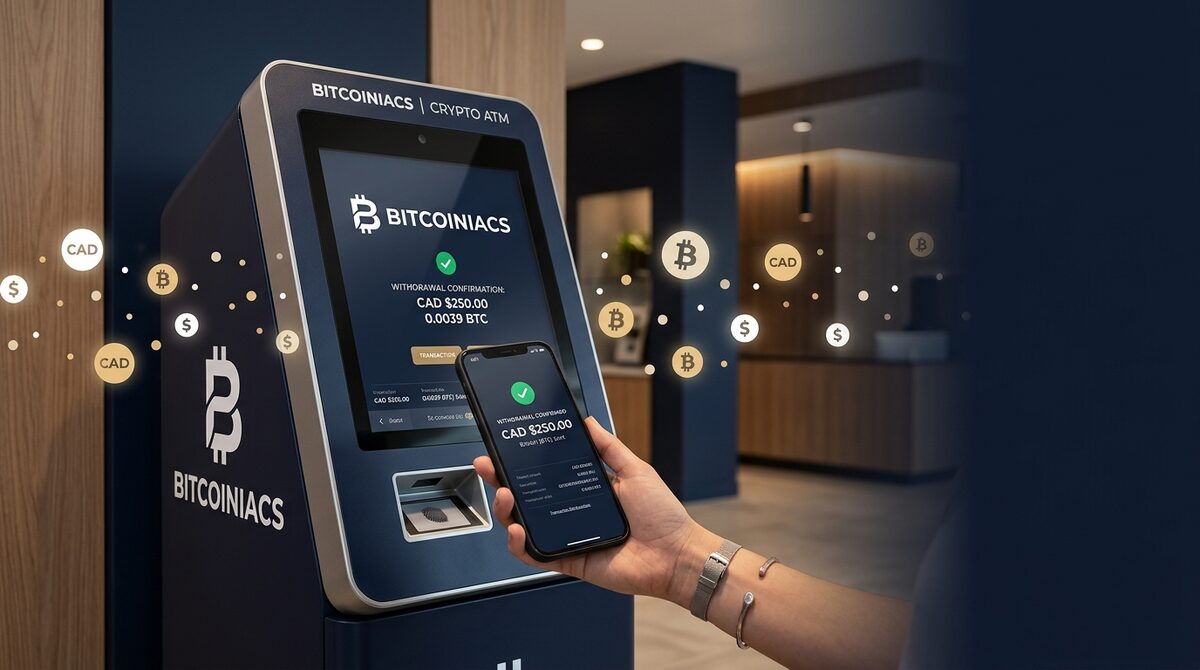
A Bitcoin ATM is the fastest way to turn BTC into physical Canadian cash. You walk up to the machine, scan your wallet’s QR code, the ATM sends your Bitcoin, and bills come out, usually in under five minutes. Bitcoiniacs operates Bitcoin ATMs across British Columbia, Alberta, Ontario, New Brunswick, Nova Scotia, and Yukon, and every machine supports both buying and selling Bitcoin at the same kiosk.
How a Bitcoin ATM Cash-Out Works Step by Step
The process is the mirror of a buy. Select “Sell Bitcoin” on the ATM screen, enter the cash amount you want (or the BTC amount you want to send), the machine generates a QR code for its hot wallet, you scan it with your wallet app and confirm the transaction. After one blockchain confirmation the machine dispenses the cash. For most operators one confirmation is enough; the ATM credits your withdrawal before the network fully confirms.
Fees and Limits to Expect
ATM cash-out fees in Canada typically run between 8% and 15% of the transaction value, depending on the operator and the size of the withdrawal. Smaller transactions tend to carry a higher percentage fee. Daily and per-transaction limits also apply because of FINTRAC reporting thresholds; the typical Bitcoin ATM daily limit in Canada sits between $3,000 and $9,999 for fully verified customers, with lower limits for unverified users. Above those thresholds, full ID verification (photo ID plus a selfie) is mandatory and the operator files a Large Virtual Currency Transaction Report with FINTRAC.
When an ATM Makes Sense
ATMs win for small-to-mid-size cash-out requests (roughly $100 to $3,000), situations where you need physical bills immediately, and people who don’t want to open a brokerage or exchange account. If you already bought Bitcoin through an ATM and want to reverse the trade in the same week, using the same ATM to sell is the simplest path. Our complete walkthrough of selling Bitcoin for cash in Canada covers the specific ID requirements and what to bring to the machine.
Method 2: Canadian Crypto Exchanges (NDAX, Bitbuy, Coinbase)
For withdrawals above a few thousand dollars, a Canadian-registered crypto exchange is almost always cheaper than an ATM. Platforms like NDAX, Bitbuy, Coinsquare, and the Canadian arms of Coinbase and Kraken let you deposit BTC, sell it at the live spot price, and withdraw CAD to your bank account. Trading commissions on these platforms are typically 0.1% to 0.5%, a fraction of ATM fees.
What You Need to Open an Exchange Account
Every FINTRAC-registered exchange requires full identity verification before you can deposit or withdraw fiat: government photo ID, a selfie, proof of address, and sometimes a video call. Verification usually clears in a few hours but can take up to two business days. Once verified, you link your bank account via Interac Online, Interac e-Transfer, or EFT, and you can move CAD in and out.
Withdrawal Times and Fees by Method
Interac e-Transfer withdrawals are typically free or under $1 and land in minutes, this is the cheapest, fastest way to move CAD from an exchange to your bank. EFT withdrawals are usually free but take one to three business days. Wire transfers work for very large amounts but the receiving bank may charge $15 to $30. When funding the exchange in the first place, our guide on buying Bitcoin with Interac e-Transfer covers the deposit side in detail.
When an Exchange Wins
Exchanges are the right choice for withdrawals of $1,000 and up, especially if you do not need the funds the same day. They are also the only sensible option for very large positions (six figures and above) where ATM fees and limits simply don’t work. The trade-off is one to three days of settlement time and the upfront effort of getting verified.
Method 3: Peer-to-Peer and OTC Desks
Peer-to-peer (P2P) platforms connect you directly with another person who wants to buy your Bitcoin. You agree on a price and payment method, the platform escrows your BTC until the buyer’s payment clears, and the trade settles. The most common P2P venues accessible to Canadians are international platforms with active CAD desks; domestic-only P2P is rare.
Common P2P Payment Methods in Canada
The CAD side of a P2P trade is typically settled via Interac e-Transfer, EMT for cash at a Canada Post location, bank transfer, or in-person cash meetup. Interac e-Transfer is the fastest but carries chargeback risk; cash meetups eliminate that risk but require you to physically meet a stranger. Each payment method has trade-offs around privacy, fraud risk, and settlement time.
When P2P Is the Right Answer
P2P makes sense when you want to avoid exchange verification, when the buyer offers a premium over spot that makes the higher effort worthwhile, or when you specifically need cash in hand and don’t mind coordinating a meetup. It is also the path of last resort for people whose bank has blocked deposits from crypto exchanges. The downsides are clear: P2P scams are common, escrow is not foolproof, and the CRA treats P2P income identically to exchange income for tax purposes.
Method 4: Direct Bank Transfer and Wire Withdrawals
For very large positions, OTC (over-the-counter) desks and institutional services offer direct settlement to your Canadian bank account via wire transfer or EFT. These services negotiate a price slightly above or below spot depending on size, and they handle compliance paperwork themselves. Settlement is usually same-day for wires and one to three days for EFT, with fees quoted as a percentage of the trade (often 0.1% to 0.5% for trades above $100,000).
Banks themselves are not in the business of buying Bitcoin from retail customers, but they do receive CAD wires from exchanges and OTC desks. Some Canadian banks have tightened their policies on incoming wires from known crypto businesses, which is why most retail users route their cash-out through an exchange first and then EFT the funds to their chequing account.
CRA Tax Rules When You Cash Out Bitcoin in Canada
The Canada Revenue Agency treats Bitcoin as a commodity, not currency. Every time you dispose of BTC, including converting it to CAD, is a taxable event. You owe capital gains tax on 50% of any profit, calculated as the difference between your CAD proceeds and your adjusted cost base (the average price you paid for the BTC you are selling). The Bank of Canada has confirmed that cryptocurrencies like Bitcoin are not legal tender in Canada and are treated as a digital asset for tax purposes.
The critical detail is that moving CAD between your bank and an exchange is not a taxable event, but every BTC-to-CAD conversion is. The CRA expects you to track every purchase, every sale, and every conversion, even ones made on different platforms. If you started buying Bitcoin in 2020 and have used multiple exchanges and ATMs since, the cost-base math can get complicated fast. The CRA’s own guide on income tax and cryptoassets walks through the reporting framework in detail.
Record-Keeping Essentials
For every BTC-to-CAD transaction, keep: the date and time, the CAD amount you received, the BTC amount you sold, the spot price at the time of the trade, the exchange or platform used, and any fees charged. Exchange trade histories are downloadable as CSV, but ATM receipts and P2P trades require manual logging. FINTRAC-registered businesses like Bitcoiniacs issue transaction records for every ATM cash-out, which can be exported and used as supporting documentation. FINTRAC’s guidance for virtual currency dealers outlines what these records must contain.
When in doubt, a Canadian crypto-tax accountant can reconstruct your history from exchange CSV exports and ATM receipts and file the proper T1 adjustments. The cost is modest relative to the penalty for under-reporting, and the Bank of Canada’s digital currency resource explains how the regulator frames crypto in the broader Canadian financial system.
Frequently Asked Questions
What is the cheapest way to cash out Bitcoin in Canada?
For amounts over $1,000, the cheapest method is a Canadian-registered exchange like NDAX or Bitbuy. Trading commissions are typically 0.1% to 0.5%, and Interac e-Transfer withdrawals to your bank are usually free. For example, cashing out $5,000 in BTC through an exchange costs roughly $5 to $25 in trading fees plus any network withdrawal fee, versus $400 to $750 at a typical Bitcoin ATM. The trade-off is one to three days of settlement time versus cash in minutes at an ATM.
Do I have to pay tax when I cash out Bitcoin in Canada?
Yes. The CRA treats every BTC-to-CAD conversion as a taxable disposition. You owe capital gains tax on 50% of any profit, calculated as the difference between your sale price and your adjusted cost base. If you bought 0.1 BTC for $1,000 and later sold it for $2,500, you report $750 of taxable capital gain (50% of the $1,500 profit). Losses can offset gains. Moving CAD between your bank and a Canadian exchange is not a taxable event; only the BTC-to-CAD conversion is. Full framework in the CRA’s cryptoasset guide.
Do all Bitcoin ATMs require ID to cash out?
In Canada, FINTRAC-registered Bitcoin ATM operators are required to verify your identity for any transaction, including cash-outs. The exact threshold varies by operator but most require some form of ID verification (phone number at minimum, photo ID plus selfie above certain amounts). For amounts above FINTRAC’s Large Virtual Currency Transaction Report threshold (currently $10,000 in cumulative transactions within 24 hours), full ID plus a selfie is mandatory and the ATM files the report automatically. No legitimate Canadian ATM will let you cash out large amounts anonymously.
How long does it take to withdraw Bitcoin to a Canadian bank account?
It depends on the withdrawal method. From a Canadian crypto exchange, Interac e-Transfer withdrawals typically land in your bank within minutes to a few hours and are usually free. EFT withdrawals take one to three business days and are also typically free. Wire transfers settle same-day but the receiving bank may charge $15 to $30. From a Bitcoin ATM, the cash is in your hand in under five minutes once the BTC transaction confirms on the blockchain, which usually takes 10 to 60 minutes depending on network congestion and the operator’s confirmation policy.
Choosing the right way to cash out Bitcoin in Canada comes down to amount, speed, and how much personal information you are willing to share. Bitcoin ATMs win for same-day cash under a few thousand dollars, exchanges win for everything above that, and OTC desks handle the largest positions. Whatever method you pick, keep clean records of every BTC-to-CAD conversion, the CRA treats each one as a taxable event, and good records are the difference between a smooth tax season and a costly audit. Bitcoiniacs operates Bitcoin ATMs across Canada if you want the cash-in-hand route, and our team can walk you through the verification steps at the machine.